
Mufti Offices in Thrace – Time for Institutional Truth Against Propaganda
The article argues that maintaining appointed Muftis in Thrace upholds legal order and counters Ankara’s influence, warning that electing them risks politicization and undermines Greece’s protection of minority rights.
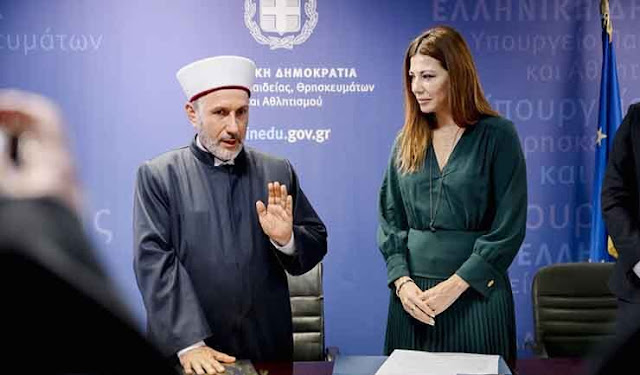

Mufti Offices: Institutional Shielding Against Ideological Obsessions and “Hybrid Diplomacy”
Written by Nikos Arvanitis
Thrace is once again caught in the turmoil of artificial polarization, with the institution of the Mufti Offices at the forefront. A recent article by Mr. Stamatis Sakellion adds a perspective that, although cloaked in the guise of “democratic sensitivity,” overlooks the institutional reality and, whether unintentionally or not, supports the revisionist agenda of Ankara.
There is a need to restore the truth with facts, beyond formalities, touching upon the “living reality” that some insist on interpreting arbitrarily.
The discussion about the election of Muftis in Thrace is often presented as a demand for democratization. In reality, however, it is a complex institutional issue that cannot be addressed on the basis of a simple majority choice.
The Legal Paradox and the Comparison with the Patriarchate
Mr. Sakellion chooses to liken the selection of a Mufti by the Greek state to a hypothetical intervention by Turkey in the election of the Ecumenical Patriarch. This comparison lacks any legal basis.
The Mufti in Greece is not merely a religious leader; he is a public official vested with judicial and administrative powers that form the core of Greek legal order.
The Patriarchate, on the other hand, is a spiritual institution without state authority. Requesting elections for an official whose decisions are enforced by the Greek state is akin to demanding that the judges of the Supreme Court be elected by their audience.
The “Trap” of Election and the Removal of Powers
The argument is put forward that the solution lies in removing the judicial powers and subsequently holding elections. Here the question arises: Why downgrade an institution that makes Greece the only country in Europe to organically incorporate Islamic law, offering the Minority a unique status of religious freedom?
The optional application of Sharia law, established under SYRIZA and continued thereafter, already provides citizens with that option. Insistence on elections, while in Turkey Muftis are appointed by presidential decree from the Diyanet, reveals the hypocrisy of Turkish rhetoric, which Mr. Sakellion seems to easily overlook.
The Strategy of Division and the “Merchants of Faith”
The “lack of trust” invoked by Mr. Sakellion is not spontaneous. It is the product of systematic instrumentalization by extrainstitutional mechanisms such as the “Advisory Body” (ASETMTH/BTTADK), which acts as an arm of the Turkish Consulate.
The incidents at the Çınar Mosque and the recent tour of the Diyanet leadership in Thrace prove that a hybrid war is underway.
The 30 Iftar dinners organized under consular guidance and the “staged piety” with rose petals in Echinus are not about worship; they are about the display of power of “Political Islam.”
When the lawful Mufti Offices gather 3,000 worshipers in spontaneous assemblies and Ankara’s “selected” representatives are confined to sterile hotel conference rooms, it becomes clear who represents the grassroots and who represents propaganda.
The State’s Response: Law 4964/2022
The Greek state responded to the challenges with Law 4964/2022, introducing a transparent evaluation process conducted by a committee of members of the Minority itself. The appointment of the new Mufti of Didymoteicho and the upcoming calls for candidates in Xanthi and Komotini constitute the institutional response to division.
Against voices speaking of “petty quarrels” and “outdated acts,” we must oppose legality. Thrace is not a testing ground for convenient audiences but a place where equality before the law and religious freedom are protected by international law and not by the whims of Ankara.
Why the Election of Muftis by the Faithful Carries Risks: The Institutional Approach
1. The Mufti as Part of the State Machinery
The Mufti in the Greek legal order is not exclusively a religious leader. He exercises specific administrative powers and, under certain conditions, jurisdictional functions within the application of Islamic law when selected by citizens. This makes him part of the state machinery. In every modern rule-of-law country, those who exercise authority with legal consequences are not elected by the public they serve but appointed through institutional processes that ensure accountability and constitutional compatibility.
2. The Risk of Politicization and External Interventions
Electing such a person carries the risk of politicizing an institution that must remain neutral. Electoral processes require campaigns, mobilizations, and confrontations—elements that can easily turn religious leadership into a ground for competing influences. In areas with geopolitical particularities like Thrace, this adds the risk of external interventions or indirect manipulation of the electorate.
3. Religious Freedom and Public Authority
The argument of “religious freedom” does not necessarily imply elections. Freedom of worship and religious expression is already institutionally secured, while the optional recourse to Sharia law allows citizens to select the legal framework governing them. Therefore, non-election of the Mufti does not imply restriction of rights, but rather regulation of the exercise of public authority.
4. International Practice and Legal Security
International practice does not uniformly support the election of religious officials, especially when these are linked with state functions. On the contrary, in many cases, states retain a role in appointment or approval precisely to ensure institutional coherence and legal security.
5. The Issue of Representativeness
Election alone does not guarantee representativeness. It can lead to the dominance of more organized or influential groups, sidelining quieter or less consolidated voices within the minority. Thus, instead of enhancing unity, internal dividing lines may be sharpened.
APPENDIX – The Flawed Election of a Deputy Mufti in Xanthi and Ankara’s Intervention
In a thoroughly flawed and opaque procedure carried out under the supervision of agents of the Turkish Consulate in 2022, the Movement for Equal Rights (KIEΦ) “crowned” Mr. Mustafa Trampa as “deputy mufti” of Xanthi.
This appointment, clearly a distortion of reality, was based on a contentious count of 4,750 “votes” against 2,570 for the rival Mr. Mustafa Kamo, without clarifying the methods used to ensure the integrity of the process in any of the area’s mosques.
This move constitutes a “(para)religious coup” attempting to create faits accomplis in Thrace, blatantly ignoring both the Treaty of Lausanne—which does not foresee the election of muftis—and the recent Greek institutional framework for the modernization of the Mufti Offices.
At the same time that Ankara seeks to impose on a third country procedures it refuses to apply within its own territory, it should be recalled that Greece remains a European democracy promoting the prosperity of the minority, in contrast to the systematic violation of the rights of the Greek minority in Turkey.
Conclusion
Overall, the issue of Muftis is not merely a matter of democratic principle but a balance between religious freedom and institutional order.
Maintaining an appointment system with transparent and participatory processes may better serve this balance than a purely electoral process, which carries more risks than it promises to resolve.
The issue of Thrace requires seriousness and deep knowledge of geopolitical balances. The attempt to equate legitimate institutions with paramilitary structures in the name of a misguided progressivism is dangerous. Legality is not a choice; it is the only guarantee for peaceful coexistence.
Source: TAXIARHISpress
Related articles





