You Can’t Understand America Without the Bible
The Texas State Board of Education's mandate for Bible readings in public schools has sparked debate, with Democrats opposing it as undermining religious freedom while supporters argue biblical literacy is essential to understanding American civic institutions.
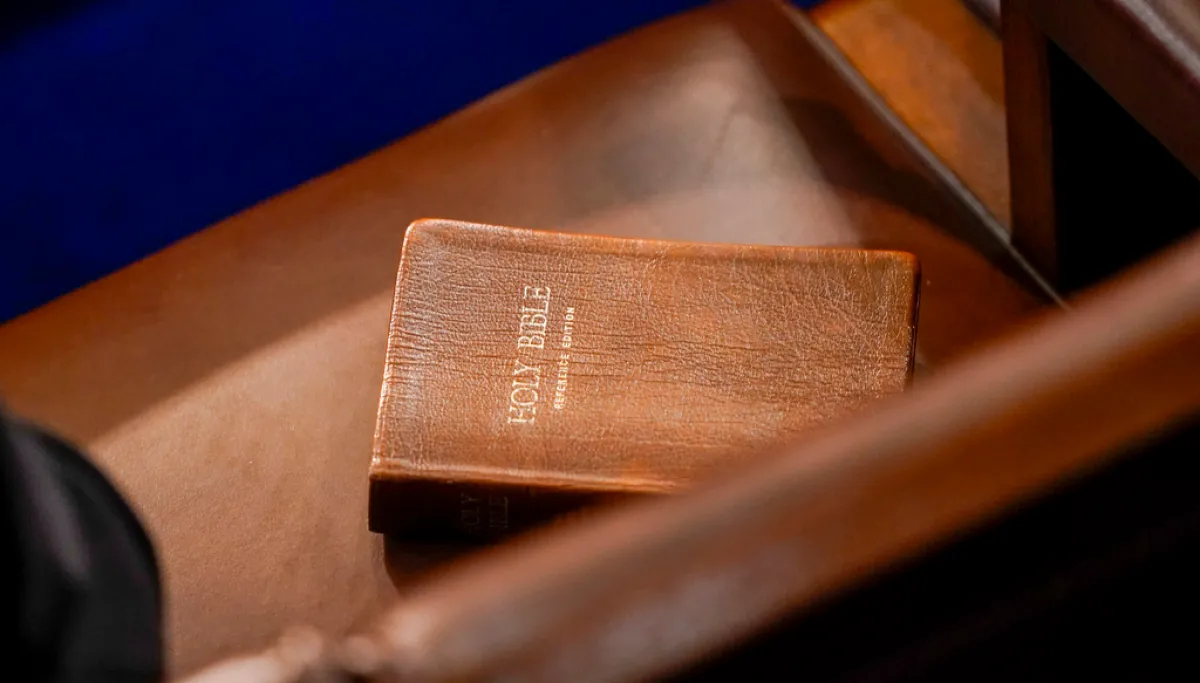



As Conn Carroll argues in Washington Examiner, the controversy exposes a fundamental misunderstanding of the relationship between biblical literacy and American institutions. The Texas board’s recent vote requires selected biblical passages to be incorporated into public school curricula, prompting immediate opposition from state Democratic leadership.
Texas Democratic Party Chairman Gilberto Hinojosa denounced Republicans for what he characterized as completely undermining religious freedom and interfering with parental authority over children’s faith formation. In his statement, Hinojosa contended that in a diverse state like Texas, with millions of residents representing various faiths and beliefs, public education should concentrate on college and workforce preparation rather than religious instruction.
However, this perspective fundamentally misreads the historical and cultural necessity of biblical knowledge in American education. Precisely because the United States and Texas are home to such religious diversity, public schools bear a greater responsibility to ensure students understand Christian thought, biblical literature, and the values that shaped the nation’s founding institutions.
The Founders’ Vision for Education and Faith
America’s founders grasped this principle with clarity. In Federalist No. 2, John Jay, who would become the first Chief Justice of the Supreme Court, described Americans as a people sharing common ancestry, language, religion, and governmental principles. This shared foundation was not incidental but essential to the republic’s functioning.
President George Washington reinforced this understanding in his farewell address, emphasizing that Americans, with only slight variations, shared the same religion, customs, habits, and political principles. This commonality, he believed, was crucial for national unity.
Benjamin Rush, the Philadelphia signatory to the Declaration of Independence, wrote that schools must produce a general and uniform educational system to make the populace more unified and suitable for peaceful governance. He insisted that the foundation for useful education in a republic must be religion itself, since virtue depends on it, liberty depends on virtue, and liberty is the essence of republican government.
Biblical Literacy as Cultural Foundation
These statements reflected the founders’ conviction that a democratic republic required shared understanding, settled moral standards, and common public language to survive. Christianity and the Bible formed the intellectual framework for virtually every founder, including those whose personal beliefs diverged from traditional Christian orthodoxy. The Old and New Testaments were foundational texts of their shared culture.
This did not mean the founders advocated for any particular Christian denomination to receive preferential treatment in schools. At independence, Americans worshipped as Congregationalists, Anglicans, Presbyterians, Baptists, Quakers, Lutherans, Methodists, Moravians, Mennonites, and Catholics. These groups maintained sharp theological disagreements over church governance, sacraments, and worship practices. What united them was familiarity with identical biblical narratives, moral vocabulary, and conception of human nature.
Constitutional Protections Without State Religion
This understanding explains why Article VI of the Constitution prohibits religious tests as qualifications for public office. It also clarifies why the First Amendment states that Congress shall make no law establishing religion or prohibiting its free exercise.
The founders firmly believed religious choice must be voluntary. During the 1776 debate over the Virginia Declaration of Rights, James Madison argued that religion and the duty owed to the Creator can be directed only by reason and conviction, never by force or violence.
Later, while opposing a Virginia proposal to tax citizens for supporting Christian teachers, Madison explained that ecclesiastical establishments, rather than maintaining religious purity and effectiveness, had produced contrary results: pride and laziness among clergy, ignorance and servility among laypeople, and superstition, bigotry, and persecution throughout society.
Madison viewed state-subsidized religion not merely as a violation of individual rights but as a threat to genuine belief itself. This distinction remains crucial: teaching about the Bible’s historical and cultural influence differs fundamentally from state-sponsored religious instruction or compulsory worship.
The Texas board’s curriculum decision recognizes that biblical literacy serves educational purposes beyond sectarian religious training, providing students with essential knowledge for understanding American history, literature, law, and civic culture. The controversy demonstrates the ongoing tension between secular education advocates and those who recognize Scripture’s foundational role in Western civilization.
With information from Washington Examiner