Necessary Cookies

Required for the site to function. Cannot be disabled.

Analytics Cookies

Help us understand how visitors interact with our site (Google Analytics via GTM).

Marketing Cookies

Used to track visitors and deliver personalised advertisements.

We use cookies to enhance your browsing experience and analyse site traffic. By clicking Accept All, you consent to our use of cookies. Privacy Policy
NewsFire Global
Home News Europe World Christianity Culture Wars Opinion Video
Information
About Us Authors Advertising Terms & Conditions Privacy Policy Contact
R2B Media
R2B NEWSFIRE.GR PAPAFOTIS.GR THRACTION HELLENIC CONSERVATIVES RIGHT2THEBONE YT
News World

SCOTUS Allows Late Mail-In Ballots in 5-4 Split Decision

The Supreme Court ruled 5-4 that states may count mail-in ballots received after election day if postmarked by election day, rejecting Republican challenges.
Stefanos Banos
Stefanos Banos Staff Writer
JUNE 30, 2026 AT 5:35 PM

In a closely divided 5-4 decision issued Monday, the nation’s highest court affirmed that states may lawfully count mail-in ballots postmarked on or before election day even when those ballots arrive at state election offices in the days following the election, according to Breitbart News.

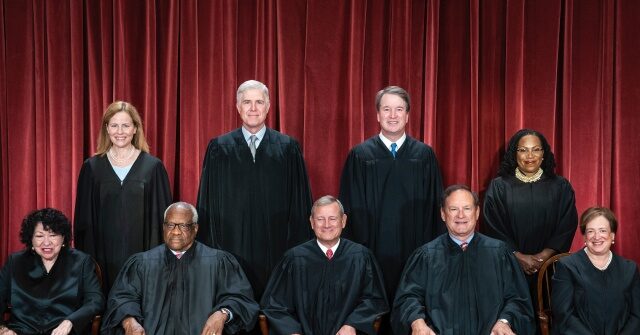
Justice Amy Coney Barrett authored the majority opinion, which garnered support from Chief Justice John Roberts and Justices Sonia Sotomayor, Elena Kagan, and Ketanji Brown Jackson.

The majority held that post-election-day receipt of ballots does not inherently conflict with federal election-day statutes when considered independently. The Court further determined that federal law preempts state law only to the extent an actual conflict exists, rejecting the plaintiffs’ argument that receiving ballots after election day is unlawful in itself.

The ruling emphasized that America’s founding fathers understood the challenge of creating election laws suitable for every conceivable circumstance facing the nation. Rather than embedding election law in the Constitution, they chose to vest discretionary authority over elections elsewhere—specifically not in the Supreme Court, the majority noted.

Conservative Justices Issue Strong Dissent

Justice Samuel Alito penned a forceful dissenting opinion joined by Justices Clarence Thomas and Neil Gorsuch, with Justice Brett Kavanaugh concurring with most of the dissent.

Alito argued that if the election-day statutes merely require individuals to cast votes on or before election day, then the electorate cannot meaningfully be understood as making its collective choice on a single election day, as Breitbart News reports. Instead, he wrote, the electorate’s decision would be rendered gradually over an extended timeframe preceding election day—a scenario fundamentally at odds with what federal election-day statutes mandate.

The dissent stressed that election day represents a specific date, not a multi-day period. Federal law requires elections to occur on that precise date. Under Mississippi’s contested statute, which permits ballot collection for five additional days, the actual election effectively continues beyond the federally mandated election day. This arrangement, Alito contended, should be preempted by federal law.

Case Details

The case is designated Watson v. Republican National Committee, No. 24–1260 in the Supreme Court of the United States.

The decision represents a consequential interpretation of federal election law at a time when mail-in voting procedures remain a contentious political issue across numerous states.

With information from Breitbart News

Share:
Stefanos Banos
Stefanos Banos

Stefanos Banos was born in Piraeus and is an editor at NewsFire.GR, specializing in political analysis and international relations. He graduated from the Department of Communication and Media at the University of Bremen in Germany, where he also completed his Master of Arts in Communication and Media Studies. Married to Zoi, he is a proud father of three boys.

In a closely divided 5-4 decision issued Monday, the nation’s highest court affirmed that states may lawfully count mail-in ballots postmarked on or before election day even when those ballots arrive at state election offices in the days following the election, according to Breitbart News.

Justice Amy Coney Barrett authored the majority opinion, which garnered support from Chief Justice John Roberts and Justices Sonia Sotomayor, Elena Kagan, and Ketanji Brown Jackson.

The majority held that post-election-day receipt of ballots does not inherently conflict with federal election-day statutes when considered independently. The Court further determined that federal law preempts state law only to the extent an actual conflict exists, rejecting the plaintiffs’ argument that receiving ballots after election day is unlawful in itself.

The ruling emphasized that America’s founding fathers understood the challenge of creating election laws suitable for every conceivable circumstance facing the nation. Rather than embedding election law in the Constitution, they chose to vest discretionary authority over elections elsewhere—specifically not in the Supreme Court, the majority noted.

Conservative Justices Issue Strong Dissent

Justice Samuel Alito penned a forceful dissenting opinion joined by Justices Clarence Thomas and Neil Gorsuch, with Justice Brett Kavanaugh concurring with most of the dissent.

Alito argued that if the election-day statutes merely require individuals to cast votes on or before election day, then the electorate cannot meaningfully be understood as making its collective choice on a single election day, as Breitbart News reports. Instead, he wrote, the electorate’s decision would be rendered gradually over an extended timeframe preceding election day—a scenario fundamentally at odds with what federal election-day statutes mandate.

The dissent stressed that election day represents a specific date, not a multi-day period. Federal law requires elections to occur on that precise date. Under Mississippi’s contested statute, which permits ballot collection for five additional days, the actual election effectively continues beyond the federally mandated election day. This arrangement, Alito contended, should be preempted by federal law.

Case Details

The case is designated Watson v. Republican National Committee, No. 24–1260 in the Supreme Court of the United States.

The decision represents a consequential interpretation of federal election law at a time when mail-in voting procedures remain a contentious political issue across numerous states.

With information from Breitbart News