Pope Leo XIV Urges Europe to Defend Life in Spain Address
Pope Leo XIV urged Spanish lawmakers to protect vulnerable lives and reject political polarization in the first-ever papal address to the country's parliament on June 8.
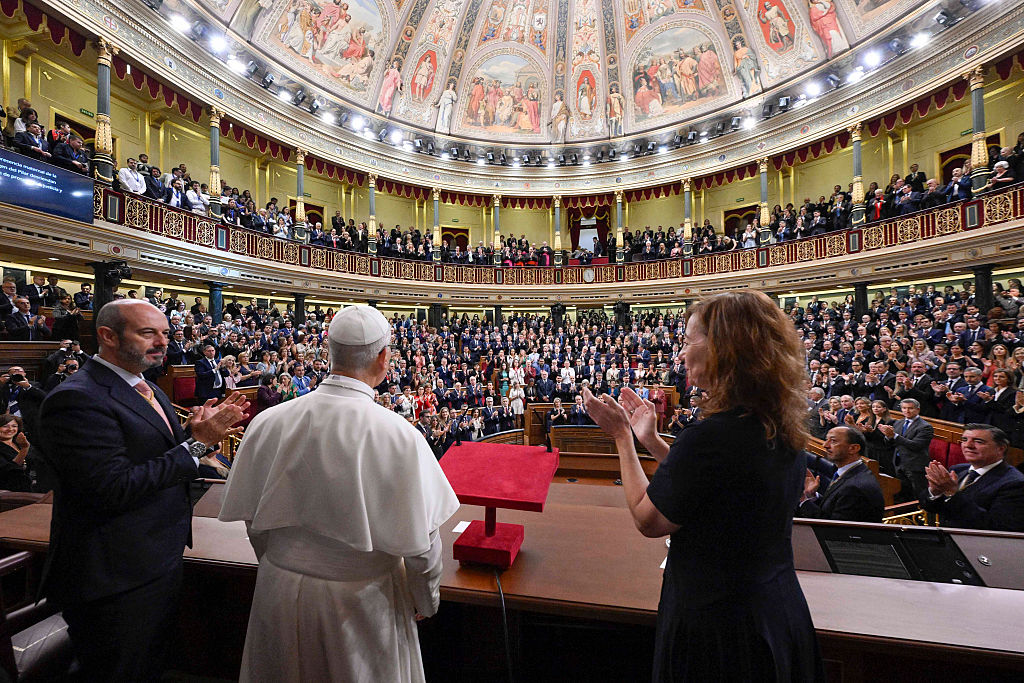

Speaking before a joint session of the Congress of Deputies and the Senate in Madrid on June 8, the American-born pope used the platform to warn against what he termed a “throwaway culture” threatening the unborn, the elderly, and the sick, according to Brussels Signal.
Pope Leo XIV told lawmakers that the moral greatness of a nation rests on its willingness to protect its most vulnerable members. He challenged Spanish deputies to consider whether a society that “casts into the shadows” those deemed inconvenient could truly call itself just. The remarks drew a seven-minute standing ovation from the chamber.
The pontiff framed the protection of life not as a narrow religious concern but as a fundamental goal of civilisation itself, rejecting characterisations of the issue as merely confessional or partisan.
Warning Against Political Warfare
The pope reserved particularly sharp language for Spain’s fractious political climate, as Brussels Signal reports. He cautioned that legitimate political plurality must not descend into the permanent demonisation of opponents, urging legislators to “disarm” their rhetoric.
Leo XIV emphasised that political firmness does not require contempt and that disagreement need not involve humiliation. The message arrived at a moment of deep division in Spanish politics, with Prime Minister Pedro Sánchez‘s minority Socialist government locked in ongoing confrontation with the right-wing opposition led by Alberto Núñez Feijóo.
Immigration and International Law
On immigration, the pontiff called for respect for migrants’ rights and adherence to international law. The theme is expected to feature prominently in the final leg of his Spanish tour in the Canary Islands, a major entry point for African migrants crossing into Europe.
The pope also addressed the moral limits of state power and raised ethical concerns about artificial intelligence in warfare, drawing on the 16th-century School of Salamanca and its contributions to early conceptions of international law and human rights.
Europe’s Christian Identity
Throughout the visit, Leo XIV has reasserted Christianity’s central role in European identity. At a gathering with cultural and business leaders at Madrid’s Movistar Arena, he revived the call of Pope John Paul II to “open wide the doors to Christ,” arguing that Europe cannot be understood apart from its Christian heritage.
That emphasis is set to continue in Barcelona, where the pope will inaugurate a new tower at the Sagrada Família basilica, the iconic structure designed by Antoni Gaudí, whose cause for canonisation advanced in 2025.
Confronting Clerical Abuse
Following his parliamentary address, Leo XIV met with approximately 80 Spanish bishops at the headquarters of the Spanish Episcopal Conference, where he addressed the ongoing scandal of clerical sexual abuse. He described such crimes as a “plague” and insisted the Church owes victims listening, truth, justice, and reparation.
The meeting came after an agreement, strongly supported by the Vatican, in which Spain’s bishops accepted that the country’s State ombudsman would have final authority over victim compensation.
Mass Public Devotion
The Madrid portion of the visit has combined high-level institutional meetings with large-scale public worship. On June 7, the pope celebrated a Corpus Christi Mass at the Plaza de Cibeles that organisers estimated drew up to 1.5 million people. The previous evening, hundreds of thousands of young people attended a vigil at the Plaza de Lima, where the pontiff urged them to become “protagonists of change.”
The trip marks Leo XIV‘s first visit to Spain as pope and the first papal visit to the country in 15 years. The Chicago-born Augustinian, formerly known as Robert Prevost, was elected to succeed Pope Francis in May 2025.
With information from Brussels Signal