Necessary Cookies

Required for the site to function. Cannot be disabled.

Analytics Cookies

Help us understand how visitors interact with our site (Google Analytics via GTM).

Marketing Cookies

Used to track visitors and deliver personalised advertisements.

We use cookies to enhance your browsing experience and analyse site traffic. By clicking Accept All, you consent to our use of cookies. Privacy Policy
NewsFire Global
Home News Europe World Christianity Culture Wars Opinion Video
Information
About Us Authors Advertising Terms & Conditions Privacy Policy Contact
R2B Media
R2B NEWSFIRE.GR PAPAFOTIS.GR THRACTION HELLENIC CONSERVATIVES RIGHT2THEBONE YT
News Europe

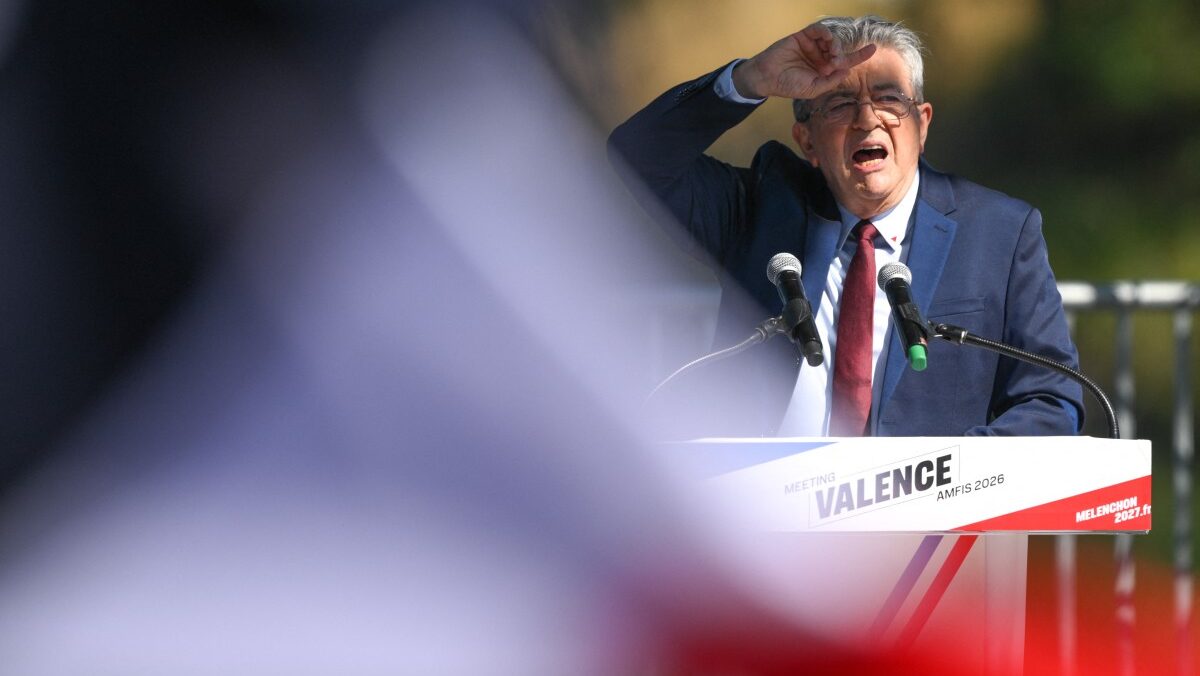
Mélenchon Stages Surprising Political Comeback in France

Far-left candidate Jean-Luc Mélenchon gains momentum in France's presidential race as centrist and right-wing opponents remain fragmented and struggle to present a unified challenge.

Dimitris Papafotis
Dimitris Papafotis Editor in Chief
AUGUST 24, 2026 AT 2:59 PM

With just eight months remaining before France goes to the polls in its presidential election, far-left firebrand Jean-Luc Mélenchon has managed to generate genuine political momentum while his rivals across the spectrum struggle to find their footing, according to The European Conservative.

The political landscape reveals a fragmented opposition unable to mount a coherent challenge to Mélenchon’s increasingly energized campaign. The centrist bloc remains splintered between competing candidacies from former prime ministers Édouard Philippe and Gabriel Attal, both aligned with the Macron political project but unable to consolidate support.

Meanwhile, the French Right finds itself in a familiar predicament: unable to establish a compelling narrative that resonates with voters. The non-Mélenchonist Left faces an equally difficult challenge, searching in vain for a formula that would allow it to distinguish itself and gain traction in the race.

La France Insoumise Capitalizes on Opposition Disarray

In stark contrast to his opponents’ organizational difficulties, Mélenchon’s La France Insoumise movement has demonstrated the kind of campaign discipline and clarity of message that typically characterizes winning efforts. The far-left formation appears to be the only major political force currently operating with a clear strategic vision.

The situation represents a troubling development for those concerned about the direction of French politics. With the traditional center-right weakened and the Macronist center divided among competing personalities, Mélenchon has found an opening to position himself as the primary alternative to the status quo.

A Divided Field Benefits the Extremes

The current political fragmentation recalls previous electoral cycles in which divided mainstream forces inadvertently cleared a path for more radical candidates. France’s two-round electoral system typically rewards candidates who can consolidate their base while their opponents split the vote among multiple contenders.

Unless the center and right can resolve their internal divisions and present voters with a unified alternative, Mélenchon’s path to the second round becomes increasingly plausible. The question facing French voters is whether the political establishment can overcome its factional disputes in time to mount an effective challenge.

With information from The European Conservative

Share:
Dimitris Papafotis
Dimitris Papafotis

Dimitris Papafotis is the editor-in-chief of NewsFire.GR. He was born and raised in Athens. He studied at the Journalism Workshop (1991-1993). He currently lives in Pyrgos, Ilia, where he has been active in radio and various newspapers, while also maintaining his personal blog, Papafotis.gr.

Recent News

With just eight months remaining before France goes to the polls in its presidential election, far-left firebrand Jean-Luc Mélenchon has managed to generate genuine political momentum while his rivals across the spectrum struggle to find their footing, according to The European Conservative.

The political landscape reveals a fragmented opposition unable to mount a coherent challenge to Mélenchon’s increasingly energized campaign. The centrist bloc remains splintered between competing candidacies from former prime ministers Édouard Philippe and Gabriel Attal, both aligned with the Macron political project but unable to consolidate support.

Meanwhile, the French Right finds itself in a familiar predicament: unable to establish a compelling narrative that resonates with voters. The non-Mélenchonist Left faces an equally difficult challenge, searching in vain for a formula that would allow it to distinguish itself and gain traction in the race.

La France Insoumise Capitalizes on Opposition Disarray

In stark contrast to his opponents’ organizational difficulties, Mélenchon’s La France Insoumise movement has demonstrated the kind of campaign discipline and clarity of message that typically characterizes winning efforts. The far-left formation appears to be the only major political force currently operating with a clear strategic vision.

The situation represents a troubling development for those concerned about the direction of French politics. With the traditional center-right weakened and the Macronist center divided among competing personalities, Mélenchon has found an opening to position himself as the primary alternative to the status quo.

A Divided Field Benefits the Extremes

The current political fragmentation recalls previous electoral cycles in which divided mainstream forces inadvertently cleared a path for more radical candidates. France’s two-round electoral system typically rewards candidates who can consolidate their base while their opponents split the vote among multiple contenders.

Unless the center and right can resolve their internal divisions and present voters with a unified alternative, Mélenchon’s path to the second round becomes increasingly plausible. The question facing French voters is whether the political establishment can overcome its factional disputes in time to mount an effective challenge.

With information from The European Conservative