Necessary Cookies

Required for the site to function. Cannot be disabled.

Analytics Cookies

Help us understand how visitors interact with our site (Google Analytics via GTM).

Marketing Cookies

Used to track visitors and deliver personalised advertisements.

We use cookies to enhance your browsing experience and analyse site traffic. By clicking Accept All, you consent to our use of cookies. Privacy Policy
NewsFire Global
Home News Europe World Christianity Culture Wars Opinion Video
Information
About Us Authors Advertising Terms & Conditions Privacy Policy Contact
R2B Media
R2B NEWSFIRE.GR PAPAFOTIS.GR THRACTION HELLENIC CONSERVATIVES RIGHT2THEBONE YT
News World

Can El Salvador’s Tough Prison Policy Work in France?

A French police officer who worked in El Salvador suggests President Bukele's security crackdown, which grew the prison population from 40,000 to over 100,000, may offer lessons for France.
SEPTEMBER 2, 2026 AT 10:11 AM

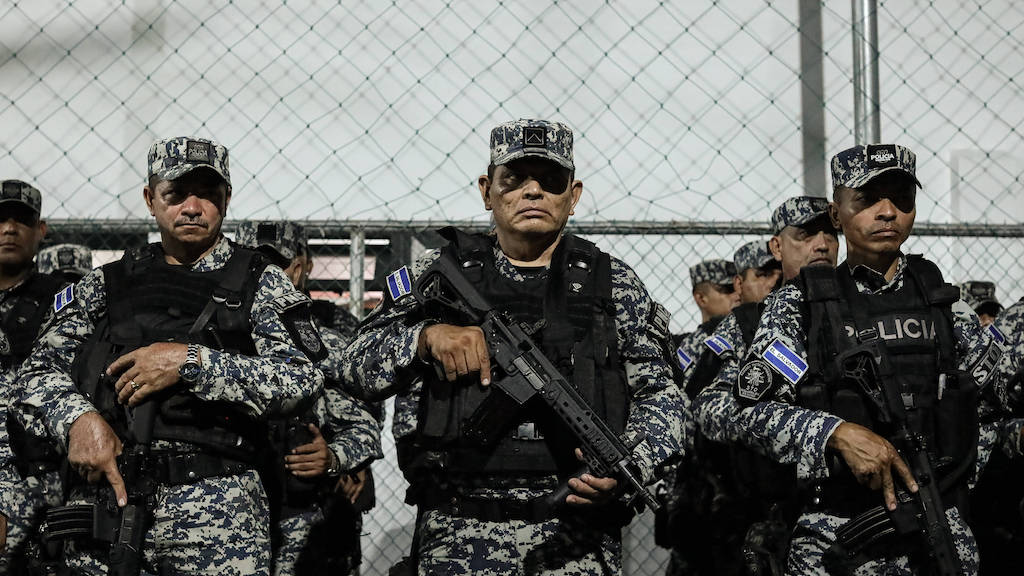
According to Valeurs Actuelles, the author conducted multiple international cooperation missions in San Salvador, introducing French expertise in crisis management and crowd control under degraded conditions. Several Salvadoran police units, including the riot control units known as U.M.O., were established with French assistance, notably by Commander J.F. Piret.

The officer describes a country once plagued by near-constant physical violence, attacks on persons and property, and profound corruption penetrating every level of government, including law enforcement. El Salvador faced an exceptional challenge: the presence of the Maras 13 and 18, two criminal organizations whose combined membership rivaled the entire Salvadoran police force.

Criminal Empire Before Bukele

These gangs engaged in murder, drug trafficking, kidnapping, extortion, assassinations, score-settling, and corruption. Far from petty criminals, they practiced torture and exported their operations internationally, particularly to Los Angeles, where they control substantial markets in organized crime.

Nayib Bukele, former mayor of San Salvador, was elected president in 2019 and reelected in 2024 on a promise to restore order and end the reign of criminal gangs. His approach involved comprehensive coordination between internal security forces, armed forces, intelligence services, and judicial authorities to target and arrest criminals and gang members.

Mass Incarceration and Mega-Prisons

The president ordered construction of mega-prisons capable of housing up to 100,000 inmates. In a nation of approximately 6.5 million people, the prison population exploded from 40,000 in 2019 to over 100,000 by 2026. His reelection represented a genuine plebiscite.

The results speak for themselves: the crime rate plummeted from 87 per 1,000 inhabitants in 2019 to just 0.9 per 1,000 in 2026. The Salvadoran president did not merely make campaign promises—he delivered on them.

Since March 2022, the Salvadoran model has operated under a state of exception, featuring mass arrests, reduced procedural guarantees, and extremely severe detention conditions. The government announced prolonged detentions, mass transfers to high-security facilities, elimination of certain detention activities, and construction of the CECOT prison for terrorists, designed to hold approximately 40,000 people.

France’s Inverse Trajectory

The comparison between the two countries proves instructive, as Valeurs Actuelles reports. In the 2026 Global Peace Index, France ranks 99th out of 163 countries for peace and security, placing it between Tanzania and Gabon. Paradoxically, El Salvador’s increased prison population correlates with massively reduced criminality, while France’s growing prison population reflects constantly increasing crime.

The author acknowledges that while certain components of Bukele’s policy could be adapted for France, full transposition of his model would be legally incompatible with the French rule of law and practically very difficult to implement.

What Could Work in France

Two elements must be distinguished: a firm policy against criminal networks, prison corruption, and organized crime versus the Salvadoran model itself, which relies on exceptional measures that curtail normal legal protections.

France already possesses differentiated prison regimes, isolation quarters, surveillance systems, and specific procedures for terrorism and organized crime. The debate would therefore focus less on whether a firm policy is possible than on its degree and its guarantees.

The article suggests that France’s challenge is not a lack of legal tools but rather political will to use them effectively. While Bukele’s emergency measures may be incompatible with French law, his coordination of security services, commitment to construction of adequate detention facilities, and refusal to tolerate criminal impunity offer potential lessons for a nation struggling with deteriorating public safety.

With information from Valeurs Actuelles
Share:
Eleni Papadaki-Van Der Merwe

She was born in 1986 in Johannesburg, South Africa. She is the granddaughter of an immigrant from Crete who settled in the Greek community of Johannesburg (one of the largest in Africa). She holds a bachelor’s degree in International Relations and Political Science from the University of the Witwatersrand (Wits) in Johannesburg and a master’s degree in Journalism from Rhodes University in Grahamstown. She began her career at English-language media outlets in Johannesburg, covering politics and economics, with a focus on issues related to migration and the diaspora. She moved to Athens in 2015 to “return to her roots,” initially to pursue graduate studies, and has remained there permanently. She is married to an Afrikaner; they have two children and live in the southern suburbs of Athens.

According to Valeurs Actuelles, the author conducted multiple international cooperation missions in San Salvador, introducing French expertise in crisis management and crowd control under degraded conditions. Several Salvadoran police units, including the riot control units known as U.M.O., were established with French assistance, notably by Commander J.F. Piret.

The officer describes a country once plagued by near-constant physical violence, attacks on persons and property, and profound corruption penetrating every level of government, including law enforcement. El Salvador faced an exceptional challenge: the presence of the Maras 13 and 18, two criminal organizations whose combined membership rivaled the entire Salvadoran police force.

Criminal Empire Before Bukele

These gangs engaged in murder, drug trafficking, kidnapping, extortion, assassinations, score-settling, and corruption. Far from petty criminals, they practiced torture and exported their operations internationally, particularly to Los Angeles, where they control substantial markets in organized crime.

Nayib Bukele, former mayor of San Salvador, was elected president in 2019 and reelected in 2024 on a promise to restore order and end the reign of criminal gangs. His approach involved comprehensive coordination between internal security forces, armed forces, intelligence services, and judicial authorities to target and arrest criminals and gang members.

Mass Incarceration and Mega-Prisons

The president ordered construction of mega-prisons capable of housing up to 100,000 inmates. In a nation of approximately 6.5 million people, the prison population exploded from 40,000 in 2019 to over 100,000 by 2026. His reelection represented a genuine plebiscite.

The results speak for themselves: the crime rate plummeted from 87 per 1,000 inhabitants in 2019 to just 0.9 per 1,000 in 2026. The Salvadoran president did not merely make campaign promises—he delivered on them.

Since March 2022, the Salvadoran model has operated under a state of exception, featuring mass arrests, reduced procedural guarantees, and extremely severe detention conditions. The government announced prolonged detentions, mass transfers to high-security facilities, elimination of certain detention activities, and construction of the CECOT prison for terrorists, designed to hold approximately 40,000 people.

France’s Inverse Trajectory

The comparison between the two countries proves instructive, as Valeurs Actuelles reports. In the 2026 Global Peace Index, France ranks 99th out of 163 countries for peace and security, placing it between Tanzania and Gabon. Paradoxically, El Salvador’s increased prison population correlates with massively reduced criminality, while France’s growing prison population reflects constantly increasing crime.

The author acknowledges that while certain components of Bukele’s policy could be adapted for France, full transposition of his model would be legally incompatible with the French rule of law and practically very difficult to implement.

What Could Work in France

Two elements must be distinguished: a firm policy against criminal networks, prison corruption, and organized crime versus the Salvadoran model itself, which relies on exceptional measures that curtail normal legal protections.

France already possesses differentiated prison regimes, isolation quarters, surveillance systems, and specific procedures for terrorism and organized crime. The debate would therefore focus less on whether a firm policy is possible than on its degree and its guarantees.

The article suggests that France’s challenge is not a lack of legal tools but rather political will to use them effectively. While Bukele’s emergency measures may be incompatible with French law, his coordination of security services, commitment to construction of adequate detention facilities, and refusal to tolerate criminal impunity offer potential lessons for a nation struggling with deteriorating public safety.

With information from Valeurs Actuelles