Necessary Cookies

Required for the site to function. Cannot be disabled.

Analytics Cookies

Help us understand how visitors interact with our site (Google Analytics via GTM).

Marketing Cookies

Used to track visitors and deliver personalised advertisements.

We use cookies to enhance your browsing experience and analyse site traffic. By clicking Accept All, you consent to our use of cookies. Privacy Policy
NewsFire Global
Home News Europe World Christianity Culture Wars Opinion Video
Information
About Us Authors Advertising Terms & Conditions Privacy Policy Contact
R2B Media
R2B NEWSFIRE.GR PAPAFOTIS.GR THRACTION HELLENIC CONSERVATIVES RIGHT2THEBONE YT
News Europe

Channel Gangs Deploy Mega Dinghies as Boat Crackdown Bites

Smuggling gangs are packing hundreds of migrants into oversized inflatable boats launched in daylight after French enforcement restricted smaller vessel supplies and intercepted two-thirds of crossings.

Dimitris Papafotis
Dimitris Papafotis Editor in Chief
SEPTEMBER 4, 2026 AT 11:56 AM

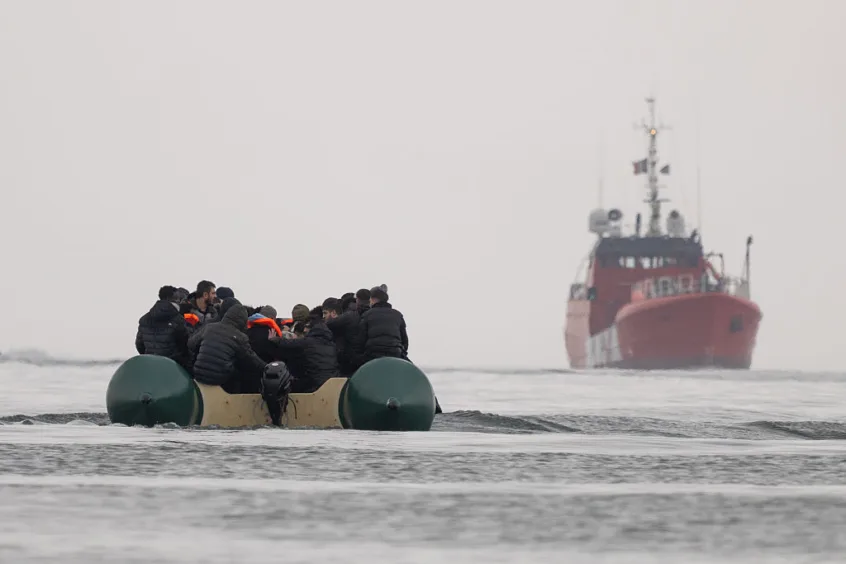
The shift has seen previously competing gangs now cooperating to consolidate their human cargo onto single boats, with smugglers confirming that more of these so-called mega dinghies are in preparation. The change in tactics comes as authorities intercept approximately two-thirds of attempted small boat launches before they can reach open water.

A single 15-metre boat carrying a staggering 230 people successfully reached British waters in August, shattering the previous record of 165 set just one month earlier in July. The unprecedented overcrowding has introduced deadly new risks to an already dangerous crossing.

Daytime Launches Replace Nighttime Operations

French coastal patrols have proven so effective that smuggling gangs have abandoned their traditional pattern of nighttime launches, now pushing boats out in broad daylight instead. Charity workers operating in the area confirmed to the BBC that the tactical shift reflects the heightened enforcement pressure on established smuggling routines.

The BBC investigation team itself came under attack near a migrant camp at Loon-Plage, close to Dunkirk, where they were pelted with stones and their cameraman sustained injuries. Riot police had conducted a clearance operation at the encampment just days before the incident.

Cross-Border Smuggling Networks Expand Range

Smuggling operations have also grown more sophisticated in evading detection. Taxi boats—vessels that depart from one location and collect passengers at another point along the coast—are now travelling significantly longer distances. One boat filmed collecting migrants at Gravelines had originated from Belgium, underscoring the cross-border nature of the criminal enterprise.

The British Home Office reported that the National Crime Agency and international partners have seized over 1,100 boats and engines as part of a coordinated effort to strangle the smugglers’ equipment supply chain.

European law enforcement agencies have pursued the same strategy. Eurojust and Europol announced in March that four individuals had been arrested in connection with deliveries of nautical equipment manufactured in Asia and imported into Germany through Turkey, with individual packages valued at more than €10,000 on the black market.

Overcrowding Creates Catastrophic Risks

The larger vessels have introduced grave new dangers to Channel crossings. On August 4, 170 people required rescue after their boat caught fire mid-crossing. Another dinghy carrying 173 passengers sank off Boulogne after launching from Dieppe in Normandy.

French maritime rescue teams have warned that the overloaded boats make recovery operations far more hazardous. The record-breaking 230-passenger vessel was reported to have buckled under the strain of heavy seas.

British ministers faced sharp criticism after images of that massively overcrowded boat circulated widely, with opponents accusing the government of losing control over the crossings. French police also drew renewed condemnation for reportedly standing by as the boat made its way to sea.

Despite the shift to larger boats, Frontex, the European Union border agency, recorded approximately 9,900 attempted crossings from the bloc to Britain across the Channel between January and April—close to half the number documented during the same period the previous year.

With information from Brussels Signal
Share:
Dimitris Papafotis
Dimitris Papafotis

Dimitris Papafotis is the editor-in-chief of NewsFire.GR. He was born and raised in Athens. He studied at the Journalism Workshop (1991-1993). He currently lives in Pyrgos, Ilia, where he has been active in radio and various newspapers, while also maintaining his personal blog, Papafotis.gr.

The shift has seen previously competing gangs now cooperating to consolidate their human cargo onto single boats, with smugglers confirming that more of these so-called mega dinghies are in preparation. The change in tactics comes as authorities intercept approximately two-thirds of attempted small boat launches before they can reach open water.

A single 15-metre boat carrying a staggering 230 people successfully reached British waters in August, shattering the previous record of 165 set just one month earlier in July. The unprecedented overcrowding has introduced deadly new risks to an already dangerous crossing.

Daytime Launches Replace Nighttime Operations

French coastal patrols have proven so effective that smuggling gangs have abandoned their traditional pattern of nighttime launches, now pushing boats out in broad daylight instead. Charity workers operating in the area confirmed to the BBC that the tactical shift reflects the heightened enforcement pressure on established smuggling routines.

The BBC investigation team itself came under attack near a migrant camp at Loon-Plage, close to Dunkirk, where they were pelted with stones and their cameraman sustained injuries. Riot police had conducted a clearance operation at the encampment just days before the incident.

Cross-Border Smuggling Networks Expand Range

Smuggling operations have also grown more sophisticated in evading detection. Taxi boats—vessels that depart from one location and collect passengers at another point along the coast—are now travelling significantly longer distances. One boat filmed collecting migrants at Gravelines had originated from Belgium, underscoring the cross-border nature of the criminal enterprise.

The British Home Office reported that the National Crime Agency and international partners have seized over 1,100 boats and engines as part of a coordinated effort to strangle the smugglers’ equipment supply chain.

European law enforcement agencies have pursued the same strategy. Eurojust and Europol announced in March that four individuals had been arrested in connection with deliveries of nautical equipment manufactured in Asia and imported into Germany through Turkey, with individual packages valued at more than €10,000 on the black market.

Overcrowding Creates Catastrophic Risks

The larger vessels have introduced grave new dangers to Channel crossings. On August 4, 170 people required rescue after their boat caught fire mid-crossing. Another dinghy carrying 173 passengers sank off Boulogne after launching from Dieppe in Normandy.

French maritime rescue teams have warned that the overloaded boats make recovery operations far more hazardous. The record-breaking 230-passenger vessel was reported to have buckled under the strain of heavy seas.

British ministers faced sharp criticism after images of that massively overcrowded boat circulated widely, with opponents accusing the government of losing control over the crossings. French police also drew renewed condemnation for reportedly standing by as the boat made its way to sea.

Despite the shift to larger boats, Frontex, the European Union border agency, recorded approximately 9,900 attempted crossings from the bloc to Britain across the Channel between January and April—close to half the number documented during the same period the previous year.

With information from Brussels Signal