Necessary Cookies

Required for the site to function. Cannot be disabled.

Analytics Cookies

Help us understand how visitors interact with our site (Google Analytics via GTM).

Marketing Cookies

Used to track visitors and deliver personalised advertisements.

We use cookies to enhance your browsing experience and analyse site traffic. By clicking Accept All, you consent to our use of cookies. Privacy Policy
NewsFire Global
Home News Europe World Christianity Culture Wars Opinion Video
Information
About Us Authors Advertising Terms & Conditions Privacy Policy Contact
R2B Media
R2B NEWSFIRE.GR PAPAFOTIS.GR THRACTION HELLENIC CONSERVATIVES RIGHT2THEBONE YT
News World

Japan Leaps Toward Becoming Military Superpower in Pacific

Japan is abandoning its post-war pacifist doctrine to become a major arms exporter, driven by security threats from China, North Korea, and lessons from Ukraine's war.

Dimitris Papafotis
Dimitris Papafotis Editor in Chief
JUNE 9, 2026 AT 6:40 PM

For decades, Japan was regarded as an economic giant but a military dwarf. The 1947 Japanese constitution explicitly renounced war as an instrument of policy, restricted armed forces to self-defense capabilities, and made weapons exports politically undesirable. The domestic defense industry produced almost exclusively for internal use. That era is now drawing to a close, according to Junge Freiheit, and most Japanese citizens, apart from older generations, welcome the shift.

The transformation is being fueled by what Tokyo now openly describes as the greatest security challenge in modern Japanese history: China. At the same time, North Korea regularly test-fires missiles over the Sea of Japan, while Russia’s war against Ukraine has strengthened the conviction in Tokyo that industrial capacity and a capable defense industry are themselves components of national security.

Lessons From Ukraine Drive Rearmament Strategy

The Japanese government has drawn two critical lessons from the Ukraine conflict. First, modern wars consume enormous quantities of ammunition, missiles, and spare parts. Second, states without their own industrial base can become dangerously dependent in times of crisis. Those who rely exclusively on foreign suppliers lose room for maneuver when emergencies strike.

This realization comes as global defense spending approaches three trillion dollars annually. Many nations are seeking new suppliers as American production capacity is increasingly stretched by support for Ukraine, commitments in the Middle East, and strategic competition with China. Delivery times are lengthening and waiting lists growing.

Export Restrictions Systematically Dismantled

The Japanese government has systematically loosened export restrictions that had been in place for decades. In 2014, Tokyo replaced near-total export bans with new regulations. In late 2023, Japan authorized for the first time the export of certain licensed weapons systems back to their countries of origin. Further relaxations followed in 2024. Then in spring 2026, numerous categories that had previously limited exports to rescue, transport, or surveillance systems were abolished. The message is unambiguous: Japan wants to sell weapons.

There is no shortage of buyers for the advanced systems produced by industrial giants like Mitsubishi and Toyota.

Mogami-Class Frigates Lead Naval Export Push

Tokyo has been particularly successful in shipbuilding. The country possesses decades of experience constructing complex naval systems and ranks among the world’s technological leaders. Currently at the forefront is the Mogami-class, a modern frigate with a comparatively small crew, high automation, and versatile deployment options. The vessels are designed for submarine hunting, air defense, surveillance, and surface combat.

Australia recently chose an advanced variant of this frigate. A total of eleven ships are to be procured, marking one of the most significant Japanese defense export projects since World War II and sending a signal across the entire region.

Radar Systems and Long-Range Missiles

Japanese radar and sensor systems may prove even more important in the long term. The Philippines has already received modern air surveillance radars from Japan. For states facing increasing Chinese pressure in the South China Sea, such systems possess enormous strategic significance. They enable early detection of aircraft, drones, or missiles and form the backbone of modern air defense.

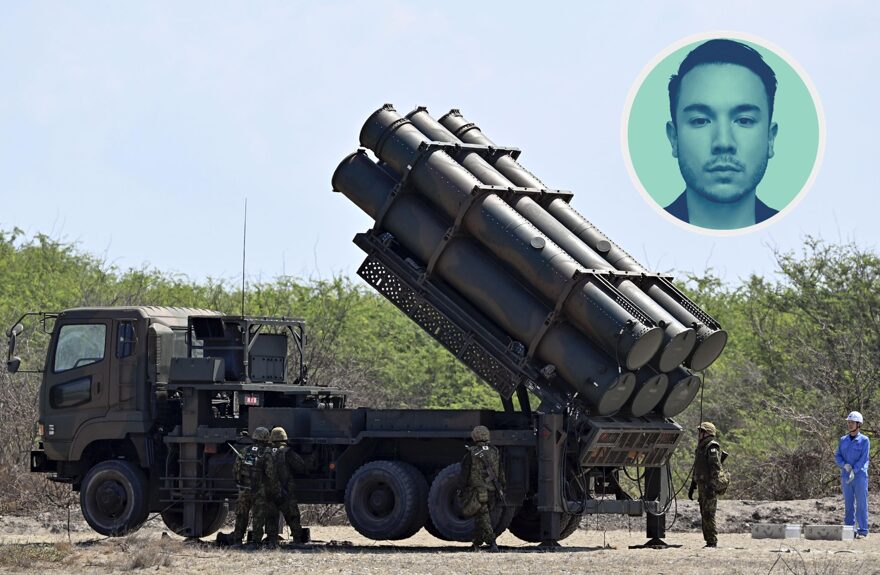
Simultaneously, Tokyo is investing billions in expanding its own missile programs. Enormous sums are flowing into the development of new long-range weapons. The upgraded Type 12 missile in particular is intended for deployment from land, ships, and aircraft. Japan is thereby pursuing a strategy increasingly discussed in Europe as well: building as many capabilities domestically as possible and avoiding complete dependence on American supplies.

Sixth-Generation Fighter Jet in Development

Particularly ambitious is the Global Combat Air Programme, which Japan is developing jointly with Britain and Italy. The goal is a sixth-generation fighter aircraft to become operational in the 2030s. Tokyo has already created the legal framework to allow future exports of the aircraft, a timeline that Germany can only dream of.

All of this would have been politically unthinkable just a few years ago. Japan’s transformation from pacifist state to arms exporter reflects both the shifting balance of power in Asia and a pragmatic recognition that in an increasingly dangerous world, economic strength alone does not guarantee security.

With information from Junge Freiheit

Share:
Dimitris Papafotis
Dimitris Papafotis

Dimitris Papafotis is the editor-in-chief of NewsFire.GR. He was born and raised in Athens. He studied at the Journalism Workshop (1991-1993). He currently lives in Pyrgos, Ilia, where he has been active in radio and various newspapers, while also maintaining his personal blog, Papafotis.gr.

For decades, Japan was regarded as an economic giant but a military dwarf. The 1947 Japanese constitution explicitly renounced war as an instrument of policy, restricted armed forces to self-defense capabilities, and made weapons exports politically undesirable. The domestic defense industry produced almost exclusively for internal use. That era is now drawing to a close, according to Junge Freiheit, and most Japanese citizens, apart from older generations, welcome the shift.

🇯🇵 Japan is now the first country to fire an electromagnetic railgun from a warship at a moving target.

China has spent decades building a missile-heavy navy using anti-ship missiles.

A working ship-based railgun changes the entire dynamic.

Clip: @IsabellaAn67 https://t.co/42EFNbgv32 pic.twitter.com/rsYHK7QoKD

— Mario Nawfal (@MarioNawfal) April 30, 2026

The transformation is being fueled by what Tokyo now openly describes as the greatest security challenge in modern Japanese history: China. At the same time, North Korea regularly test-fires missiles over the Sea of Japan, while Russia’s war against Ukraine has strengthened the conviction in Tokyo that industrial capacity and a capable defense industry are themselves components of national security.

Lessons From Ukraine Drive Rearmament Strategy

The Japanese government has drawn two critical lessons from the Ukraine conflict. First, modern wars consume enormous quantities of ammunition, missiles, and spare parts. Second, states without their own industrial base can become dangerously dependent in times of crisis. Those who rely exclusively on foreign suppliers lose room for maneuver when emergencies strike.

This realization comes as global defense spending approaches three trillion dollars annually. Many nations are seeking new suppliers as American production capacity is increasingly stretched by support for Ukraine, commitments in the Middle East, and strategic competition with China. Delivery times are lengthening and waiting lists growing.

Export Restrictions Systematically Dismantled

The Japanese government has systematically loosened export restrictions that had been in place for decades. In 2014, Tokyo replaced near-total export bans with new regulations. In late 2023, Japan authorized for the first time the export of certain licensed weapons systems back to their countries of origin. Further relaxations followed in 2024. Then in spring 2026, numerous categories that had previously limited exports to rescue, transport, or surveillance systems were abolished. The message is unambiguous: Japan wants to sell weapons.

There is no shortage of buyers for the advanced systems produced by industrial giants like Mitsubishi and Toyota.

‼️‼️🇯🇵 BREAKING – The Japanese government has approved a major relaxation of arms export rules, effectively ending the post-war pacifism era and opening the country’s military-industrial complex to the global market.

Japan, with a billion military budget, already produces… pic.twitter.com/OgbUpM4rI6

— Visioner (@visionergeo) April 15, 2026

Mogami-Class Frigates Lead Naval Export Push

Tokyo has been particularly successful in shipbuilding. The country possesses decades of experience constructing complex naval systems and ranks among the world’s technological leaders. Currently at the forefront is the Mogami-class, a modern frigate with a comparatively small crew, high automation, and versatile deployment options. The vessels are designed for submarine hunting, air defense, surveillance, and surface combat.

Australia recently chose an advanced variant of this frigate. A total of eleven ships are to be procured, marking one of the most significant Japanese defense export projects since World War II and sending a signal across the entire region.

Radar Systems and Long-Range Missiles

Japanese radar and sensor systems may prove even more important in the long term. The Philippines has already received modern air surveillance radars from Japan. For states facing increasing Chinese pressure in the South China Sea, such systems possess enormous strategic significance. They enable early detection of aircraft, drones, or missiles and form the backbone of modern air defense.

Simultaneously, Tokyo is investing billions in expanding its own missile programs. Enormous sums are flowing into the development of new long-range weapons. The upgraded Type 12 missile in particular is intended for deployment from land, ships, and aircraft. Japan is thereby pursuing a strategy increasingly discussed in Europe as well: building as many capabilities domestically as possible and avoiding complete dependence on American supplies.

Sixth-Generation Fighter Jet in Development

Particularly ambitious is the Global Combat Air Programme, which Japan is developing jointly with Britain and Italy. The goal is a sixth-generation fighter aircraft to become operational in the 2030s. Tokyo has already created the legal framework to allow future exports of the aircraft, a timeline that Germany can only dream of.

All of this would have been politically unthinkable just a few years ago. Japan’s transformation from pacifist state to arms exporter reflects both the shifting balance of power in Asia and a pragmatic recognition that in an increasingly dangerous world, economic strength alone does not guarantee security.

With information from Junge Freiheit

