Necessary Cookies

Required for the site to function. Cannot be disabled.

Analytics Cookies

Help us understand how visitors interact with our site (Google Analytics via GTM).

Marketing Cookies

Used to track visitors and deliver personalised advertisements.

We use cookies to enhance your browsing experience and analyse site traffic. By clicking Accept All, you consent to our use of cookies. Privacy Policy
NewsFire Global
Home News Europe World Christianity Culture Wars Opinion Video
Information
About Us Authors Advertising Terms & Conditions Privacy Policy Contact
R2B Media
R2B NEWSFIRE.GR PAPAFOTIS.GR THRACTION HELLENIC CONSERVATIVES RIGHT2THEBONE YT
News World

Fed’s Future Hangs in Balance Amid Leadership Fight

Kevin Warsh was sworn in as Federal Reserve chairman at the White House on Friday, marking a shift toward reform-oriented monetary policy under the Trump administration.

Stefanos Banos
Stefanos Banos Staff Writer
MAY 23, 2026 AT 2:10 PM

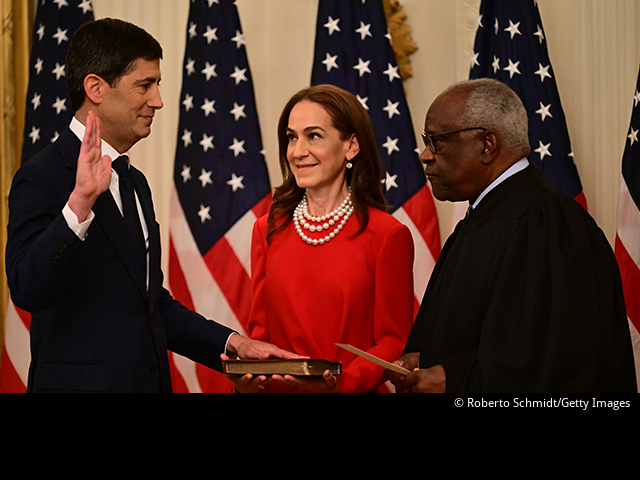
Supreme Court Justice Clarence Thomas administered the oath to Warsh in the East Room of the White House on Friday, May 22, 2026, marking only the second time in modern history that a Federal Reserve chairman has been sworn in at that location. The first was Alan Greenspan, who took his oath in 1987 under President Ronald Reagan.
Roberto Schmidt/Getty Images
Photo: Roberto Schmidt/Getty Images

The decision to hold the ceremony at the White House rather than the Federal Reserve’s headquarters sparked predictable criticism from establishment media outlets and commentators who have made questioning Fed independence a reflexive response to any Trump administration action. Critics suggested that the friendly atmosphere between the president and the new chairman—evidenced by handshakes and positive remarks—somehow threatened the institution’s autonomy.

This criticism reflects what can only be described as institutional bias. Similar objections would have greeted any Trump appointee regardless of venue or circumstance. The notion that a Federal Reserve chairman must be adversarial toward the sitting president to maintain credibility represents a fundamental misunderstanding of institutional function and reflects the broader politicization of the central bank.

Warsh struck a notably different tone from his predecessor. “I will lead a reform–oriented Federal Reserve, learning from past successes and mistakes, escaping static frameworks and models, and upholding clear standards of integrity and performance,” he stated from the podium in the East Room.

That commitment to escape “static frameworks and models” carries particular significance. For decades, Federal Reserve policy has been governed by economic theories that treat growth and tax reduction as inherently inflationary threats requiring monetary tightening. This orthodoxy has suppressed long-term growth estimates to dangerously low levels—only recently raising potential output growth estimates from 1.8 percent to 2 percent annually. Challenging this low-growth consensus could prove to be Warsh’s most consequential contribution to economic policy.

President Trump characterized his expectations for the new chairman in straightforward terms. “I want him to be totally independent. Just do a great job,” Trump said before the swearing-in ceremony. The president’s emphasis on independence rather than coordination underscores a commitment to institutional autonomy, despite media narratives suggesting otherwise.

Market Expectations and Monetary Policy Direction

Financial markets are currently pricing in a markedly different monetary policy trajectory than existed under previous leadership. Federal funds futures contracts show virtually no expectation of rate cuts throughout 2026, with traders forecasting one or two increases by year-end. Looking forward to summer 2027, market pricing reflects expectations for continued tightening.

The primary driver of this hawkish positioning centers on concerns about inflationary pressures emerging from artificial intelligence infrastructure buildout. Major Wall Street firms view the massive capital investments required for AI development and deployment as potentially overheating the economy and generating pricing pressures across sectors.

With information from Breitbart News
Share:
Stefanos Banos
Stefanos Banos

Stefanos Banos was born in Piraeus and is an editor at NewsFire.GR, specializing in political analysis and international relations. He graduated from the Department of Communication and Media at the University of Bremen in Germany, where he also completed his Master of Arts in Communication and Media Studies. Married to Zoi, he is a proud father of three boys.

Supreme Court Justice Clarence Thomas administered the oath to Warsh in the East Room of the White House on Friday, May 22, 2026, marking only the second time in modern history that a Federal Reserve chairman has been sworn in at that location. The first was Alan Greenspan, who took his oath in 1987 under President Ronald Reagan.

Roberto Schmidt/Getty Images
Photo: Roberto Schmidt/Getty Images

The decision to hold the ceremony at the White House rather than the Federal Reserve’s headquarters sparked predictable criticism from establishment media outlets and commentators who have made questioning Fed independence a reflexive response to any Trump administration action. Critics suggested that the friendly atmosphere between the president and the new chairman—evidenced by handshakes and positive remarks—somehow threatened the institution’s autonomy.

This criticism reflects what can only be described as institutional bias. Similar objections would have greeted any Trump appointee regardless of venue or circumstance. The notion that a Federal Reserve chairman must be adversarial toward the sitting president to maintain credibility represents a fundamental misunderstanding of institutional function and reflects the broader politicization of the central bank.

Warsh struck a notably different tone from his predecessor. “I will lead a reform–oriented Federal Reserve, learning from past successes and mistakes, escaping static frameworks and models, and upholding clear standards of integrity and performance,” he stated from the podium in the East Room.

That commitment to escape “static frameworks and models” carries particular significance. For decades, Federal Reserve policy has been governed by economic theories that treat growth and tax reduction as inherently inflationary threats requiring monetary tightening. This orthodoxy has suppressed long-term growth estimates to dangerously low levels—only recently raising potential output growth estimates from 1.8 percent to 2 percent annually. Challenging this low-growth consensus could prove to be Warsh’s most consequential contribution to economic policy.

President Trump characterized his expectations for the new chairman in straightforward terms. “I want him to be totally independent. Just do a great job,” Trump said before the swearing-in ceremony. The president’s emphasis on independence rather than coordination underscores a commitment to institutional autonomy, despite media narratives suggesting otherwise.

Market Expectations and Monetary Policy Direction

Financial markets are currently pricing in a markedly different monetary policy trajectory than existed under previous leadership. Federal funds futures contracts show virtually no expectation of rate cuts throughout 2026, with traders forecasting one or two increases by year-end. Looking forward to summer 2027, market pricing reflects expectations for continued tightening.

The primary driver of this hawkish positioning centers on concerns about inflationary pressures emerging from artificial intelligence infrastructure buildout. Major Wall Street firms view the massive capital investments required for AI development and deployment as potentially overheating the economy and generating pricing pressures across sectors.

With information from Breitbart News