
Traveling the Road That Led to Our National Identity
A new book reveals how George Washington's vision for the National Road, America's first federally funded highway begun in 1811, was essential to holding the young republic together by linking East and West.
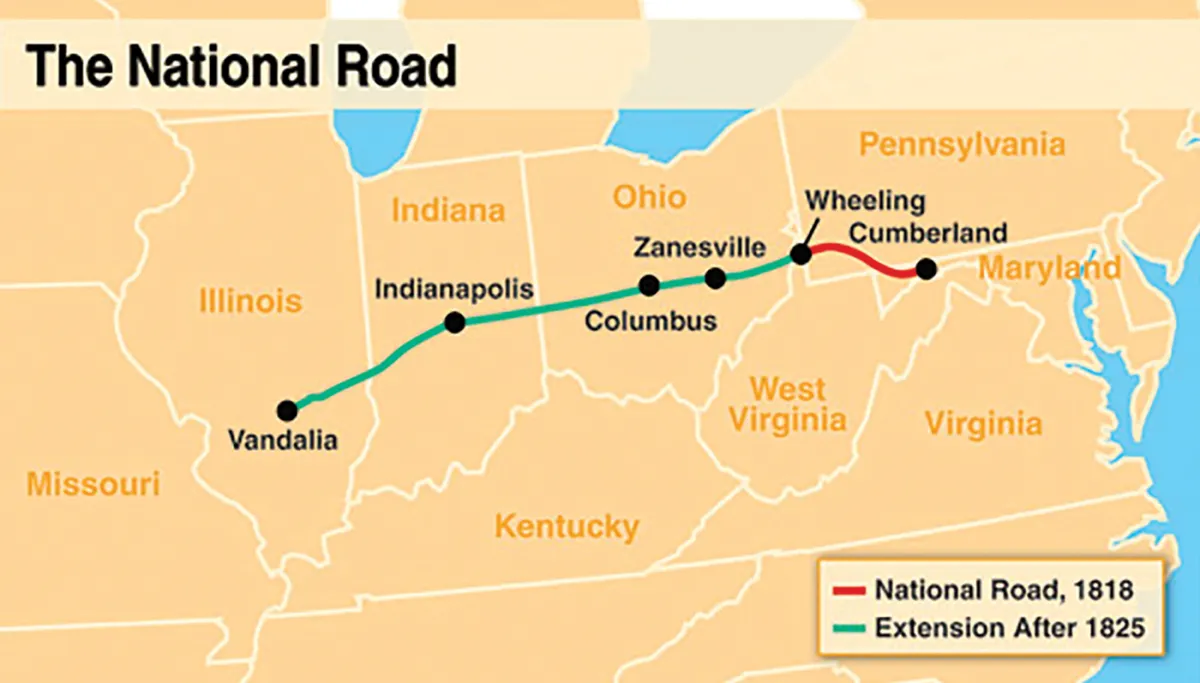

The National Road was more than a highway—it was the backbone of a young republic trying to hold itself together, and a new book reveals how George Washington’s vision for westward unity outlived him and shaped the nation’s destiny.
In a compelling analysis published by Washington Examiner, Carl Paulus examines how Brady J. Crytzer’s The National Road: George Washington and America’s First Highway West transforms our understanding of the nation’s first federally funded infrastructure project—and the statesmen who made it possible.
The National Road, authorized by Congress in 1806 and begun at Cumberland, Maryland, in 1811, eventually pushed west through the Appalachians and across much of what was then the American frontier. But as Paulus argues, this was never merely about transportation. It was about national survival.
Crytzer’s account reveals a republic that desperately needed this road—and the broader vision behind it—to maintain cohesion between East and West. The book presents surveyors pushing through forests, workers laying stone, and travelers in stagecoaches heading west with everything they owned, all part of the first example of interstate cooperation in American history.


Washington’s Unfinished Vision
For George Washington, the concept of linking the Potomac River to the Ohio River was a lifelong passion. Yet he died in 1799, seven years before Congress authorized the road that would fulfill his dream.
Paulus highlights how Crytzer reintroduces Washington not as the familiar general or president, but as the surveyor—the young man who walked the frontier, measured land, and understood with unusual clarity how the continent’s vast geography would shape the fate of the United States.
Washington’s vision was formed decades before his presidency, during his service in the French and Indian War when he surveyed territory and built the road for Braddock’s campaign. Whether serving Virginia, the British Empire, or the sovereign United States, Washington always reached the same conclusion: The future lay in the west, and the Ohio River was critical to controlling the North American continent.
From Military Strategy to National Unity
Washington saw the strategic value of western connection first as a major in the Virginia militia, then as a colonel, later as a speculator and entrepreneur. But in Washington’s mind, a national road was not about convenience and only partly for commerce. It was about cohesion in a new nation that had very little of it, particularly between East and West following the Whiskey Rebellion.
Paulus explains how Washington’s aim for the National Road was carried forward by two consequential figures of the early republic: Albert Gallatin, the Swiss-born treasury secretary who served under Presidents Thomas Jefferson and James Madison, and Henry Clay, the Kentucky statesman who won the House speakership in 1811 and spent the next four decades championing federally supported roads and canals.
Gallatin’s Critical Role
Gallatin, though not widely remembered by the general public today, emerges in Crytzer’s account as the figure who transformed Washington’s vision into reality. The immigrant from Geneva understood the problem clearly: Settlement without connection leads to isolation, and isolation to grievance. If the West could not move goods east, it would look elsewhere.
Binding the West to the union required more than rhetoric. It required roads, trade, and the steady movement of people and goods. Crytzer shows how Gallatin used the Treasury to keep the project moving when it might otherwise have stalled, translating Washington’s idea into fiscal reality.
Clay’s National Program
While Gallatin provided the financial framework, Clay extended the vision into a coherent national program. As speaker of the House for much of the period between 1811 and 1825, Clay occupied one of the most powerful positions in the federal government, and he used it to advance what became known as the American System—a comprehensive approach to internal improvements that would bind the nation together through infrastructure.
The book forces readers to reconsider the significance of landmarks not as tombstones to a dead past, but as living monuments to the ideas and struggles that forged the nation. The National Road represents the first interstate highway, the first project to unite East and West, and the original connection between the continent’s most vital watersheds.
Paulus’s examination reveals how infrastructure was never merely a technical matter for the founding generation—it was a question of national survival, unity, and the practical realization of constitutional union across a vast and expanding continent.
With information from Washington Examiner





