Necessary Cookies

Required for the site to function. Cannot be disabled.

Analytics Cookies

Help us understand how visitors interact with our site (Google Analytics via GTM).

Marketing Cookies

Used to track visitors and deliver personalised advertisements.

We use cookies to enhance your browsing experience and analyse site traffic. By clicking Accept All, you consent to our use of cookies. Privacy Policy
NewsFire Global
Home News Europe World Christianity Culture Wars Opinion Video
Information
About Us Authors Advertising Terms & Conditions Privacy Policy Contact
R2B Media
R2B NEWSFIRE.GR PAPAFOTIS.GR THRACTION HELLENIC CONSERVATIVES RIGHT2THEBONE YT
News World

Putin, Modi and Xi Unite Against US at Global Summit

China, Russia and India's leaders met in Kyrgyzstan for the Shanghai Cooperation Organization summit, a bloc challenging Western influence with ten member states including Iran and Belarus.
AUGUST 31, 2026 AT 10:56 PM

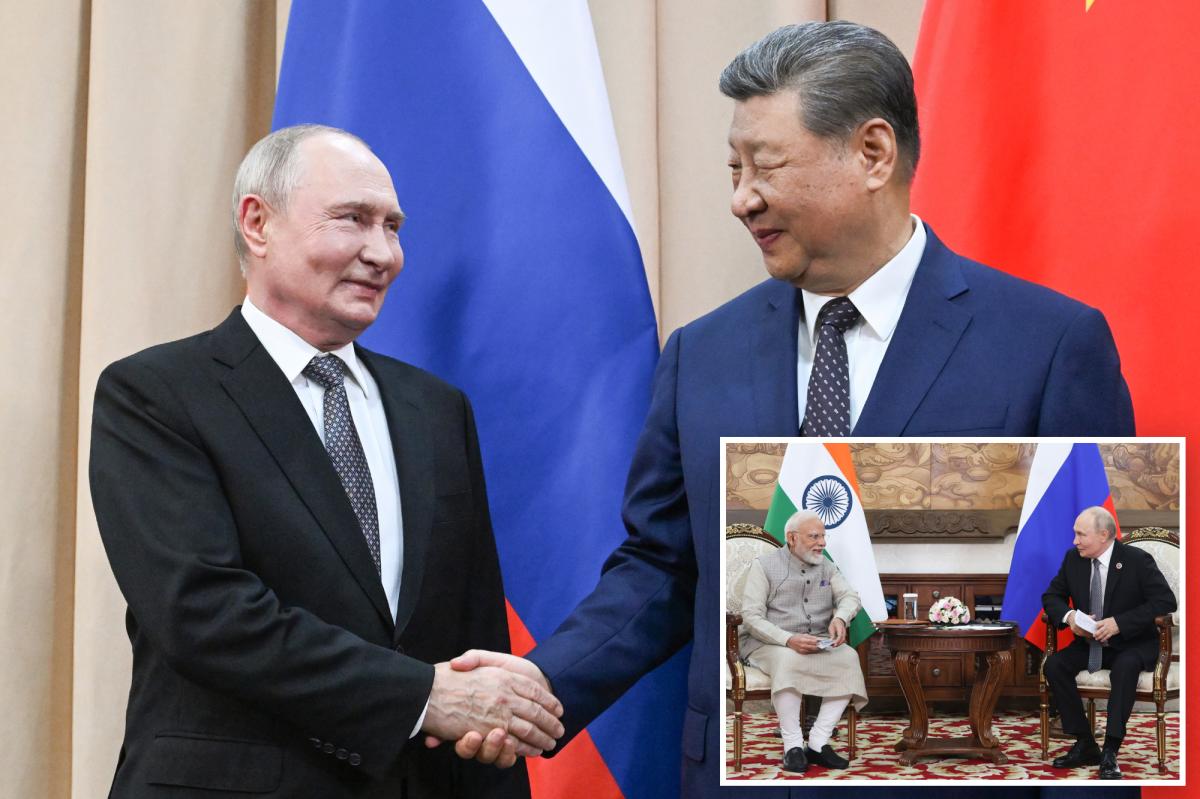
According to New York Post, Chinese President Xi Jinping, Russian President Vladimir Putin and Indian Prime Minister Narendra Modi are attending the gathering in Bishkek, the capital city, where multiple bilateral meetings are taking place alongside the main summit proceedings.

Putin and Xi held talks on the sidelines of the event, with the Russian leader affirming Moscow’s willingness to establish a permanent visa-free travel arrangement with China, Russian state media reported.

Further discussions are scheduled for Tuesday between Putin and Iranian President Masoud Pezeshkian, when the formal SCO sessions officially commence.

Summit Platform for Isolated Regimes

For Russia, now more than four and a half years into its full-scale military invasion of Ukraine, and Iran, six months into conflict with the United States and Israel, the summit represents a critical opportunity to deepen relationships with non-Western allies and partners.

The SCO was established in 2001 by China, Russia and four Central Asian republics as a security cooperation forum. Over the past quarter-century, the organization has expanded both its membership roster and geopolitical ambitions, though its actual objectives and operational programmes remain notably undefined and its public profile relatively limited.

The bloc currently comprises ten full member states: Russia, China, India, Iran, Pakistan, Belarus, Kazakhstan, Kyrgyzstan, Tajikistan and Uzbekistan. Numerous additional countries participate with “dialogue partner” status.

Beijing’s Vision for Alternative World Order

Alongside Russia, China has actively promoted the SCO as a counterbalance to Western-aligned institutions such as the G7. In recent years, Beijing has pushed to broaden the organization’s reach and authority, offering development aid and financial support to member states.

China’s Ministry of Foreign Affairs declared last week that the organization has successfully charted a new course for regional cooperation. Beijing has consistently championed the concept of an alternative global order, with Moscow’s backing.

Deep Divisions Among Member States

While the summit allows participating nations to demonstrate continued international engagement despite deteriorating relations with the West, the SCO is far from a cohesive political or military alliance. Analysts emphasize that member countries harbour substantial disagreements and pursue their own separate strategic interests.

For India specifically, experts suggest the gathering serves more as a symbolic exercise and strategic positioning tool than a venue for meaningful policy achievements. The forum is dominated by China and includes Pakistan among its members—both nations with which New Delhi maintains adversarial relationships.

Dinakar Peri, a fellow in security studies at Carnegie India, explained that the SCO provides India with representation in a region increasingly defined by great power rivalry, enabling the country to safeguard its interests, monitor evolving geopolitical dynamics and present itself as a credible regional actor.

The platform gives New Delhi direct insight into regional developments and allows it to balance its positions among competing powers, Peri noted.

Turkey Seeks Full Membership

Turkey, which maintains partner status within the SCO, is also leveraging the platform to enhance its regional standing. Ankara views potential SCO membership as part of a foreign policy strategy that seeks to preserve its traditional Western alliances through NATO while simultaneously expanding its influence across Eurasia.

President Recep Tayyip Erdogan, who brought Turkey into the organization as a dialogue partner in 2012, has repeatedly expressed his ambition for full membership. While Turkey enjoys substantial trade relations with the European Union under a 1995 customs agreement, its EU accession process has been stalled for over 25 years.

With information from New York Post
Share:
Eleni Papadaki-Van Der Merwe

She was born in 1986 in Johannesburg, South Africa. She is the granddaughter of an immigrant from Crete who settled in the Greek community of Johannesburg (one of the largest in Africa). She holds a bachelor’s degree in International Relations and Political Science from the University of the Witwatersrand (Wits) in Johannesburg and a master’s degree in Journalism from Rhodes University in Grahamstown. She began her career at English-language media outlets in Johannesburg, covering politics and economics, with a focus on issues related to migration and the diaspora. She moved to Athens in 2015 to “return to her roots,” initially to pursue graduate studies, and has remained there permanently. She is married to an Afrikaner; they have two children and live in the southern suburbs of Athens.

According to New York Post, Chinese President Xi Jinping, Russian President Vladimir Putin and Indian Prime Minister Narendra Modi are attending the gathering in Bishkek, the capital city, where multiple bilateral meetings are taking place alongside the main summit proceedings.

Putin and Xi held talks on the sidelines of the event, with the Russian leader affirming Moscow’s willingness to establish a permanent visa-free travel arrangement with China, Russian state media reported.

Further discussions are scheduled for Tuesday between Putin and Iranian President Masoud Pezeshkian, when the formal SCO sessions officially commence.

Summit Platform for Isolated Regimes

For Russia, now more than four and a half years into its full-scale military invasion of Ukraine, and Iran, six months into conflict with the United States and Israel, the summit represents a critical opportunity to deepen relationships with non-Western allies and partners.

The SCO was established in 2001 by China, Russia and four Central Asian republics as a security cooperation forum. Over the past quarter-century, the organization has expanded both its membership roster and geopolitical ambitions, though its actual objectives and operational programmes remain notably undefined and its public profile relatively limited.

The bloc currently comprises ten full member states: Russia, China, India, Iran, Pakistan, Belarus, Kazakhstan, Kyrgyzstan, Tajikistan and Uzbekistan. Numerous additional countries participate with “dialogue partner” status.

Beijing’s Vision for Alternative World Order

Alongside Russia, China has actively promoted the SCO as a counterbalance to Western-aligned institutions such as the G7. In recent years, Beijing has pushed to broaden the organization’s reach and authority, offering development aid and financial support to member states.

China’s Ministry of Foreign Affairs declared last week that the organization has successfully charted a new course for regional cooperation. Beijing has consistently championed the concept of an alternative global order, with Moscow’s backing.

Deep Divisions Among Member States

While the summit allows participating nations to demonstrate continued international engagement despite deteriorating relations with the West, the SCO is far from a cohesive political or military alliance. Analysts emphasize that member countries harbour substantial disagreements and pursue their own separate strategic interests.

For India specifically, experts suggest the gathering serves more as a symbolic exercise and strategic positioning tool than a venue for meaningful policy achievements. The forum is dominated by China and includes Pakistan among its members—both nations with which New Delhi maintains adversarial relationships.

Dinakar Peri, a fellow in security studies at Carnegie India, explained that the SCO provides India with representation in a region increasingly defined by great power rivalry, enabling the country to safeguard its interests, monitor evolving geopolitical dynamics and present itself as a credible regional actor.

The platform gives New Delhi direct insight into regional developments and allows it to balance its positions among competing powers, Peri noted.

Turkey Seeks Full Membership

Turkey, which maintains partner status within the SCO, is also leveraging the platform to enhance its regional standing. Ankara views potential SCO membership as part of a foreign policy strategy that seeks to preserve its traditional Western alliances through NATO while simultaneously expanding its influence across Eurasia.

President Recep Tayyip Erdogan, who brought Turkey into the organization as a dialogue partner in 2012, has repeatedly expressed his ambition for full membership. While Turkey enjoys substantial trade relations with the European Union under a 1995 customs agreement, its EU accession process has been stalled for over 25 years.

With information from New York Post