Marco Rubio Leads Quad Meeting in India to Counter China
Foreign ministers from the Quad met in New Delhi to announce new security and energy initiatives countering China's growing influence in the Indo-Pacific region.
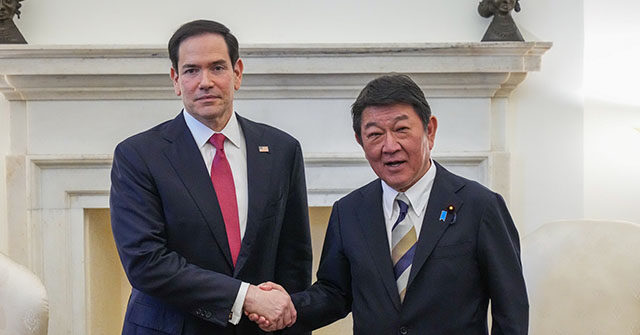


The Tuesday gathering in the Indian capital brought together U.S. Secretary of State Marco Rubio, Indian Foreign Minister Subrahmanyam Jaishankar, Japanese Foreign Minister Motegi Toshimitsu, and Australian Foreign Minister Penny Wong, according to Breitbart News.
Rubio characterized the United States as deeply invested in the partnership, describing the Quad as fundamental to America’s global strategic posture. He called on member states to move past discussion and toward concrete collective action on maritime security and critical mineral supplies.
From Disaster Relief to Security Alliance
The four nations first coordinated informally in 2004 to provide disaster relief following a devastating earthquake and tsunami in the Indian Ocean. The Quadrilateral Security Dialogue achieved formal status in 2007 but fell dormant within twelve months after Australia withdrew, fearful of antagonizing China. Beijing has maintained fierce opposition to the Quad since its inception, viewing it as a coalition arrayed against Chinese interests.
Chinese aggression in contested South China Sea territories prompted the Quad’s reactivation in 2017. Annual meetings commenced in 2019, with the first formal summit held in 2021. The 2025 summit was cancelled amid trade and tariff disputes between India and the United States.
Jaishankar described Tuesday’s discussions as highly valuable, echoing Rubio’s sentiment that the Quad’s obligations will expand in proportion to the Indo-Pacific region’s growing importance in international commerce.
Regional Economic Stress and Freedom of Navigation
Wong highlighted severe economic pressure facing the region due to Iran’s closure of the Strait of Hormuz, a vital energy corridor for India, Japan, and Australia. She emphasized the imperative of preserving freedom of navigation principles and rejecting any tolling schemes, aligning with President Donald Trump‘s position that Iran must not be permitted to extract payments from vessels transiting the international waterway.
There is great alignment between our interests, Wong stated, noting shared commitment to a free and open Indo-Pacific.
Japan Pushes Expanded Indo-Pacific Strategy
Motegi conducted bilateral discussions with both Rubio and Jaishankar alongside the multilateral Quad talks, Breitbart News reports. The Japanese foreign minister advocated for Japan and India to serve as the primary force safeguarding the free and open Indo-Pacific, citing geographic proximity to contested areas and aligned interests.
Japanese Prime Minister Takaichi Sanae recently announced revisions to Japan’s Free and Open Indo-Pacific initiative, shifting emphasis toward practical cooperation with allied nations rather than abstract appeals to international law, while seeking greater participation from Association of Southeast Asian Nations members.
Motegi has undertaken outreach to Global South nations in Africa and Asia to broaden Japan’s FOIP strategy. India has long positioned itself as a leading voice for the Global South, a loosely organized group of developing nations largely outside major economic blocs such as the Group of Seven.
The Japanese Foreign Ministry confirmed Motegi presented Japan’s FOIP proposals to Quad partners at the summit’s opening, receiving favorable reception for the framework.
The Japanese minister also urged Quad unity against North Korea’s illegal ballistic missile and weapons of mass destruction programs, as well as its malicious cyber operations.
Beijing Denounces Meeting Despite Diplomatic Language
The Quad’s joint statement avoided explicitly naming China, but Beijing nonetheless condemned the gathering. The communiqué expressed serious concern regarding situations in the East China Sea and South China Sea, including dangerous and coercive actions such as unsafe deployment of water cannons and flares—tactics Chinese vessels routinely employ against Philippine ships near disputed islands.
Chinese Foreign Ministry spokeswoman Mao Ning stated Tuesday that her government opposes the formation of exclusive groups or bloc confrontation, insisting that cooperation should not undermine regional trust and collaboration.
With information from Breitbart News