Necessary Cookies

Required for the site to function. Cannot be disabled.

Analytics Cookies

Help us understand how visitors interact with our site (Google Analytics via GTM).

Marketing Cookies

Used to track visitors and deliver personalised advertisements.

We use cookies to enhance your browsing experience and analyse site traffic. By clicking Accept All, you consent to our use of cookies. Privacy Policy
NewsFire Global
Home News Europe World Christianity Culture Wars Opinion Video
Information
About Us Authors Advertising Terms & Conditions Privacy Policy Contact
R2B Media
R2B NEWSFIRE.GR PAPAFOTIS.GR THRACTION HELLENIC CONSERVATIVES RIGHT2THEBONE YT
News Culture Wars

“Living in permanent ugliness debases us all”: When ugliness brings Beauty back to politics

A plan to replace France's National Assembly reception pavilion with glass and steel has sparked opposition over heritage concerns and its 50 million euro cost.
Stefanos Banos
Stefanos Banos Staff Writer
AUGUST 14, 2026 AT 3:52 PM

The project, dubbed “L’A-venir” (The Future), was initiated in 2023 when the National Assembly presidency launched an architectural competition to replace the current pavilion, deemed too cramped. The winning design was unveiled to the public in June 2025, according to Valeurs Actuelles.

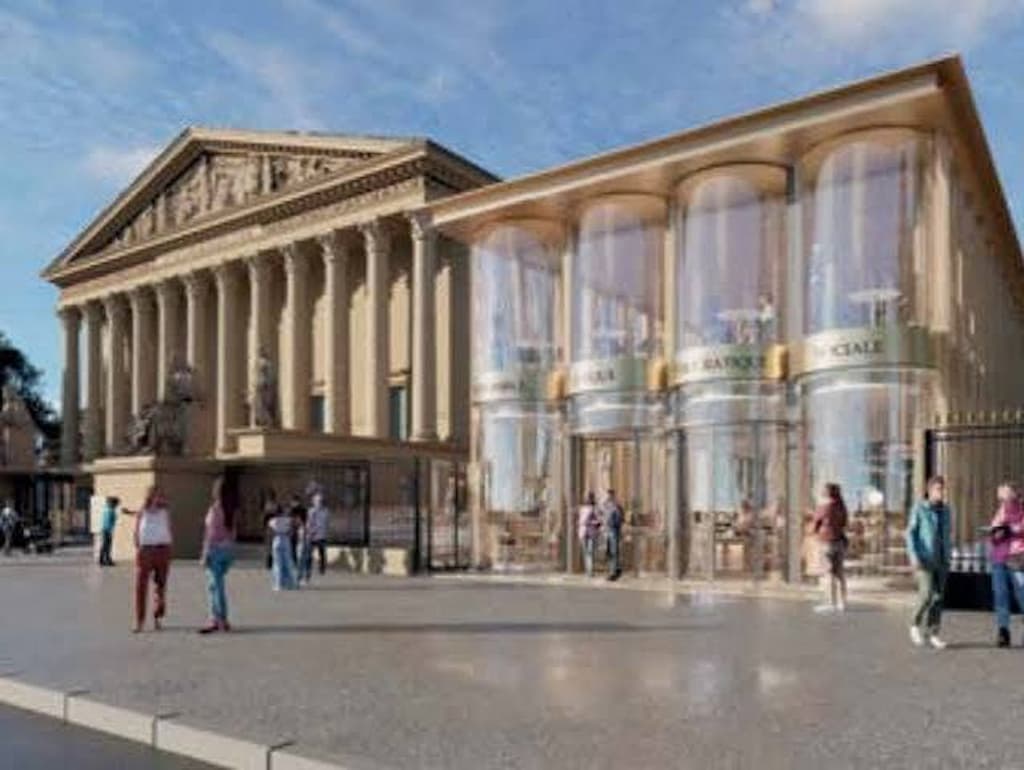
Under the proposal, the existing building dating from 1888 would be demolished and replaced with a structure featuring an additional floor housing a shop and restaurant with panoramic views of the Seine. The new facade would be constructed from glass and steel, with cylindrical forms intended to echo the columns of the Palais Bourbon.

Heritage Concerns and Legal Obstacles

Opposition to the project has coalesced around the heritage association Sites et Monuments, which launched a petition titled “No to the uglification of Paris by the National Assembly.” The organization, founded in 1901 and recognized as serving the public interest since 1936, has described the chosen design as possibly the worst of all submissions.

The association’s petition states that the 4,000 square meter structure would irreparably disfigure a monumental ensemble belonging to the nation’s history. The site holds dual protected status as part of the 7th arrondissement’s remarkable heritage site and the UNESCO World Heritage-listed Banks of the Seine.

Legal challenges have already forced modifications to the timeline. The project violates the Safeguarding and Enhancement Plan for the 7th arrondissement, leading to its suspension and withdrawal of the building permit application in February 2026.

Financial Controversy

The estimated cost of 50 million euros has drawn sharp criticism at a time when state finances are under severe strain. Critics argue the project is poorly conceived, excessively expensive, and above all, aesthetically objectionable.

Yaël Braun-Pivet, the National Assembly president, appears particularly committed to the project despite mounting opposition. However, critics contend that modern architecture policy has abandoned concern for beauty in favor of what Valeurs Actuelles characterizes as a politics of ugliness masked by a modernism that permits all manner of absurdities.

Architectural Harmony at Stake

The Old Paris Commission, in minutes from its plenary session on July 8, 2025, expressed regret over the damage the project would inflict on the perspective between the Palais Bourbon and the Church of the Madeleine, denouncing the rupture of the site’s total harmony.

Sites et Monuments argued that it would be unacceptable to damage the composition extending from Place de la Concorde, characterized by open, horizontal, and mineral space marked by strong symmetry, with perfect correspondence between the colonnades of the National Assembly and the Madeleine church. The association asserted this emblematic architectural ensemble currently suffers no false note.

The petition has attracted signatures from diverse public figures including rapper Joeystarr, former presidential candidate Ségolène Royal, Justice Minister Rachida Dati, National Rally deputy Sébastien Chenu, and European Parliament member Sarah Knafo.

Knafo responded on social media platform X, emphasizing that a city’s beauty is not merely ornamental but a condition for happy living, affecting morale, pride, and desire. Her intervention highlighted how beauty has been relegated to a secondary position in public debate and political action.

The controversy echoes broader concerns about “La France Moche” (Ugly France), a term describing the uniform sprawl of identical town entrances, parking lots, advertising billboards, and rendered housing developments that have proliferated across the country.

With information from Valeurs Actuelles

Share:
Stefanos Banos
Stefanos Banos

Stefanos Banos was born in Piraeus and is an editor at NewsFire.GR, specializing in political analysis and international relations. He graduated from the Department of Communication and Media at the University of Bremen in Germany, where he also completed his Master of Arts in Communication and Media Studies. Married to Zoi, he is a proud father of three boys.

The project, dubbed “L’A-venir” (The Future), was initiated in 2023 when the National Assembly presidency launched an architectural competition to replace the current pavilion, deemed too cramped. The winning design was unveiled to the public in June 2025, according to Valeurs Actuelles.

Under the proposal, the existing building dating from 1888 would be demolished and replaced with a structure featuring an additional floor housing a shop and restaurant with panoramic views of the Seine. The new facade would be constructed from glass and steel, with cylindrical forms intended to echo the columns of the Palais Bourbon.

Heritage Concerns and Legal Obstacles

Opposition to the project has coalesced around the heritage association Sites et Monuments, which launched a petition titled “No to the uglification of Paris by the National Assembly.” The organization, founded in 1901 and recognized as serving the public interest since 1936, has described the chosen design as possibly the worst of all submissions.

The association’s petition states that the 4,000 square meter structure would irreparably disfigure a monumental ensemble belonging to the nation’s history. The site holds dual protected status as part of the 7th arrondissement’s remarkable heritage site and the UNESCO World Heritage-listed Banks of the Seine.

Legal challenges have already forced modifications to the timeline. The project violates the Safeguarding and Enhancement Plan for the 7th arrondissement, leading to its suspension and withdrawal of the building permit application in February 2026.

Financial Controversy

The estimated cost of 50 million euros has drawn sharp criticism at a time when state finances are under severe strain. Critics argue the project is poorly conceived, excessively expensive, and above all, aesthetically objectionable.

Yaël Braun-Pivet, the National Assembly president, appears particularly committed to the project despite mounting opposition. However, critics contend that modern architecture policy has abandoned concern for beauty in favor of what Valeurs Actuelles characterizes as a politics of ugliness masked by a modernism that permits all manner of absurdities.

Architectural Harmony at Stake

The Old Paris Commission, in minutes from its plenary session on July 8, 2025, expressed regret over the damage the project would inflict on the perspective between the Palais Bourbon and the Church of the Madeleine, denouncing the rupture of the site’s total harmony.

Sites et Monuments argued that it would be unacceptable to damage the composition extending from Place de la Concorde, characterized by open, horizontal, and mineral space marked by strong symmetry, with perfect correspondence between the colonnades of the National Assembly and the Madeleine church. The association asserted this emblematic architectural ensemble currently suffers no false note.

The petition has attracted signatures from diverse public figures including rapper Joeystarr, former presidential candidate Ségolène Royal, Justice Minister Rachida Dati, National Rally deputy Sébastien Chenu, and European Parliament member Sarah Knafo.

Knafo responded on social media platform X, emphasizing that a city’s beauty is not merely ornamental but a condition for happy living, affecting morale, pride, and desire. Her intervention highlighted how beauty has been relegated to a secondary position in public debate and political action.

The controversy echoes broader concerns about “La France Moche” (Ugly France), a term describing the uniform sprawl of identical town entrances, parking lots, advertising billboards, and rendered housing developments that have proliferated across the country.

With information from Valeurs Actuelles

