
Iran’s President Seeks Exit as Terrorist IRGC Seizes Control
Iranian President Masoud Pezeshkian has reportedly resigned, citing the Revolutionary Guard Corps making his position untenable amid power struggles following Ali Khamenei's death.
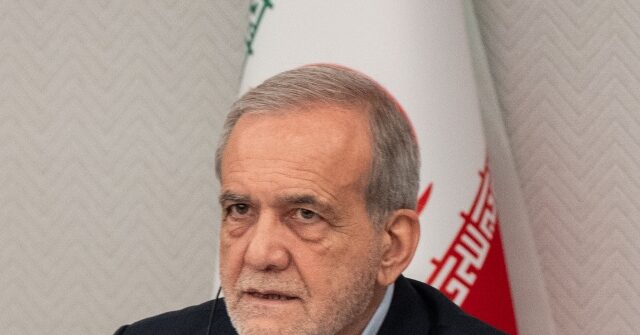

The independent outlet Iran International revealed on Sunday, citing anonymous sources, that Pezeshkian complained in his resignation letter that the terrorist Islamic Revolutionary Guard Corps had rendered his job impossible.
In the Iranian regime, the “supreme leader” functions as the country’s all-powerful dictator, maintaining a delicate balance between the IRGC—a formal military wing—and civilian leadership. Both the president and the IRGC answer directly to the “supreme leader.” Under longtime dictator Ali Khamenei, the IRGC frequently intervened in civilian matters, including seizing control of diplomatic initiatives with the approval of the “supreme leader.”
Since Ali Khamenei’s death in an American military operation on February 28, the power structure has remained murky. His son has made no public appearances, and no public evidence exists confirming he is actually running the country or capable of doing so. This vacuum has produced contradictory messaging from the Iranian regime, particularly between Pezeshkian and his cabinet versus military leadership. Most recently, Tasnim News, believed to maintain close IRGC ties, reported Monday that Tehran was ending negotiations with the United States, while Foreign Minister Abbas Araghchi denied this claim in the state-run Islamic Republic News Agency.
Before Monday’s conflicting reports on American talks emerged, Iran International indicated that Pezeshkian, heading the regime’s civilian wing, could soon leave office. A “source familiar” with the matter confirmed to the outlet that Pezeshkian had submitted his resignation letter and protested the IRGC’s disproportionate influence over his affairs.
According to the source, the Sunday letter emphasized that the president and government have been effectively shut out from major and vital decision-making processes in the country. The vacuum created by this exclusion has enabled hardline factions within the IRGC to seize control of national affairs, the source stated.
The president reportedly argued that the IRGC prevents him from running the government and fulfilling his legal responsibilities, prompting his request to step down immediately.
State Media Denial
IRNA, the state news agency, published comments Monday from Pezeshkian that appeared to deny the Iran International report without directly addressing it. Pezeshkian allegedly used a cabinet meeting Sunday to reiterate—for no apparent reason as presented—his desire to continue as president.
The state outlet reported that Pezeshkian reaffirmed his determination to serve the Iranian nation, emphasizing resistance and national solidarity. He also stated his life was not more valuable than that of the martyred leader Ali Khamenei, and stressed the need to remain present and manage problems honestly in the field while trusting in divine help.
IRNA ominously noted these remarks followed recent rumors reported by certain media outlets about the president’s resignation, indicating the comments came after Iran International’s publication.
Pezeshkian also posted a comment on his Twitter profile addressing unspecified hardships. He wrote that confronting major challenges without enduring hardships is impossible, and crossing this rugged and winding path requires public awareness and cooperation. He insisted on explaining existing realities to the people so all segments of society participate in solving problems.
Background on Pezeshkian
Pezeshkian became president in 2024 during the last sham election run by Ali Khamenei, organized to replace his predecessor Ebrahim Raisi, who died in a mysterious helicopter crash that year. Pezeshkian was presented as the “moderate” “reformist” candidate who publicly acknowledged that widespread protests responded to legitimate government failures—a tactic designed to relieve pressure on the regime by making protesters feel represented.
Once in office, however, Pezeshkian governed no differently than any other president and regurgitated the radical Islamist and violent viewpoints of the jihadist “supreme leader.”
Long-Standing Tensions
Tensions between civilian and military wings of the Iranian government have long plagued the regime. In 2021, Iran International published audio of then-Foreign Minister Mohammad Javad Zarif complaining that the IRGC was hijacking the country’s diplomacy. In that audio, Zarif particularly complained about the already deceased head of the IRGC Quds Force, Qasem Soleimani, who had used his position to undermine civilian diplomatic efforts.
With information from Breitbart News





