Necessary Cookies

Required for the site to function. Cannot be disabled.

Analytics Cookies

Help us understand how visitors interact with our site (Google Analytics via GTM).

Marketing Cookies

Used to track visitors and deliver personalised advertisements.

We use cookies to enhance your browsing experience and analyse site traffic. By clicking Accept All, you consent to our use of cookies. Privacy Policy
NewsFire Global
Home News Europe World Christianity Culture Wars Opinion Video
Information
About Us Authors Advertising Terms & Conditions Privacy Policy Contact
R2B Media
R2B NEWSFIRE.GR PAPAFOTIS.GR THRACTION HELLENIC CONSERVATIVES RIGHT2THEBONE YT
Opinion Europe

Greece lags far behind in long-term care beds. What does it mean?

Greece ranks last in the EU for long-term care beds with just 20 per 100,000 people despite having near-average hospital beds, causing patients to remain in costlier acute care unnecessarily.

JULY 22, 2026 AT 5:00 PM Updated: Jul 24, 2026 5:28 PM

Greece has one of the most striking imbalances in healthcare infrastructure across the European Union, according to data published by Eurostat just a few days ago.

While Greece runs close to the European average on hospital beds (acute care), it ranks dead last in the EU when it comes to long-term care beds.

The latter refers to beds in nursing and other long-stay institutions that provide accommodation alongside nursing, personal, and medical care to people with chronic illnesses, disabilities, or long-term dependence on help from others. A typical example would be nursing homes.

What the figures show

According to Eurostat, for 2024, the EU average is 507 hospital beds per 100,000 inhabitants. Greece comes in slightly below that, at 423 beds.

But the picture for long-term care beds is significantly different: Greece has just 20 beds per 100,000 inhabitants. That puts it in last place in the EU. For comparison, the Netherlands has 1,390, Sweden 1,298, and Belgium 1,249.

A particularly interesting contrast emerges here: countries such as Sweden, the Netherlands, and Denmark maintain far fewer hospital beds (acute care) than Greece, yet they rank among Europe’s leaders in long-term care beds. This is no accident. It is the result of a deliberate policy choice over many years: less prolonged hospitalisation and greater investment in long-term and community care structures.

The consequences

This imbalance is not merely of statistical or academic interest. The lack of long-term care beds has real-world consequences.

Patients who have completed the acute phase of their treatment remain trapped in an environment that does not offer them the appropriate rehabilitation or care. This leads to prolonged stays in hospital without any need for acute care.

As a rule, a hospital bed is considerably more expensive than a long-term care bed. Consequently, higher costs arise for the system.

Furthermore, this contributes to the blocking of acute care beds and, therefore, to greater pressure on Emergency Departments, delays in admissions, and, ultimately, delays in the provision of appropriate treatment in the appropriate setting.

In addition, prolonged hospital stays are associated with increased risk of hospital-acquired infections, muscular weakness, falls, and organic psychosyndrome, especially among the elderly.

Also, the lack of long-term care beds often results in families having to take on an extremely demanding task almost entirely on their own, without adequate support.

Moreover, the lack of the necessary number of long-term care beds makes timely rehabilitation after a serious health problem more difficult. This can determine whether the patient will return to relative independence or remain dependent. Consequently, the human and economic cost multiplies.

The demographic problem factor

At this point I would like to introduce into the discussion the factor of the demographic problem. Greece has one of the most aged populations in Europe. The median age in our country is approximately 47 years, versus 45 in the EU. Roughly one quarter of our population is over 65. In this context, the lack of adequate long-term care structures constitutes a structural weakness that will become increasingly felt in the years ahead.

Lessons from Europe

Countries that have invested systematically in long-term care structures have simultaneously achieved shorter average lengths of stay, better quality of life for patients, and better cost control. This is not a luxury. The rational organisation of the health system is a necessity.

Greece cannot continue to cover the gap mainly through hospitals and the prolonged stay of patients in acute care beds.

Finally, while our excellent tradition is compatible with care provided by the family, this is often neither sufficient nor feasible. And it is expected to worsen due to the demographic problem.

The discussion about the problem of inadequate long-term care in our country is imperative, and the recent Eurostat data remind us of this.

Yours,

Leonidas
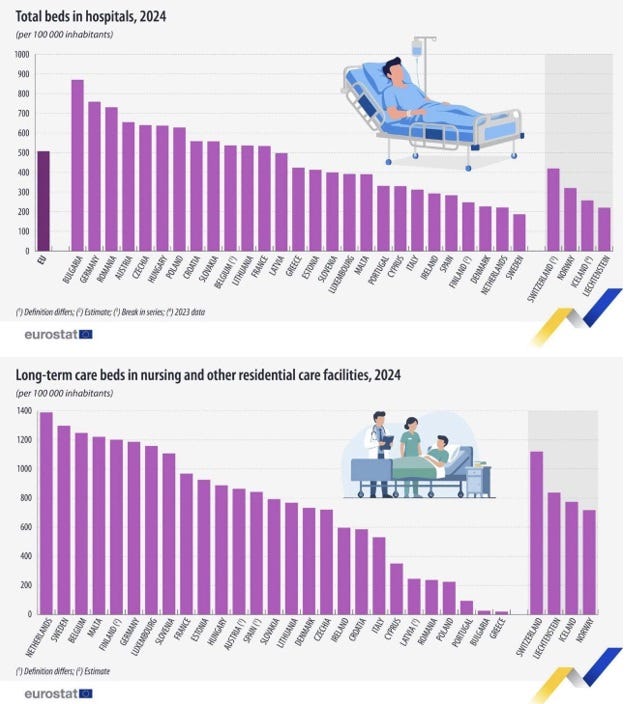
Eurostat data on the number of hospital beds and long-term care beds in EU countries


Eurostat data on the number of hospital beds and long-term care beds in EU countries
Share:
Leonidas Palaiodimos

He was born in 1985 in Agrinio and grew up in Panaitolio, with origins from Epirus. He studied at the Medical School of Aristotle University of Thessaloniki and the Hellenic Military Academy of Combat Support Officers, serving as a military doctor in the Hellenic Air Force from 2009 to 2015 in various units. Concurrently, he completed postgraduate studies with distinction in the pathological anatomy of cancer at the University of Athens. In 2015, he moved to New York for a specialization in internal medicine at Jacobi Medical Center / Albert Einstein College of Medicine, where he was awarded for outstanding performance and humanitarianism. Since 2018, he has worked as a hospital physician, assistant professor, and director of clinical research at institutions such as Montefiore Medical Center and the CUNY School of Medicine, receiving further awards for teaching and mentorship, and contributing to clinical research through publications.

Greece has one of the most striking imbalances in healthcare infrastructure across the European Union, according to data published by Eurostat just a few days ago.

While Greece runs close to the European average on hospital beds (acute care), it ranks dead last in the EU when it comes to long-term care beds.

The latter refers to beds in nursing and other long-stay institutions that provide accommodation alongside nursing, personal, and medical care to people with chronic illnesses, disabilities, or long-term dependence on help from others. A typical example would be nursing homes.

What the figures show

According to Eurostat, for 2024, the EU average is 507 hospital beds per 100,000 inhabitants. Greece comes in slightly below that, at 423 beds.

But the picture for long-term care beds is significantly different: Greece has just 20 beds per 100,000 inhabitants. That puts it in last place in the EU. For comparison, the Netherlands has 1,390, Sweden 1,298, and Belgium 1,249.

A particularly interesting contrast emerges here: countries such as Sweden, the Netherlands, and Denmark maintain far fewer hospital beds (acute care) than Greece, yet they rank among Europe’s leaders in long-term care beds. This is no accident. It is the result of a deliberate policy choice over many years: less prolonged hospitalisation and greater investment in long-term and community care structures.

The consequences

This imbalance is not merely of statistical or academic interest. The lack of long-term care beds has real-world consequences.

Patients who have completed the acute phase of their treatment remain trapped in an environment that does not offer them the appropriate rehabilitation or care. This leads to prolonged stays in hospital without any need for acute care.

As a rule, a hospital bed is considerably more expensive than a long-term care bed. Consequently, higher costs arise for the system.

Furthermore, this contributes to the blocking of acute care beds and, therefore, to greater pressure on Emergency Departments, delays in admissions, and, ultimately, delays in the provision of appropriate treatment in the appropriate setting.

In addition, prolonged hospital stays are associated with increased risk of hospital-acquired infections, muscular weakness, falls, and organic psychosyndrome, especially among the elderly.

Also, the lack of long-term care beds often results in families having to take on an extremely demanding task almost entirely on their own, without adequate support.

Moreover, the lack of the necessary number of long-term care beds makes timely rehabilitation after a serious health problem more difficult. This can determine whether the patient will return to relative independence or remain dependent. Consequently, the human and economic cost multiplies.

The demographic problem factor

At this point I would like to introduce into the discussion the factor of the demographic problem. Greece has one of the most aged populations in Europe. The median age in our country is approximately 47 years, versus 45 in the EU. Roughly one quarter of our population is over 65. In this context, the lack of adequate long-term care structures constitutes a structural weakness that will become increasingly felt in the years ahead.

Lessons from Europe

Countries that have invested systematically in long-term care structures have simultaneously achieved shorter average lengths of stay, better quality of life for patients, and better cost control. This is not a luxury. The rational organisation of the health system is a necessity.

Greece cannot continue to cover the gap mainly through hospitals and the prolonged stay of patients in acute care beds.

Finally, while our excellent tradition is compatible with care provided by the family, this is often neither sufficient nor feasible. And it is expected to worsen due to the demographic problem.

The discussion about the problem of inadequate long-term care in our country is imperative, and the recent Eurostat data remind us of this.

Yours,

Leonidas

Eurostat data on the number of hospital beds and long-term care beds in EU countries


Eurostat data on the number of hospital beds and long-term care beds in EU countries