Necessary Cookies

Required for the site to function. Cannot be disabled.

Analytics Cookies

Help us understand how visitors interact with our site (Google Analytics via GTM).

Marketing Cookies

Used to track visitors and deliver personalised advertisements.

We use cookies to enhance your browsing experience and analyse site traffic. By clicking Accept All, you consent to our use of cookies. Privacy Policy
NewsFire Global
Home News Europe World Christianity Culture Wars Opinion
Information
About Us Authors Advertising Terms & Conditions Privacy Policy Contact
R2B Media
R2B NEWSFIRE.GR PAPAFOTIS.GR THRACTION HELLENIC CONSERVATIVES RIGHT2THEBONE YT
News Culture Wars

Google CEO to Grads: You’ll Have to Deal with AI Impact

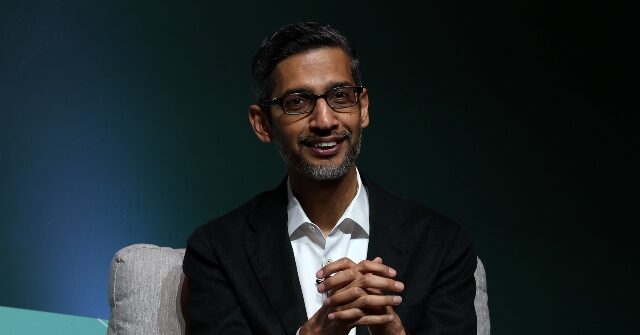
Google CEO Sundar Pichai faces potential hostility from Stanford graduates at next month's commencement amid growing student anxiety over AI's impact on employment prospects.
Stefanos Banos
Stefanos Banos Staff Writer
MAY 25, 2026 AT 8:05 PM

According to Breitbart News, technology executives are encountering an unexpected challenge at college graduation ceremonies across the United States. Students concerned about their career futures in an AI-dominated economy have begun openly voicing their disapproval during commencement speeches, forcing tech leaders to develop what observers describe as a defensive “boo strategy.”

Tech executives face graduate backlash

Recent graduation ceremonies have witnessed graduates heckling prominent technology executives who delivered optimistic messages about artificial intelligence. Former Google CEO and Democratic Party mega donor Eric Schmidt faced boos from students at the University of Arizona, while Scott Borchetta, CEO of Big Machine Records, experienced similar pushback at Middle Tennessee State University after discussing AI’s transformative effects on the music and media industries.

The commencement speech at Stanford University represents a significant test for Pichai, who leads one of the world’s foremost companies developing AI technology. Many soon-to-be graduates view the industry with concern, fearing AI systems could eliminate the very careers they have spent years preparing to enter.

Pichai emphasizes optimism despite concerns

During a recent interview on the technology podcast Hard Fork, Pichai emphasized optimism and experience-sharing rather than defensive positioning. The Google chief executive told the podcast hosts that he remains extraordinarily optimistic about the next generation, insisting that AI does not diminish that outlook.

Pichai acknowledged the dual role today’s graduates will occupy in the AI transformation, noting that these graduates are actually both going to be a big part of driving that progress and also dealing with the impact of artificial intelligence’s expanding influence across multiple industries.

Stanford may offer friendlier terrain

Stanford University may prove more receptive territory for Pichai’s message than other institutions. Located at the epicenter of Silicon Valley, the university hosts some of the nation’s most prominent AI courses and maintains deep institutional connections to the technology industry. However, broader public sentiment toward AI remains cautious at best, according to recent polling data.

Breitbart News recently reported that only 18 percent of young people express hope about artificial intelligence, according to a Gallup poll. An Economist and YouGov poll released this week showed that over 70 percent of Americans believe AI is advancing too quickly. The concern spans partisan lines, with 68 percent of Republicans and 77 percent of Democrats expressing that the technology is moving too fast. Additional YouGov polling demonstrates that negative views of AI have risen from 34 percent three years ago to just over 50 percent currently.

Widespread concerns over job displacement

The backlash against AI among young people has become increasingly evident as commencement speakers who mention the technology positively have been booed at universities including the University of Central Florida and Arizona State University.

Public concerns center on several key issues: widespread job displacement, increased electricity costs, environmental damage, and fears that AI will primarily benefit wealthy individuals and corporations rather than ordinary workers. Despite these widespread concerns, many AI executives appear either unaware of or unconcerned by the growing opposition to the technology’s rapid deployment.

Artificial intelligence has emerged as an increasingly divisive topic, particularly among America’s youth who face the prospect of entering a job market transformed by automation and machine learning systems.

With information from Breitbart News

Share:
Stefanos Banos
Stefanos Banos

Stefanos Banos was born in Piraeus and is an editor at NewsFire.GR, specializing in political analysis and international relations. He graduated from the Department of Communication and Media at the University of Bremen in Germany, where he also completed his Master of Arts in Communication and Media Studies. Married to Zoi, he is a proud father of three boys.

According to Breitbart News, technology executives are encountering an unexpected challenge at college graduation ceremonies across the United States. Students concerned about their career futures in an AI-dominated economy have begun openly voicing their disapproval during commencement speeches, forcing tech leaders to develop what observers describe as a defensive “boo strategy.”

Tech executives face graduate backlash

Recent graduation ceremonies have witnessed graduates heckling prominent technology executives who delivered optimistic messages about artificial intelligence. Former Google CEO and Democratic Party mega donor Eric Schmidt faced boos from students at the University of Arizona, while Scott Borchetta, CEO of Big Machine Records, experienced similar pushback at Middle Tennessee State University after discussing AI’s transformative effects on the music and media industries.

The commencement speech at Stanford University represents a significant test for Pichai, who leads one of the world’s foremost companies developing AI technology. Many soon-to-be graduates view the industry with concern, fearing AI systems could eliminate the very careers they have spent years preparing to enter.

Pichai emphasizes optimism despite concerns

During a recent interview on the technology podcast Hard Fork, Pichai emphasized optimism and experience-sharing rather than defensive positioning. The Google chief executive told the podcast hosts that he remains extraordinarily optimistic about the next generation, insisting that AI does not diminish that outlook.

Pichai acknowledged the dual role today’s graduates will occupy in the AI transformation, noting that these graduates are actually both going to be a big part of driving that progress and also dealing with the impact of artificial intelligence’s expanding influence across multiple industries.

Stanford may offer friendlier terrain

Stanford University may prove more receptive territory for Pichai’s message than other institutions. Located at the epicenter of Silicon Valley, the university hosts some of the nation’s most prominent AI courses and maintains deep institutional connections to the technology industry. However, broader public sentiment toward AI remains cautious at best, according to recent polling data.

Breitbart News recently reported that only 18 percent of young people express hope about artificial intelligence, according to a Gallup poll. An Economist and YouGov poll released this week showed that over 70 percent of Americans believe AI is advancing too quickly. The concern spans partisan lines, with 68 percent of Republicans and 77 percent of Democrats expressing that the technology is moving too fast. Additional YouGov polling demonstrates that negative views of AI have risen from 34 percent three years ago to just over 50 percent currently.

Widespread concerns over job displacement

The backlash against AI among young people has become increasingly evident as commencement speakers who mention the technology positively have been booed at universities including the University of Central Florida and Arizona State University.

Public concerns center on several key issues: widespread job displacement, increased electricity costs, environmental damage, and fears that AI will primarily benefit wealthy individuals and corporations rather than ordinary workers. Despite these widespread concerns, many AI executives appear either unaware of or unconcerned by the growing opposition to the technology’s rapid deployment.

Artificial intelligence has emerged as an increasingly divisive topic, particularly among America’s youth who face the prospect of entering a job market transformed by automation and machine learning systems.

With information from Breitbart News

