
Clarence Thomas blasts left’s claim blacks can’t be conservative
Supreme Court Justice Clarence Thomas rejected expectations that black Americans must adopt liberal views, telling Senator Ted Cruz he was called "confused" for his conservative beliefs.
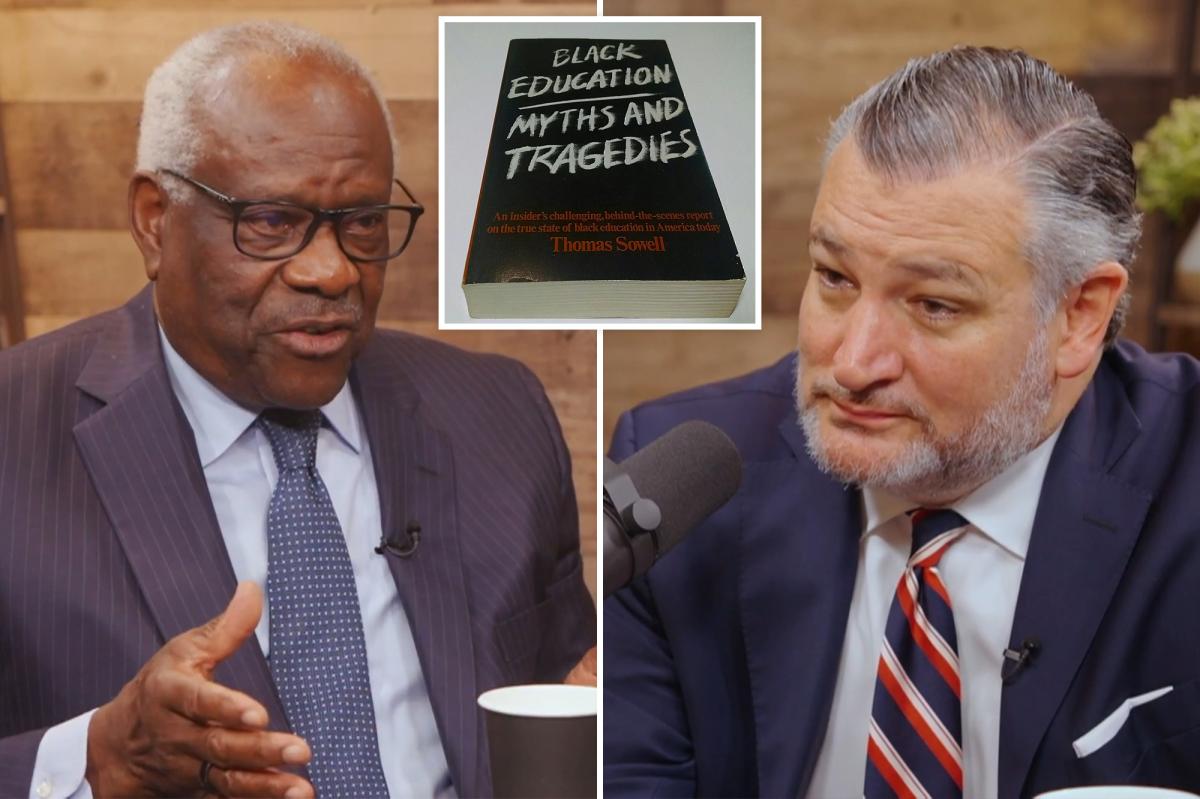

In a podcast interview with Senator Ted Cruz (R-Texas), the 78-year-old jurist—the second-longest-serving justice in Supreme Court history—opened up about resisting social and political pressure throughout his career as one of the nation’s most prominent black conservative figures, according to Ryan King writing in New York Post.
Thomas, who serves as the second black justice ever appointed to the Supreme Court, spoke candidly about the expectation that he should adopt particular political views based solely on his race.
“When I came to this town, one of the greatest difficulties, if you think about it, was that there were those who thought that I should think a certain way,” Thomas said on the “Verdict with Ted Cruz” podcast released Monday.
He recounted being told he was “confused” for holding conservative beliefs, rejecting such characterizations outright. The justice noted critics operated from a deterministic view that you’re supposed to think this because we say so, based on skin color rather than individual conviction.
Cruz Defends Thomas Legacy
The interview coincided with Cruz’s Tuesday book release event for “Going Further: The Incomparable Clarence Thomas.” The Texas senator, who previously served as Solicitor General of Texas and argued cases before the Supreme Court in the early 2000s, compiled the book after conducting approximately nine hours of one-on-one interviews with Thomas.
During their conversation, Thomas praised Cruz and Senator Mike Lee (R-Utah) as “friends” who defended him and his wife Ginni Thomas against attacks in recent years over her ties to conservative organizations and gifts the justice received from wealthy donors.
Faith and Family Shaped Conservative Worldview
Thomas credited his grandfather as a formative influence on his political philosophy. He recalled his grandfather—who had no formal education and was raised by a freed slave—challenging him during arguments about America’s shortcomings by asking what country was superior. Thomas admitted being unable to provide an answer.
After his grandparents died suddenly in 1983, the justice made a conscious decision to live the remainder of his life as a memorial to theirs, honoring their legacy of perseverance without complaint despite facing far greater hardships.
The Road to Damascus Moment
Cruz described the young Thomas as a “left-wing radical” who attended an anti-war demonstration at Harvard Square in April 1970 that descended into violent rioting. At the time, Thomas was a student at the College of the Holy Cross and had become disillusioned with the Catholic Church over what he perceived as insufficient moral clarity on racism.
The riot, however, marked a pivotal turning point in Thomas’s ideological journey.
“I think that was the Road to Damascus moment. That’s the moment where you look into the abyss, and it looks back,” Thomas explained, noting he couldn’t articulate why he had been participating in such behavior.
Exhausted but unable to sleep after the demonstration, Thomas found himself in front of the campus chapel. He prayed before the Blessed Sacrament, asking God to remove hatred from his heart and vowing never to hate again if his prayer was answered.
“And that was the moment for me, when I began to move in a more positive direction,” the justice recalled.
Thomas also described initially rejecting a copy of conservative intellectual Thomas Sowell’s book “Black Education: Myths and Tragedies” while in law school, only to later rediscover and embrace its arguments—a shift emblematic of his broader ideological transformation from radical leftist to conservative constitutionalist.
With information from New York Post





