Necessary Cookies

Required for the site to function. Cannot be disabled.

Analytics Cookies

Help us understand how visitors interact with our site (Google Analytics via GTM).

Marketing Cookies

Used to track visitors and deliver personalised advertisements.

We use cookies to enhance your browsing experience and analyse site traffic. By clicking Accept All, you consent to our use of cookies. Privacy Policy
NewsFire Global
Home News Europe World Christianity Culture Wars Opinion Video
Information
About Us Authors Advertising Terms & Conditions Privacy Policy Contact
R2B Media
R2B NEWSFIRE.GR PAPAFOTIS.GR THRACTION HELLENIC CONSERVATIVES RIGHT2THEBONE YT
News Europe

CDU faces potential extinction in East Germany after election result

The AfD nearly secured an absolute majority in Saxony-Anhalt while the CDU's support collapsed from 36 to 18 percent after Minister-President Schulze's leftward shift alienated the party base.

Dimitris Papafotis
Dimitris Papafotis Editor in Chief
SEPTEMBER 6, 2026 AT 10:49 PM

A historic electoral earthquake has rocked Saxony-Anhalt, leaving the regional CDU in ruins and raising existential questions about the party’s future in eastern Germany, as the AfD stands on the brink of an absolute majority.

Regardless of whether the AfD ultimately secures an absolute majority, this election has already entered the history books. Voters could not have expressed their distrust of the establishment parties more clearly, according to Florian Morsch writing in Nius.

Despite the AfD missing only a handful of votes needed for an outright majority, Minister-President Sven Schulze of the CDU has already claimed to see a mandate to govern. For the Christian Democrats, the result represents a worst-case scenario. Initial projections show the party’s support has been cut in half—plummeting from 36 percent in the 2021 election to just 18 percent. Schulze has underperformed even the most pessimistic forecasts, standing amid the wreckage of a catastrophic campaign.
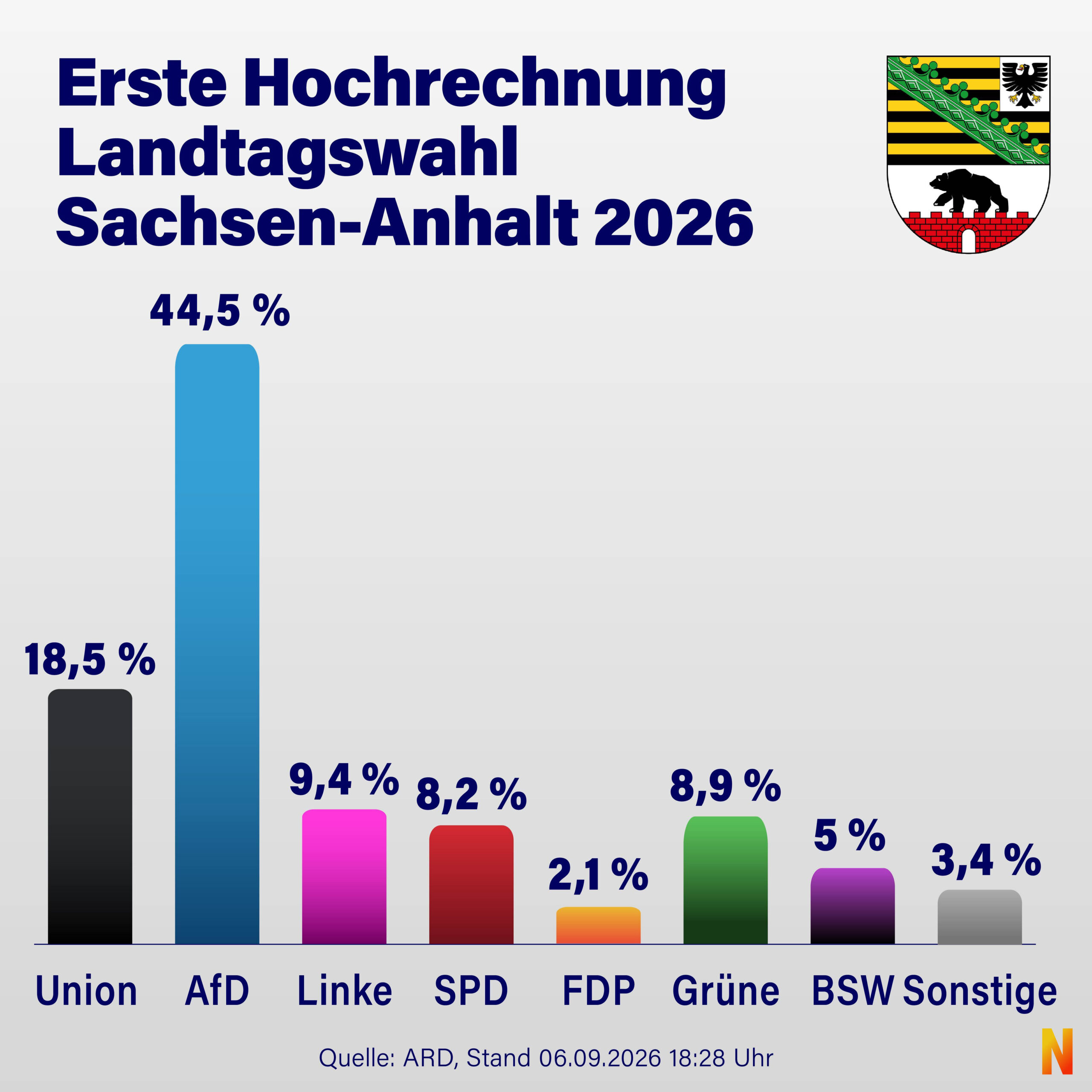
Die erste Hochrechnung zur Wahl in Sachsen-Anhalt
Photo: nius.de

A Sharp Left Turn That Alienated the Base

Schulze had charted a clear leftward course and recently even questioned the incompatibility resolution that prohibits cooperation with the Left Party. Both segments of the Union’s parliamentary group and parts of the party base had announced they would under no circumstances work with the Left Party after the election.

In the weeks leading up to the vote, warnings against collaboration with the Left Party came fast and furious from within CDU ranks. In an open letter, two former CDU heavyweights from Saxony-Anhalt—former Minister-President Dr. Gerd Gies and former Transport Minister Karl-Heinz Daehre—urgently cautioned against any potential cooperation with the Left Party. Toleration by the Left threatened to “tear the CDU apart,” they warned. Entire local associations could withdraw membership, particularly “in many places in the East, where memories of the communist dictatorship are still fresh.” The party would sink “into irrelevance,” they predicted.

Grassroots Revolt Against Red-Red Cooperation

A resolution proposal from the CDU district association in Harz categorically ruled out a state government dependent on the Left. The document rejected any government or toleration arrangement in which the CDU would rely on Left Party votes. The district association rejected “all exploratory, coalition, or toleration models” in which a CDU government, budget, or initiatives could only be implemented with the approval of the Left Party. However, CDU lead candidate Sven Schulze distanced himself from the paper, stating it had neither been officially adopted nor would serve as a basis for upcoming consultations.

Focus magazine additionally reported from internal sources that if a government were only possible through Left Party toleration, between six and twelve CDU delegates could threaten to leave and form their own faction.

The CDU’s Eastern Future Hangs in the Balance

Should portions of Union delegates announce their departure due to cooperation with the Left Party, it could mark only the beginning of a massive wave of resignations across all eastern CDU regional branches. The entire existence of the CDU in the East now hangs in the balance, Morsch argues. The party faces a fundamental choice between ideological compromise and organizational survival—a dilemma entirely of its own making after years of drifting leftward alienated its conservative base in the former East Germany.

The results deliver a devastating verdict on the establishment’s handling of voter concerns and underscore the depth of political realignment underway in eastern German states, where traditional party loyalties have collapsed in the face of dissatisfaction with mainstream politics.

With information from Nius

Share:
Dimitris Papafotis
Dimitris Papafotis

Dimitris Papafotis is the editor-in-chief of NewsFire.GR. He was born and raised in Athens. He studied at the Journalism Workshop (1991-1993). He currently lives in Pyrgos, Ilia, where he has been active in radio and various newspapers, while also maintaining his personal blog, Papafotis.gr.

Recent News

A historic electoral earthquake has rocked Saxony-Anhalt, leaving the regional CDU in ruins and raising existential questions about the party’s future in eastern Germany, as the AfD stands on the brink of an absolute majority.

Regardless of whether the AfD ultimately secures an absolute majority, this election has already entered the history books. Voters could not have expressed their distrust of the establishment parties more clearly, according to Florian Morsch writing in Nius.

Despite the AfD missing only a handful of votes needed for an outright majority, Minister-President Sven Schulze of the CDU has already claimed to see a mandate to govern. For the Christian Democrats, the result represents a worst-case scenario. Initial projections show the party’s support has been cut in half—plummeting from 36 percent in the 2021 election to just 18 percent. Schulze has underperformed even the most pessimistic forecasts, standing amid the wreckage of a catastrophic campaign.

Die erste Hochrechnung zur Wahl in Sachsen-Anhalt
Photo: nius.de

A Sharp Left Turn That Alienated the Base

Schulze had charted a clear leftward course and recently even questioned the incompatibility resolution that prohibits cooperation with the Left Party. Both segments of the Union’s parliamentary group and parts of the party base had announced they would under no circumstances work with the Left Party after the election.

In the weeks leading up to the vote, warnings against collaboration with the Left Party came fast and furious from within CDU ranks. In an open letter, two former CDU heavyweights from Saxony-Anhalt—former Minister-President Dr. Gerd Gies and former Transport Minister Karl-Heinz Daehre—urgently cautioned against any potential cooperation with the Left Party. Toleration by the Left threatened to “tear the CDU apart,” they warned. Entire local associations could withdraw membership, particularly “in many places in the East, where memories of the communist dictatorship are still fresh.” The party would sink “into irrelevance,” they predicted.

Grassroots Revolt Against Red-Red Cooperation

A resolution proposal from the CDU district association in Harz categorically ruled out a state government dependent on the Left. The document rejected any government or toleration arrangement in which the CDU would rely on Left Party votes. The district association rejected “all exploratory, coalition, or toleration models” in which a CDU government, budget, or initiatives could only be implemented with the approval of the Left Party. However, CDU lead candidate Sven Schulze distanced himself from the paper, stating it had neither been officially adopted nor would serve as a basis for upcoming consultations.

Focus magazine additionally reported from internal sources that if a government were only possible through Left Party toleration, between six and twelve CDU delegates could threaten to leave and form their own faction.

The CDU’s Eastern Future Hangs in the Balance

Should portions of Union delegates announce their departure due to cooperation with the Left Party, it could mark only the beginning of a massive wave of resignations across all eastern CDU regional branches. The entire existence of the CDU in the East now hangs in the balance, Morsch argues. The party faces a fundamental choice between ideological compromise and organizational survival—a dilemma entirely of its own making after years of drifting leftward alienated its conservative base in the former East Germany.

The results deliver a devastating verdict on the establishment’s handling of voter concerns and underscore the depth of political realignment underway in eastern German states, where traditional party loyalties have collapsed in the face of dissatisfaction with mainstream politics.

With information from Nius