Necessary Cookies

Required for the site to function. Cannot be disabled.

Analytics Cookies

Help us understand how visitors interact with our site (Google Analytics via GTM).

Marketing Cookies

Used to track visitors and deliver personalised advertisements.

We use cookies to enhance your browsing experience and analyse site traffic. By clicking Accept All, you consent to our use of cookies. Privacy Policy
NewsFire Global
Home News Europe World Christianity Culture Wars Opinion Video
Information
About Us Authors Advertising Terms & Conditions Privacy Policy Contact
R2B Media
R2B NEWSFIRE.GR PAPAFOTIS.GR THRACTION HELLENIC CONSERVATIVES RIGHT2THEBONE YT
News World

Hegseth Pushes Record Defense Spending to Shield US Growth

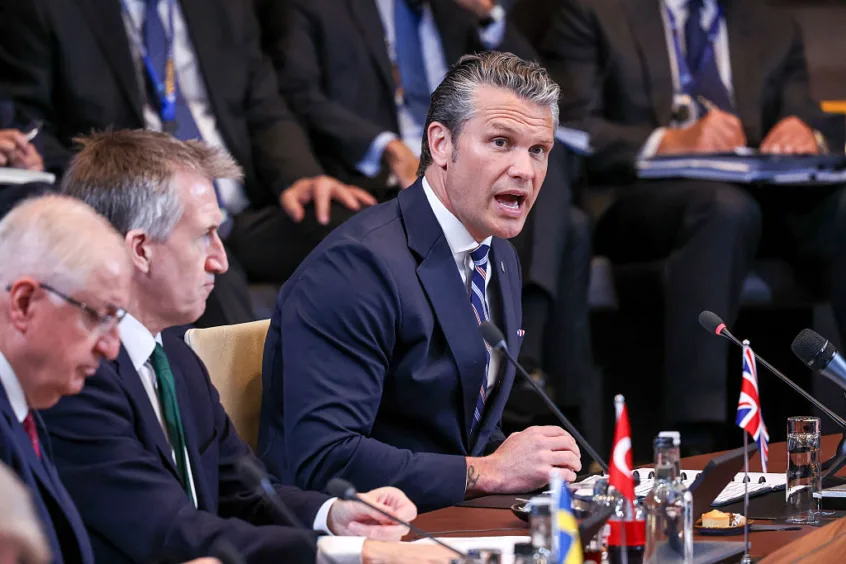
US Defence Secretary Pete Hegseth has called for a record $1.5 trillion defence budget while warning NATO allies they must meet spending commitments or face reduced American support.

Dimitris Papafotis
Dimitris Papafotis Editor in Chief
JUNE 24, 2026 AT 2:38 PM
brusselssignal.eu
Photo: brusselssignal.eu

In a forceful opinion piece published in the New York Post on June 23, Hegseth contended that the greatest danger to national security is inadequate military funding, not the expanding national debt. He warned that if America loses its military superiority, no degree of budget-cutting could preserve economic vitality.

The remarks serve as a defence of President Donald Trump’s proposed 2027 defence budget of $1.5 trillion (€1.32 trillion), the highest in American history and roughly 42 per cent higher than current spending levels. The proposal has met resistance from fiscal conservatives and non-interventionist lawmakers, prompting Hegseth to personally lobby Congress for support.

Hegseth emphasized that the Pentagon, which was renamed the Department of War in 2025, has eliminated billions of dollars in wasteful expenditures through an internal audit. He announced the department would complete its first comprehensive financial audit by 2028, ahead of schedule, having never previously achieved one.

European allies put on notice

The defence secretary’s domestic push mirrors his hardline stance toward European NATO members. On June 18 at NATO headquarters in Brussels, Hegseth ordered a six-month assessment of US forces stationed in Europe and warned that American military contributions would decline unless member states fulfill agreed spending commitments.

NATO leaders committed at The Hague in June 2025 to spend 5 per cent of GDP on defence by 2035, with 3.5 per cent dedicated to core military capabilities. Member states are expected to present credible roadmaps at an upcoming summit in Ankara, Turkey, starting July 7.

Hegseth has repeatedly criticized European governments for depending on American military power while chronically underfunding their own armed forces. Spain, which negotiated an exemption from the 5 per cent target, has drawn particular skepticism from other allies regarding its ability to meet alternative obligations.

Military strength as economic foundation

In his article, Hegseth framed military dominance as essential to American economic health, arguing that an unchallenged United States can borrow at favorable rates and dictate global trade conditions. He identified urgency, speed, efficiency, competition, and lethality as the core principles now guiding the renamed Department of War.

The secretary’s position represents a sharp break from conventional budget concerns, prioritizing strategic competition with China and other rivals over deficit reduction. His argument underscores the administration’s view that military rearmament is not merely a security imperative but an economic one.

With information from Brussels Signal

Share:
Dimitris Papafotis
Dimitris Papafotis

Dimitris Papafotis is the editor-in-chief of NewsFire.GR. He was born and raised in Athens. He studied at the Journalism Workshop (1991-1993). He currently lives in Pyrgos, Ilia, where he has been active in radio and various newspapers, while also maintaining his personal blog, Papafotis.gr.

brusselssignal.eu
Photo: brusselssignal.eu

In a forceful opinion piece published in the New York Post on June 23, Hegseth contended that the greatest danger to national security is inadequate military funding, not the expanding national debt. He warned that if America loses its military superiority, no degree of budget-cutting could preserve economic vitality.

The remarks serve as a defence of President Donald Trump’s proposed 2027 defence budget of $1.5 trillion (€1.32 trillion), the highest in American history and roughly 42 per cent higher than current spending levels. The proposal has met resistance from fiscal conservatives and non-interventionist lawmakers, prompting Hegseth to personally lobby Congress for support.

Hegseth emphasized that the Pentagon, which was renamed the Department of War in 2025, has eliminated billions of dollars in wasteful expenditures through an internal audit. He announced the department would complete its first comprehensive financial audit by 2028, ahead of schedule, having never previously achieved one.

European allies put on notice

The defence secretary’s domestic push mirrors his hardline stance toward European NATO members. On June 18 at NATO headquarters in Brussels, Hegseth ordered a six-month assessment of US forces stationed in Europe and warned that American military contributions would decline unless member states fulfill agreed spending commitments.

NATO leaders committed at The Hague in June 2025 to spend 5 per cent of GDP on defence by 2035, with 3.5 per cent dedicated to core military capabilities. Member states are expected to present credible roadmaps at an upcoming summit in Ankara, Turkey, starting July 7.

Hegseth has repeatedly criticized European governments for depending on American military power while chronically underfunding their own armed forces. Spain, which negotiated an exemption from the 5 per cent target, has drawn particular skepticism from other allies regarding its ability to meet alternative obligations.

Military strength as economic foundation

In his article, Hegseth framed military dominance as essential to American economic health, arguing that an unchallenged United States can borrow at favorable rates and dictate global trade conditions. He identified urgency, speed, efficiency, competition, and lethality as the core principles now guiding the renamed Department of War.

The secretary’s position represents a sharp break from conventional budget concerns, prioritizing strategic competition with China and other rivals over deficit reduction. His argument underscores the administration’s view that military rearmament is not merely a security imperative but an economic one.

With information from Brussels Signal