
‘Yet another eyesore’: Marianne rêve artwork sparks uproar
A street art installation of Marianne on France's National Assembly has drawn conservative criticism as inappropriate despite the president's defense of cultural dialogue.
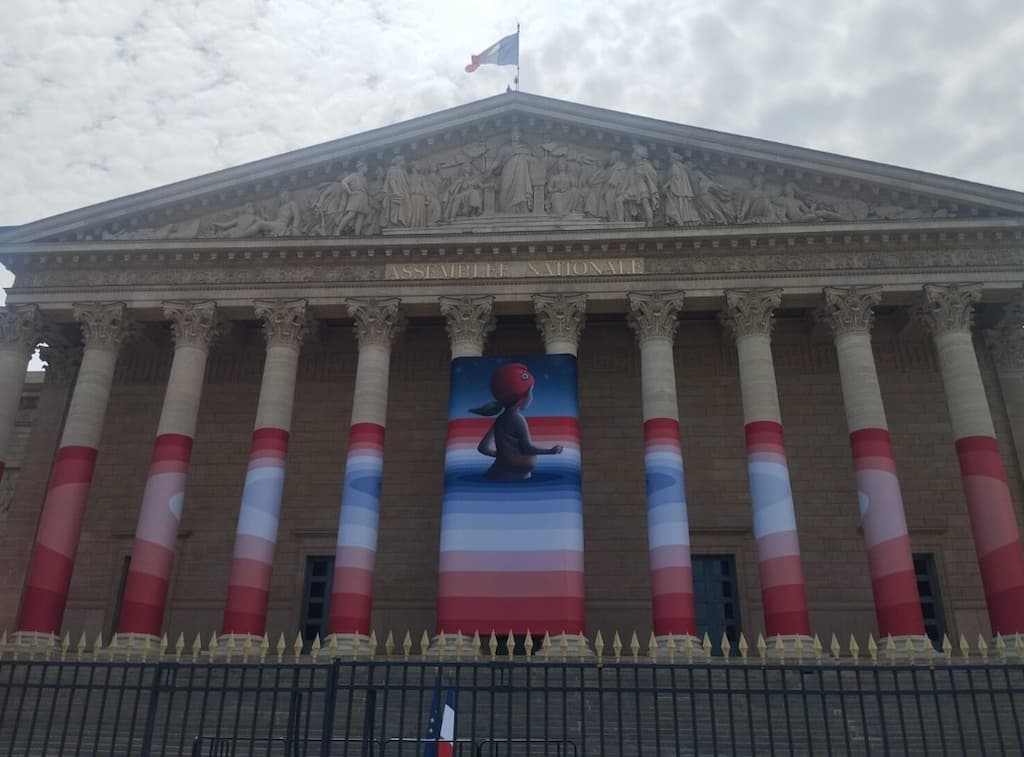

Since June 16, the columns of the National Assembly have been adorned with a large-scale artwork by street artist Seth, featuring a youthful Marianne surrounded by a starry sky in the colors of the French flag. The ephemeral installation, visible from the Place de la Concorde, will remain in place until September 28, according to Valeurs Actuelles.
The work marks the first time in over two decades that such artwork has appeared on the Palais Bourbon’s colonnade, following the “Mariannes d’aujourd’hui” exhibition displayed in 2003 under the presidency of Jean-Louis Debré. The artist describes his Marianne as spreading the seeds of liberty and advancing fearlessly toward the future.
For National Assembly President Yaël Braun-Pivet, the installation represents an effort to open the institution to artistic creation and foster dialogue between culture and democracy while inviting the French people to discover what she calls the house of the people.
Conservative Deputies Condemn Installation
The artwork immediately drew sharp criticism from right-wing lawmakers. National Rally deputy Jean-Philippe Tanguy denounced what he called yet another eyesore imposed by the Assembly president on the social media platform X.
Braun-Pivet fired back, accusing Tanguy of reflexive contempt in cultural matters and questioning whether such an attitude constitutes a proper defense of France. The RN deputy responded that she had no authority to judge his cultural tastes and that he had no interest in hers.
Anne Sicard, a deputy from the Identité-Libertés party led by Marion Maréchal, escalated the criticism further. While acknowledging that Braun-Pivet has every right to poor taste, Sicard argued that forcing it upon the national representation with French taxpayers’ money is unacceptable.
The controversy reflects broader tensions over cultural policy and the role of contemporary art in France’s national institutions, with conservative voices increasingly challenging what they view as elitist impositions on public spaces and traditional symbols of French identity.
With information from Valeurs Actuelles





