Necessary Cookies

Required for the site to function. Cannot be disabled.

Analytics Cookies

Help us understand how visitors interact with our site (Google Analytics via GTM).

Marketing Cookies

Used to track visitors and deliver personalised advertisements.

We use cookies to enhance your browsing experience and analyse site traffic. By clicking Accept All, you consent to our use of cookies. Privacy Policy
NewsFire Global
Home News Europe World Christianity Culture Wars Opinion Video
Information
About Us Authors Advertising Terms & Conditions Privacy Policy Contact
R2B Media
R2B NEWSFIRE.GR PAPAFOTIS.GR THRACTION HELLENIC CONSERVATIVES RIGHT2THEBONE YT
News World

Hegseth Gives NATO Six-Month Ultimatum to Boost Defense Spending

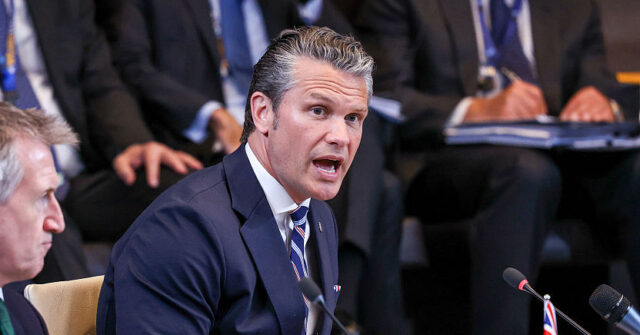
U.S. Secretary of War Pete Hegseth gave NATO six months to prove it can become a capable warfighting force or face a fundamental reassessment of American military commitment to Europe.

Dimitris Papafotis
Dimitris Papafotis Editor in Chief
JUNE 19, 2026 AT 6:15 PM Updated: Jun 19, 2026 6:05 PM

Speaking at NATO headquarters in Belgium, Hegseth opened the ministerial session with what he himself described as a “candid” assessment of the alliance’s decline, according to Breitbart News. His message was clear: the era of European free-riding on American security guarantees is over, and NATO must transform from what he characterised as a “paper tiger” into a credible military deterrent.

The Secretary framed his remarks around the concept of “NATO 3.0”, terminology frequently invoked by Secretary General Mark Rutte when discussing alliance transformation. This vision represents a return to the original NATO that won the Cold War, when European members maintained substantial military capabilities, and marks the end of what Hegseth termed “NATO 2.0″—an era in which European nations slashed defence spending to fund welfare programmes following the collapse of the Soviet Union.

Hegseth told the assembled defence ministers that the old arrangement whereby NATO guaranteed European security with minimal European contribution is not going to cut it any more. He emphasised that President Trump has maintained this position across two administrations, insisting that allies must finally shoulder their fair share of the defence burden.

The American defence chief did not limit his critique to military readiness alone. He drew a direct connection between NATO’s decline as a warfighting organisation and Europe’s broader civilisational crisis, as Breitbart News reports. Hegseth pointed to the absurdity of a military alliance preoccupied with “gender equity and climate change” rather than hard power and deterrence.

He also criticised European nations for opening their borders to mass migration, creating what many describe as an invasion, while simultaneously allowing defence capabilities to atrophy. National budgets became dominated by welfare spending whilst defence preparedness collapsed, Hegseth noted, adding that Europe lost belief in itself and its own civilisation during this period.

The Secretary stated that NATO 2.0 represented an era of distraction, deindustrialisation, and demilitarisation, describing them as lost years that would not be repeated. The founding vision of post-war leaders including Winston Churchill, Charles de Gaulle, and Konrad Adenauer never envisioned Europe as a dependency of the United States, he reminded the ministers.

America is now watching closely to determine which NATO members are genuinely committed to the alliance and which are not, Hegseth warned. Future U.S. involvement will be calibrated according to which nations step up and contribute their proportionate share to collective defence.

The Secretary delivered particularly sharp criticism of European allies who refused to allow American jets and ships heading to military operations in Iran to use European bases and airspace. Too many NATO members either refused outright, became mired in what Hegseth called arcane legal debates, or publicly criticised American actions whilst remaining unwilling or unable to act themselves. He described this response as shameful and said it directly endangered American lives.

Hegseth announced a comprehensive six-month Department of War review examining American force posture and basing arrangements across Europe. This NATO 3.0 review will identify which allies are meeting their commitments made at The Hague and which are falling short. Some of NATO’s largest and wealthiest economies, particularly those most vocal about defending the rules-based international order, continue acting as though the free-riding era persists, the Secretary noted.

The review will have consequences, Hegseth made clear. Some allies will pass with distinction whilst others will fail. America will keep close watch on nations that respond with refusal, hesitation, or delay when their commitment is tested. The assessment is designed both to optimise U.S. military positioning and to ensure American resources are concentrated where allies demonstrate genuine partnership.

The message from Brussels represents the Trump administration’s most explicit ultimatum to European NATO members to date. The Secretary’s remarks signal that Washington expects tangible action, not rhetoric, and that the transatlantic security architecture will be fundamentally restructured based on which nations prove themselves reliable partners in a renewed alliance focussed on hard power and warfighting capability.

For European governments, the six-month timeline creates immediate pressure to demonstrate credible paths toward meeting defence spending commitments and showing willingness to support American military operations when called upon. The alternative, as Hegseth made unmistakably clear, is a reduction in U.S. military presence and commitment to their defence.

With information from Breitbart News

Share:
Dimitris Papafotis
Dimitris Papafotis

Dimitris Papafotis is the editor-in-chief of NewsFire.GR. He was born and raised in Athens. He studied at the Journalism Workshop (1991-1993). He currently lives in Pyrgos, Ilia, where he has been active in radio and various newspapers, while also maintaining his personal blog, Papafotis.gr.

Speaking at NATO headquarters in Belgium, Hegseth opened the ministerial session with what he himself described as a “candid” assessment of the alliance’s decline, according to Breitbart News. His message was clear: the era of European free-riding on American security guarantees is over, and NATO must transform from what he characterised as a “paper tiger” into a credible military deterrent.

The Secretary framed his remarks around the concept of “NATO 3.0”, terminology frequently invoked by Secretary General Mark Rutte when discussing alliance transformation. This vision represents a return to the original NATO that won the Cold War, when European members maintained substantial military capabilities, and marks the end of what Hegseth termed “NATO 2.0″—an era in which European nations slashed defence spending to fund welfare programmes following the collapse of the Soviet Union.

Hegseth told the assembled defence ministers that the old arrangement whereby NATO guaranteed European security with minimal European contribution is not going to cut it any more. He emphasised that President Trump has maintained this position across two administrations, insisting that allies must finally shoulder their fair share of the defence burden.

The American defence chief did not limit his critique to military readiness alone. He drew a direct connection between NATO’s decline as a warfighting organisation and Europe’s broader civilisational crisis, as Breitbart News reports. Hegseth pointed to the absurdity of a military alliance preoccupied with “gender equity and climate change” rather than hard power and deterrence.

He also criticised European nations for opening their borders to mass migration, creating what many describe as an invasion, while simultaneously allowing defence capabilities to atrophy. National budgets became dominated by welfare spending whilst defence preparedness collapsed, Hegseth noted, adding that Europe lost belief in itself and its own civilisation during this period.

The Secretary stated that NATO 2.0 represented an era of distraction, deindustrialisation, and demilitarisation, describing them as lost years that would not be repeated. The founding vision of post-war leaders including Winston Churchill, Charles de Gaulle, and Konrad Adenauer never envisioned Europe as a dependency of the United States, he reminded the ministers.

America is now watching closely to determine which NATO members are genuinely committed to the alliance and which are not, Hegseth warned. Future U.S. involvement will be calibrated according to which nations step up and contribute their proportionate share to collective defence.

The Secretary delivered particularly sharp criticism of European allies who refused to allow American jets and ships heading to military operations in Iran to use European bases and airspace. Too many NATO members either refused outright, became mired in what Hegseth called arcane legal debates, or publicly criticised American actions whilst remaining unwilling or unable to act themselves. He described this response as shameful and said it directly endangered American lives.

Hegseth announced a comprehensive six-month Department of War review examining American force posture and basing arrangements across Europe. This NATO 3.0 review will identify which allies are meeting their commitments made at The Hague and which are falling short. Some of NATO’s largest and wealthiest economies, particularly those most vocal about defending the rules-based international order, continue acting as though the free-riding era persists, the Secretary noted.

The review will have consequences, Hegseth made clear. Some allies will pass with distinction whilst others will fail. America will keep close watch on nations that respond with refusal, hesitation, or delay when their commitment is tested. The assessment is designed both to optimise U.S. military positioning and to ensure American resources are concentrated where allies demonstrate genuine partnership.

The message from Brussels represents the Trump administration’s most explicit ultimatum to European NATO members to date. The Secretary’s remarks signal that Washington expects tangible action, not rhetoric, and that the transatlantic security architecture will be fundamentally restructured based on which nations prove themselves reliable partners in a renewed alliance focussed on hard power and warfighting capability.

For European governments, the six-month timeline creates immediate pressure to demonstrate credible paths toward meeting defence spending commitments and showing willingness to support American military operations when called upon. The alternative, as Hegseth made unmistakably clear, is a reduction in U.S. military presence and commitment to their defence.

With information from Breitbart News

