Trump: Iranians Won’t Revolt, ‘They’re Being Shot’
President Trump said Iranians cannot sustain uprisings because the regime has killed approximately 65,000 protesters, while declining to confirm U.S. intelligence support for opposition groups.
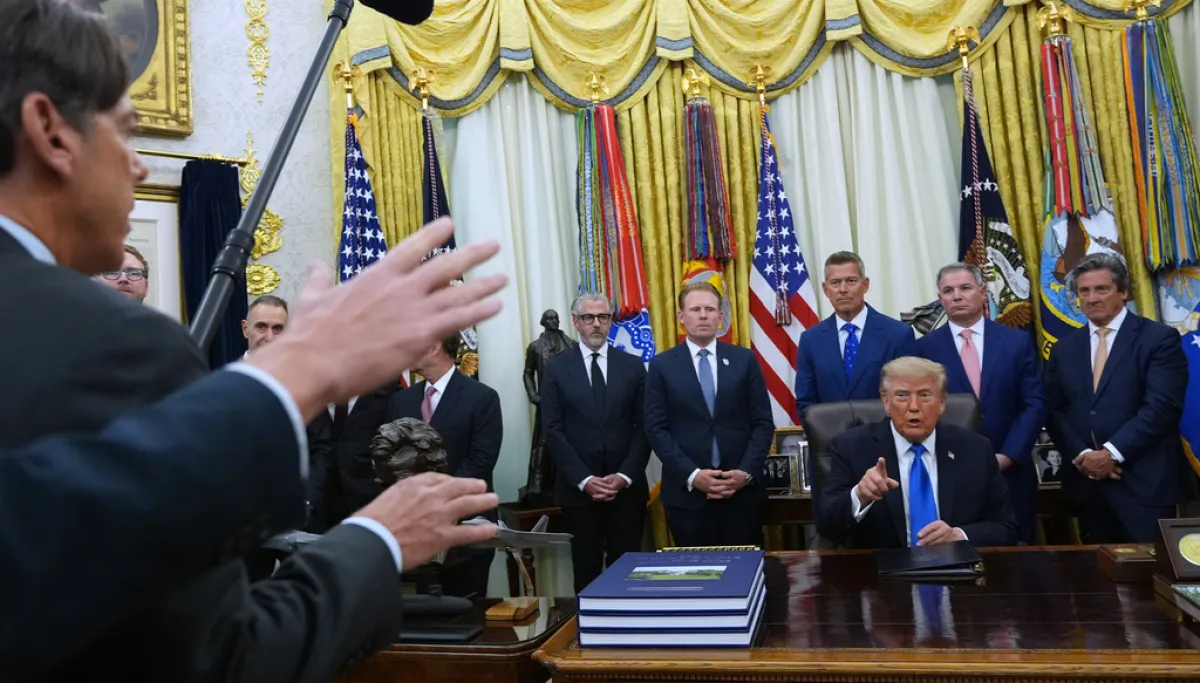

Speaking to reporters from the Oval Office, Trump told assembled media it wouldn’t be appropriate to say whether American intelligence personnel would deliver tangible assistance to Iranian protesters, as Timothy Nerozzi reports in Washington Examiner. The president expressed sympathy for ordinary Iranians, explaining that his recent Truth Social post asking when the Iranian people would rise up was meant as a rhetorical question rather than a literal call to action.
Trump stated plainly that Iranians are unable to mount sustained resistance because government forces are executing demonstrators in the streets. He estimates that approximately 65,000 protesters have been killed following the mass uprising that erupted in December 2025 and continued into January, which brought hundreds of thousands of Iranian citizens into the streets across the country.
Those protests prompted Trump to publicly promise Iranians that assistance was coming. The administration subsequently launched Operation Epic Fury in February, a large-scale military assault targeting Iranian leadership and military infrastructure across the country.
However, a brutal government crackdown crushed the demonstrations before American operations commenced. Thousands of protesters were shot dead in the streets, with many thousands more arrested and executed in the months that followed.
The president explained Wednesday that this violent repression is precisely why popular resistance has failed to materialize on a sustainable scale, adding that no one could blame the Iranian people for their reluctance to face down government bullets.
No Interest in Negotiations
On Tuesday evening, Trump made clear via Truth Social that he has no intention of forcing Iran to the negotiating table, preferring instead to wait for the regime’s internal collapse. He wrote that he does not care whether Iranian officials sign what he characterized as a worthless agreement, stating that America’s current position—with near-total control of the Hormuz Strait and Iran’s economy in free fall—is far more advantageous.
Secretary of State Marco Rubio echoed this rejection of further diplomacy during a Wednesday appearance on The Brian Kilmeade Show. When asked about reports suggesting Tehran might revisit the lapsed memorandum of understanding that failed to establish regional peace earlier this year, Rubio dismissed the possibility, saying that ship has sailed.
White House Banks on Regime Collapse
Despite acknowledging the threat of lethal force against protesters, the White House appears to be counting on economic devastation and political instability to eventually push Iranians back into the streets and topple the Tehran regime.
Trump told reporters Wednesday that the regime grows weaker daily, predicting that security forces will eventually lose their ability to suppress dissidents because the people will refuse to accept continued repression.
Ali Safavi, a member of the Foreign Affairs Committee of the National Council of Resistance of Iran, told the source publication that overthrowing the regime requires the convergence of two critical elements: a popular uprising and an organized resistance movement.
Safavi described Iranian society as being in an explosive state, with all the underlying conditions that produced the January uprising still firmly in place and growing more acute—economic hardship, inflation, unemployment, corruption, political repression, and the Iranian people’s fundamental rejection of the existing political order.
Skepticism About Regime Change Prospects
Alan Eyre, a distinguished diplomatic fellow at the Middle East Institute, expressed doubt that the Iranian public represents the powder keg many American policymakers hope to see ignite.
Eyre stated bluntly that the United States cannot engineer regime change from the outside, noting that while many brave individuals oppose the Iranian regime both inside and outside the country, no effective organized opposition movement currently exists. He emphasized that opposition movements require organization and time to develop.
Eyre cautioned against conflating widespread Iranian discontent with officials in Tehran with enthusiasm for a U.S.-backed coup that would likely plunge the country into chaos. He warned that the most likely alternative to the current regime is not a competent pro-Western government but rather a failed state scenario that most Iranians would reject.
With information from Washington Examiner