
US Ambassador Urges EU to Slash Regulations Harming Consumers
The European Union must slash regulation and remove non-tariff trade barriers if it hopes to remain economically competitive on the world stage, the US ambassador ... <a title="US Ambassador Urges EU to Slash Regulations Harming Consumers" class="read-more" href="https://newsfire.gr/en/us-ambassador-urges-eu-to-slash-regulations-harming-consumers/" aria-label="Read more about US Ambassador Urges EU to Slash Regulations Harming Consumers">Read more</a>
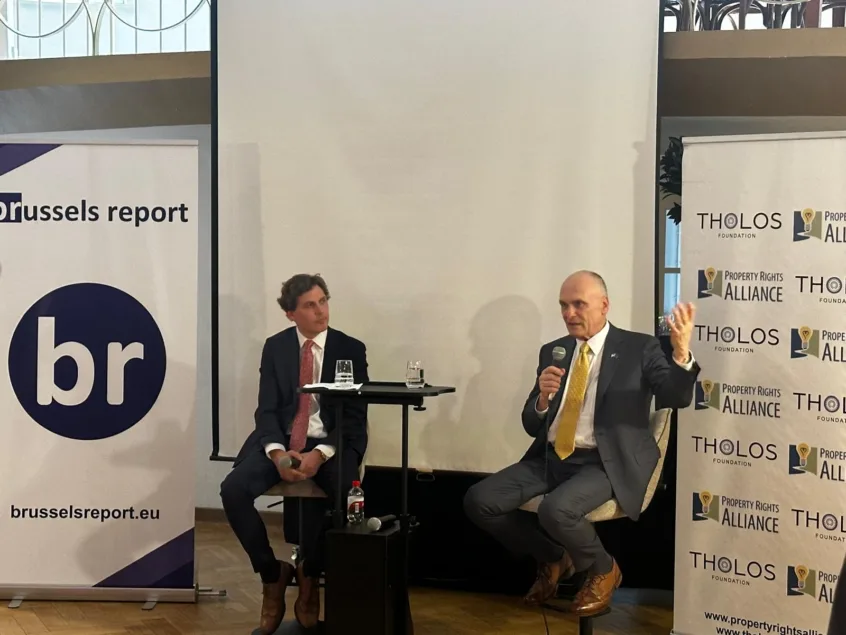

The European Union must slash regulation and remove non-tariff trade barriers if it hopes to remain economically competitive on the world stage, the US ambassador to the EU has declared, warning that Brussels’ current regulatory model is damaging both European consumers and transatlantic commerce.

Andrew Puzder, speaking at a Brussels Report event near the European Parliament on July 14, defended the recently negotiated US-EU trade agreement while delivering a stark assessment of Europe’s economic trajectory, according to Brussels Signal.
The ambassador characterised the transatlantic relationship as the world’s most significant economic partnership but stressed it had grown dangerously unbalanced. Together, the United States and the EU represent nearly 30 per cent of global trade in goods and services and 43 per cent of worldwide gross domestic product, based on Council of the European Union figures.
Puzder noted that while the European Union remains America’s largest trading partner, the United States continues running a trade deficit with the bloc—a situation he described as increasingly untenable.
Post-Cold War Assumptions No Longer Hold
The foundations of the post-Cold War economic arrangement have fundamentally shifted, Puzder argued. When the Berlin Wall came down, America provided European defence while maintaining favourable trade terms. That world no longer exists.
He said tariff imbalances between the two sides had become unsustainable, prompting both European Commission President Ursula von der Leyen and US President Donald Trump to recognise the necessity for a fresh approach. The relationship required rebalancing, he stated.
While acknowledging friction over matters including Greenland, US court decisions and Iran, Puzder dismissed these as minor obstacles compared to the broader strategic picture.
He credited the European Commission for reaching an agreement after what he called a ten-month negotiation process. The deal was finalised by von der Leyen and Trump in July 2025 and formally outlined in a joint statement issued August 21, 2025.
Regulation Strangling Growth
Tariffs no longer represent the primary barrier to transatlantic commerce, the ambassador insisted. Non-tariff trade barriers now pose far greater challenges.
Puzder identified multiple EU regulations—including methane emission requirements, the EU Deforestation Regulation and the Digital Markets Act—as examples of measures imposing heavy costs on business. The EUDR, adopted in 2023, has been delayed twice and will take effect for large and medium operators on December 30, 2026.
These regulations are devastating European economies, he warned, ultimately harming the continent’s own prosperity.
Europe can no longer depend on the economic assumptions that sustained its wealth for decades, Puzder stated. Those assumptions rested on cheap Russian energy, an unlimited Chinese export market and American security guarantees. All three have collapsed.
Combined with Europe’s extensive welfare systems and labyrinthine regulatory framework, this has severely damaged competitiveness.
The welfare state will not disappear, he acknowledged, but the solution lies in economic growth—growth that excessive regulation is currently preventing.
Europe’s Brain Drain to America and China
Citing Arthur Mensch, chief executive of Mistral AI, Puzder said innovative companies in Europe eventually hit a regulatory wall before moving investment elsewhere. Firms relocate to the United States or China because manufacturing and expansion are simpler there, he explained.
To illustrate Europe’s relative economic decline, the ambassador pointed to per capita output figures. Germany’s GDP per capita now falls below that of West Virginia, he noted. If Germany were a US state, it would rank among the poorer ones.
The AI Economy Demands Energy and Freedom
Artificial intelligence represents the defining economic challenge of the coming decades, Puzder declared, stating that the AI economy is the economy.
He praised Europe’s universities and scientific talent but argued that AI success requires five essential components: abundant energy, critical minerals, data centres, access to data and advanced hardware.
Due to limited opportunities in Europe, many technology entrepreneurs, scientists and thinkers migrate to the United States to conduct larger-scale business, he said.
Puzder called for substantially greater investment in nuclear power, fossil fuels and liquefied natural gas to supply reliable baseload electricity capacity—infrastructure he views as essential for powering the AI-driven economy of the future.
With information from Brussels Signal





