Tehran Braces for Unrest as Trump Tightens Economic Screws
Iranian President Masoud Pezeshkian admitted U.S. sanctions have cut imports and exports by up to 35 percent and blocked gasoline supplies as Treasury targeted a major foreign bank.
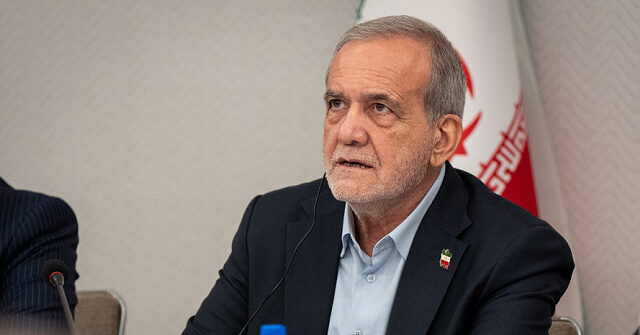

According to Breitbart News, Pezeshkian revealed during a televised interview Friday night that Iranian imports and exports have plummeted between 25 and 35 percent under the weight of U.S. sanctions and the naval blockade. The regime is now weighing a doubling of gasoline prices for purchases beyond subsidized quotas as fuel supplies grow increasingly scarce.
The route is now blocked, and goods are not coming in, Pezeshkian conceded. He singled out gasoline as one of the goods no longer reaching the country.
The Iranian leader’s admission arrives as Washington delivers on its pledge to economically isolate Tehran through Operation Economic Outcast, the comprehensive pressure campaign unveiled Monday by Treasury Secretary Scott Bessent, who vowed to economically “asphyxiate” the regime and sever every economic lifeline keeping it afloat.
Treasury Strikes First Major Foreign Bank Target
On Friday, the Treasury Department took its opening shot at a foreign financial institution, moving to sever Banque Misr UAE from correspondent access to American banks after identifying the institution’s Emirati operations as a critical node maintaining Iranian networks’ connection to U.S. dollar flows.
Treasury investigators determined that over the past two and a half years, the bank processed approximately $1.8 billion for 103 companies with potential ties to Iranian shadow-banking networks, including apparent front companies linked to the Islamic Revolutionary Guard Corps and Iran’s defense sector, as Breitbart News reports.
Bessent had warned foreign banks Monday that they could no longer finance Tehran while maintaining access to the dollar-based financial system. By week’s end, he had made an example.
Banque Misr UAE decided to find out the hard way, Bessent stated, describing the action as the first step in holding the institution accountable for its continued, egregious support of the Iranian regime.
Treasury simultaneously sanctioned the manager of Iran’s Bank Melli branch in Dubai and a Hong Kong-based facilitator, while the State Department pledged that Economic Outcast would continue in full force.
Blockade Chokes Oil Revenue While Regional Trade Flows
The financial offensive builds on a naval blockade that has already strangled Tehran’s oil revenue while permitting growing volumes of neighboring countries’ energy exports to transit the Strait of Hormuz unimpeded.
Iran had previously wielded the strait as one of its strongest sources of leverage, mining shipping lanes and threatening Gulf energy traffic. On Thursday, CENTCOM commander Adm. Brad Cooper announced that U.S. forces had cleared Iranian mines from internationally recognized lanes and restored expanding commercial traffic through them.
Nearly 1,500 vessels carrying roughly 750 million barrels of oil have moved through the strait even as Iran has exported nothing from its own shores since the U.S. blockade resumed in mid-July, according to CENTCOM figures. Ships entering or departing Iranian ports remain subject to U.S. enforcement, apart from authorized humanitarian traffic.
President Donald Trump summarized the administration’s assessment of the operation in a phone interview published Friday, declaring that the strait is now open.
Iran’s response has been very mild, Trump added, because the regime understands the consequences of retaliation. He characterized control of the strait as the entire ball game.
Economic Collapse Accelerates Inside Iran
Inside Iran, economic indicators continue their downward spiral as public hardship becomes increasingly visible across the country.
Inflation has reached 84 percent, while the rial has collapsed to roughly two million to the dollar. Fuel queues and panic buying have emerged amid mounting concerns over gasoline supplies. Oil workers, pensioners, teachers and other workers have begun staging smaller demonstrations over wages and deteriorating living conditions.
For some Iranian families, the financial strain has become so severe that they are selling burial plots they had reserved for themselves or deceased relatives to cover immediate living expenses, Iran International reported Friday. One woman described attempting to sell a tier of her father’s grave that her family had reserved for her still-living mother, explaining that the family needs the money now more than burial space later.
Other Iranians described the economic pressure in starker terms. A 37-year-old Tehran resident told the New York Times Friday that people are hungry, confused and unable to find a way out, warning that another economic uprising could prove impossible for the regime to contain.
Regime Officials Warn Economic Crisis Threatens Survival
Senior Iranian officials have publicly acknowledged that deteriorating economic conditions could threaten the regime’s ability to survive, according to Breitbart News.
Parliament Speaker Mohammad Bagher Ghalibaf warned this month that no amount of military power can sustain the regime if people are hungry and the country lacks financial circulation and economic growth.
Bessent highlighted Ghalibaf’s admission Tuesday as evidence that the administration’s pressure campaign is achieving its intended effect.
With information from Breitbart News