
Russia Forces Armenia to Pick Between EU and Eurasian Bloc
Russia has demanded Armenia choose between EU integration and its membership in the Moscow-led Eurasian Economic Union, setting a December deadline for a referendum decision.
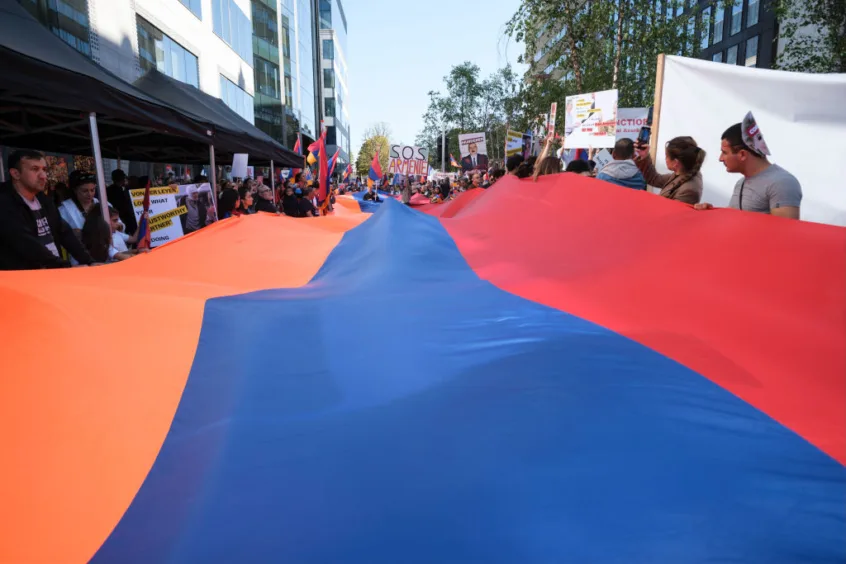

Russian deputy foreign minister Mikhail Galuzin declared on August 11 that Yerevan must decide by December whether to hold a national referendum on EU accession or remain within the EAEU framework. He warned that the matter will be raised at the Supreme Eurasian Economic Council’s December session, which is scheduled to review a report on the potential consequences of suspending Armenia’s EAEU treaty obligations.
Galuzin told TASS that if Armenia fails to call a referendum by that deadline, leaders will take this fact into account when deciding on further appropriate joint steps.
The ultimatum follows a joint statement issued by the heads of state of Russia, Belarus, Kazakhstan and Kyrgyzstan at an EAEU summit in Astana on May 29, which called on Armenia to put the question to a popular vote.
The Eurasian Economic Union, established in 2015 as a Russian-led trading bloc, includes Russia, Belarus, Kazakhstan, Armenia and Kyrgyzstan. It provides members with a common economic space and customs framework.
Armenia’s Pivot Away from Moscow
Armenia joined the EAEU on January 2, 2015, after then-president Serzh Sargsyan abandoned negotiations for an EU association agreement in 2013. The move cemented Armenia’s economic ties with Russia and granted preferential market access across the bloc.
Russia has long been Armenia’s principal economic partner and energy supplier, while the two countries maintain deep military and security cooperation. Armenia remains formally part of the Russian-led Collective Security Treaty Organisation (CSTO), though Yerevan has frozen its participation in the alliance’s political activities since February 2024.
Despite these ties, Armenia has steadily drawn closer to Brussels. The two sides signed the Comprehensive and Enhanced Partnership Agreement (CEPA) in 2017, which took effect in 2021. Following the 2018 Velvet Revolution, Prime Minister Nikol Pashinyan’s government has pursued democratic reforms and stronger relations with Western institutions.
On March 26, 2025, Armenia’s parliament passed legislation setting the country on a path toward potential EU membership. While the law does not confer candidate status or trigger accession talks, it formally endorses the government’s goal of European integration. Under Armenia’s constitution, any final decision on EU membership requires a referendum.
European Summit Accelerates Shift
The momentum accelerated sharply in 2026. On May 4-5, Yerevan hosted its first-ever EU-Armenia summit, attended by European Commission President Ursula von der Leyen, European Council President António Costa, and EU foreign policy chief Kaja Kallas. The summit followed the eighth European Political Community gathering, also held in the Armenian capital on May 4.
French President Emmanuel Macron, who visited Armenia from May 3 to 5, stated that the country had chosen a path toward Europe.
Pashinyan’s Civil Contract party won Armenia’s parliamentary election on June 7, 2026. After a Foreign Affairs Council meeting on June 15, Kallas said Armenian voters had chosen peace, sovereignty and closer ties with Europe, while Russian pressure and economic coercion had failed to alter that course.
Russian Economic Retaliation
The election was preceded by a wave of Russian trade restrictions. Beginning May 22, Russia’s agricultural regulator Rosselkhoznadzor imposed bans on imports of Armenian flowers, later extending the measures to vegetables, grapes, stone fruit and dried fruit. From June 12, the regulator suspended all Armenian quarantine-controlled produce, citing phytosanitary violations. Yerevan filed a complaint with the Eurasian Economic Commission.
Brussels has responded with financial backing. Von der Leyen announced a €52 million support package in early June, bringing total EU assistance for Armenia to €288 million.
For Moscow, the accelerating European presence in Armenia threatens a long-standing sphere of economic, political and security influence. The Kremlin’s ultimatum underscores the escalating struggle over Armenia’s geopolitical orientation.
With information from Brussels Signal





