Necessary Cookies

Required for the site to function. Cannot be disabled.

Analytics Cookies

Help us understand how visitors interact with our site (Google Analytics via GTM).

Marketing Cookies

Used to track visitors and deliver personalised advertisements.

We use cookies to enhance your browsing experience and analyse site traffic. By clicking Accept All, you consent to our use of cookies. Privacy Policy
NewsFire Global
Home News Europe World Christianity Culture Wars Opinion Video
Information
About Us Authors Advertising Terms & Conditions Privacy Policy Contact
R2B Media
R2B NEWSFIRE.GR PAPAFOTIS.GR THRACTION HELLENIC CONSERVATIVES RIGHT2THEBONE YT
Opinion Europe

Maximos’ 11-minute striptease – Dokos, the ‘Ukrainians’ and Mitsotakis’ blind trust (video)

Greek Prime Minister's National Security Adviser Thanos Dokos was tricked by Russian pranksters into revealing intelligence chief's location, election timing, and Athens' NATO views during a fake call.
Panayotis Doumas
Panayotis Doumas Political Advisor & Analyst - NewsFire.GR Director
JULY 3, 2026 AT 7:01 PM

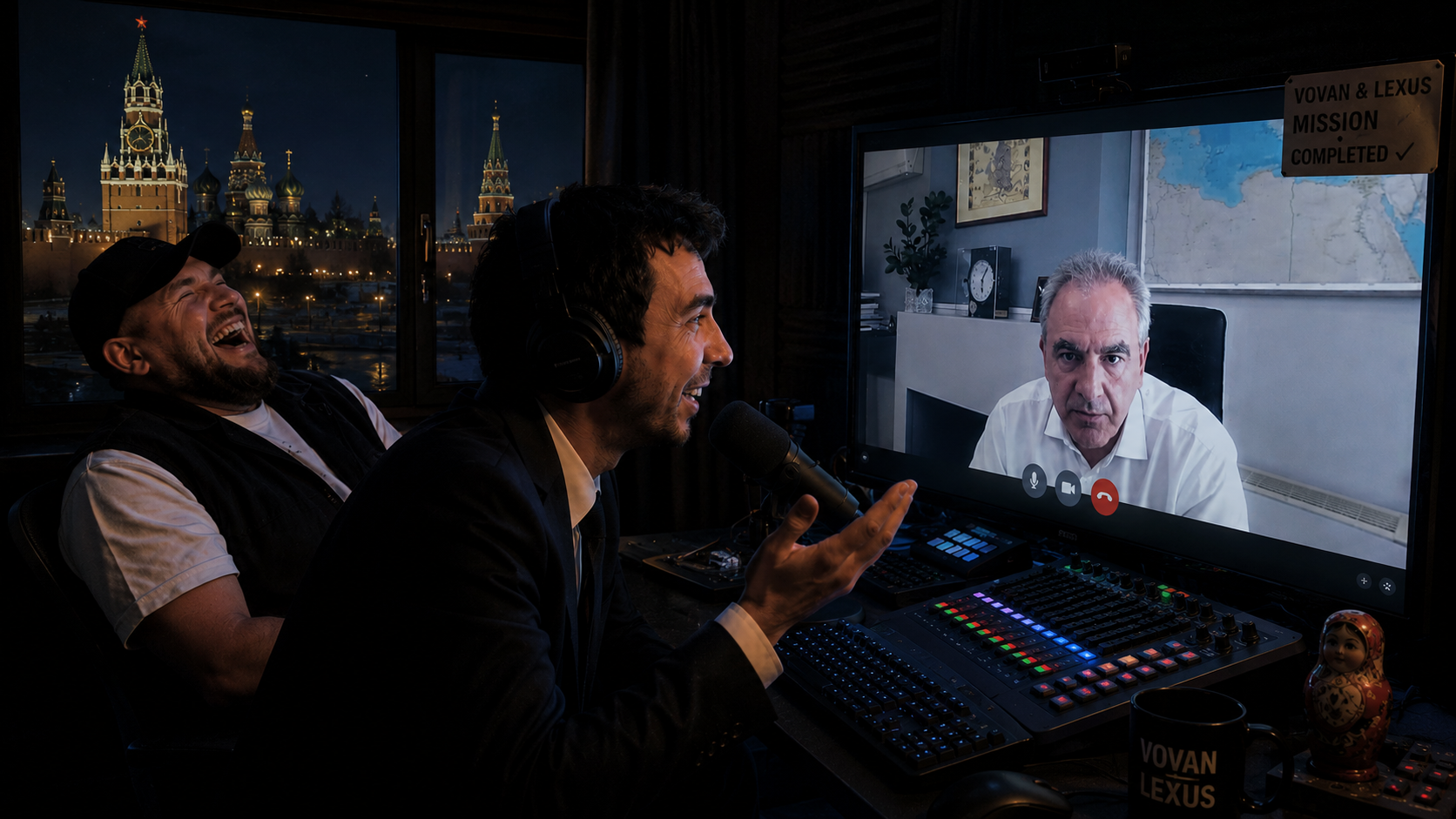
Eleven minutes and forty-two seconds. That’s how long it took two Russian pranksters, the notorious Vovan and Lexus, to extract from the Prime Minister’s National Security Adviser, Thanos Dokos, what an entire embassy wouldn’t extract in a year: where the director of the National Intelligence Service is at this moment, when the government plans to hold elections, what Athens really thinks about NATO, the United States, and Ukraine’s European prospects. The video of the teleconference — which we present with Greek subtitles — speaks for itself. We will simply underline.

Mr. Dokos believed he was speaking with Rustem Umerov, secretary of the Ukrainian National Security Council. In reality, he was speaking with the Kremlin — albeit with its unofficial, giggling branch. And he told them everything.

What Exactly “Didn’t Leak”

The Maximos Mansion’s first line of defense is already known: “no confidential or classified information was leaked.” Let’s see, then, what Maximos considers suitable for public disclosure.

The National Security Adviser informs his interlocutor — of unknown identity, as it turned out — that “the director of our intelligence service is at this moment in Kyiv” and is conducting meetings. The movements of the director of the National Intelligence Service during wartime in the region are, according to Maximos, information for general circulation. The services that cooperate with us should take note.

Next, Mr. Dokos warns the “Umerov” that “in a few months we will have elections” — and that a new incident with a Ukrainian drone “will create very serious problems for the Greek government.” Hold onto that. It won’t create a problem for the country’s security, for shipping, for our islanders. For the government. The man handling Greece’s national security is explaining to a foreign official that Athens’ red line is not its sovereignty, but its electoral calendar. And he confirms, incidentally, the scenarios of early elections that the government denies daily to Greek journalists. To Russian pranksters, you see, we don’t lie.

What follows are assessments about the NATO Summit: that Ukraine’s full integration will not be discussed, that there is “great concern” about the United States’ stance toward the Alliance, that large member states will block Kyiv’s European prospects. All of this may be analytically correct — Mr. Dokos was, after all, a highly capable analyst. Except he’s no longer paid to conduct geopolitics seminars for whoever calls him on video; he’s paid to know that every channel is considered potentially exposed. From today, the Greek NSA’s assessments of the divided West are playing on Russian state media with the closing credits of Vovan and Lexus.

The Warning Bells No One Heard

And here’s the burning question: should he have realized it? The fake “Umerov” wasn’t even careful. He confided to Mr. Dokos that the Ukrainian Defense Minister “seems to have gone crazy with the war,” that he’s working against the presidential office, and that he might strike again “near one of your islands.” No real official disparages their own government like this to a foreign counterpart. The narrative of Kyiv’s internal collapse is, coincidentally, Moscow’s favorite propaganda motif — the bait carried a label of origin. Mr. Dokos not only didn’t see it; he responded “I completely agree.” Twice.

When he even suggested to his interlocutor that Ukraine should seek instead “a Russian billionaire” and the latter answered him sternly that there are billionaires who support Russia, the head of our national security responded apologetically, that the billionaires “don’t come to Greece anymore, they go to Turkey.” Tourism reporting, in the midst of entrapment.

The Adviser Didn’t Fall from the Sky

Mr. Dokos is not a random person. For a series of years he directed ELIAMEP, that institute which taught us that every Greek-Turkish dispute is resolved with a little more “dialogue” — preferably with Greek concessions as a down payment of good will. In 2020, still fresh at Maximos, he spoke of “joint exploitation” of the Aegean and was forced to place his resignation at the Prime Minister’s disposal. Mr. Mitsotakis, of course, did not accept it. In the school of thought from which the adviser comes — the one that flourished under Simitis and never withered in the corridors of Vasilissis Sofias — leniency toward “our people” is as unlimited as understanding toward those on the other side.

Because the real scandal is not Mr. Dokos. It’s the man who appointed him in 2019, kept him after “joint exploitation,” and has shown him such blind trust for seven years that, apparently, video calls don’t even need authentication to reach his office. Mr. Mitsotakis has built around him a Maximos in the image and likeness of ELIAMEP: same people, same doctrines, same certainty that criticism is always “populism” and accommodation always “realism.” Today this edifice was ridiculed internationally by two professional jokers — and its first reaction was to assure us that nothing leaked. That is, that the National Security Adviser knows nothing worth leaking. Choose which of the two reassures you.

The Minimum and the Necessary

PASOK is demanding Mr. Dokos’ resignation. It’s the minimum — and the easiest. The necessary is something else: for the Prime Minister to answer personally. Who “authenticated” the call? What is the verification protocol for interlocutors at the National Security Council — if one exists? And above all: how many more “secure” conversations from Maximos are circulating out there, in files not yet published? It appears that the government is highly capable of violating the security of private conversations when it serves them, but is not even in a position to safeguard its own security.

A national security adviser, moreover, is judged by what he says when he thinks no one is listening. Now we’ve all heard him. It’s the Prime Minister’s turn to tell us whether what we heard expresses him — because if he remains silent, he will have said it.
Share:
Panayotis Doumas
Panayotis Doumas

He was born in Athens and is a journalist and producer of online television programs. He attended the Athens College and studied Law and History in Freiburg, Germany. He was an entrepreneur for many years and served as Vice President of the Athens Chamber of Commerce from 2012 to 2015. He has worked as a journalist for the media groups DNM GROUP and ESTIA INVESTMENT GROUP and has contributed articles to the newspapers "Dimokratia," "Estia," "Eleftheri Ora," and "Eleftheros Kosmos," the magazine "STRATEGIKI," and the websites PRONEWS and NEWSBREAK. He is a correspondent for the German weekly newspaper "Junge Freiheit." He is one of the key contributors to the Network of Greek Conservatives and the online channel Right2TheBone.

Eleven minutes and forty-two seconds. That’s how long it took two Russian pranksters, the notorious Vovan and Lexus, to extract from the Prime Minister’s National Security Adviser, Thanos Dokos, what an entire embassy wouldn’t extract in a year: where the director of the National Intelligence Service is at this moment, when the government plans to hold elections, what Athens really thinks about NATO, the United States, and Ukraine’s European prospects. The video of the teleconference — which we present with Greek subtitles — speaks for itself. We will simply underline.

Mr. Dokos believed he was speaking with Rustem Umerov, secretary of the Ukrainian National Security Council. In reality, he was speaking with the Kremlin — albeit with its unofficial, giggling branch. And he told them everything.

What Exactly “Didn’t Leak”

The Maximos Mansion’s first line of defense is already known: “no confidential or classified information was leaked.” Let’s see, then, what Maximos considers suitable for public disclosure.

The National Security Adviser informs his interlocutor — of unknown identity, as it turned out — that “the director of our intelligence service is at this moment in Kyiv” and is conducting meetings. The movements of the director of the National Intelligence Service during wartime in the region are, according to Maximos, information for general circulation. The services that cooperate with us should take note.

Next, Mr. Dokos warns the “Umerov” that “in a few months we will have elections” — and that a new incident with a Ukrainian drone “will create very serious problems for the Greek government.” Hold onto that. It won’t create a problem for the country’s security, for shipping, for our islanders. For the government. The man handling Greece’s national security is explaining to a foreign official that Athens’ red line is not its sovereignty, but its electoral calendar. And he confirms, incidentally, the scenarios of early elections that the government denies daily to Greek journalists. To Russian pranksters, you see, we don’t lie.

What follows are assessments about the NATO Summit: that Ukraine’s full integration will not be discussed, that there is “great concern” about the United States’ stance toward the Alliance, that large member states will block Kyiv’s European prospects. All of this may be analytically correct — Mr. Dokos was, after all, a highly capable analyst. Except he’s no longer paid to conduct geopolitics seminars for whoever calls him on video; he’s paid to know that every channel is considered potentially exposed. From today, the Greek NSA’s assessments of the divided West are playing on Russian state media with the closing credits of Vovan and Lexus.

The Warning Bells No One Heard

And here’s the burning question: should he have realized it? The fake “Umerov” wasn’t even careful. He confided to Mr. Dokos that the Ukrainian Defense Minister “seems to have gone crazy with the war,” that he’s working against the presidential office, and that he might strike again “near one of your islands.” No real official disparages their own government like this to a foreign counterpart. The narrative of Kyiv’s internal collapse is, coincidentally, Moscow’s favorite propaganda motif — the bait carried a label of origin. Mr. Dokos not only didn’t see it; he responded “I completely agree.” Twice.

When he even suggested to his interlocutor that Ukraine should seek instead “a Russian billionaire” and the latter answered him sternly that there are billionaires who support Russia, the head of our national security responded apologetically, that the billionaires “don’t come to Greece anymore, they go to Turkey.” Tourism reporting, in the midst of entrapment.

The Adviser Didn’t Fall from the Sky

Mr. Dokos is not a random person. For a series of years he directed ELIAMEP, that institute which taught us that every Greek-Turkish dispute is resolved with a little more “dialogue” — preferably with Greek concessions as a down payment of good will. In 2020, still fresh at Maximos, he spoke of “joint exploitation” of the Aegean and was forced to place his resignation at the Prime Minister’s disposal. Mr. Mitsotakis, of course, did not accept it. In the school of thought from which the adviser comes — the one that flourished under Simitis and never withered in the corridors of Vasilissis Sofias — leniency toward “our people” is as unlimited as understanding toward those on the other side.

Because the real scandal is not Mr. Dokos. It’s the man who appointed him in 2019, kept him after “joint exploitation,” and has shown him such blind trust for seven years that, apparently, video calls don’t even need authentication to reach his office. Mr. Mitsotakis has built around him a Maximos in the image and likeness of ELIAMEP: same people, same doctrines, same certainty that criticism is always “populism” and accommodation always “realism.” Today this edifice was ridiculed internationally by two professional jokers — and its first reaction was to assure us that nothing leaked. That is, that the National Security Adviser knows nothing worth leaking. Choose which of the two reassures you.

The Minimum and the Necessary

PASOK is demanding Mr. Dokos’ resignation. It’s the minimum — and the easiest. The necessary is something else: for the Prime Minister to answer personally. Who “authenticated” the call? What is the verification protocol for interlocutors at the National Security Council — if one exists? And above all: how many more “secure” conversations from Maximos are circulating out there, in files not yet published? It appears that the government is highly capable of violating the security of private conversations when it serves them, but is not even in a position to safeguard its own security.

A national security adviser, moreover, is judged by what he says when he thinks no one is listening. Now we’ve all heard him. It’s the Prime Minister’s turn to tell us whether what we heard expresses him — because if he remains silent, he will have said it.