Necessary Cookies

Required for the site to function. Cannot be disabled.

Analytics Cookies

Help us understand how visitors interact with our site (Google Analytics via GTM).

Marketing Cookies

Used to track visitors and deliver personalised advertisements.

We use cookies to enhance your browsing experience and analyse site traffic. By clicking Accept All, you consent to our use of cookies. Privacy Policy
NewsFire Global
Home News Europe World Christianity Culture Wars Opinion Video
Information
About Us Authors Advertising Terms & Conditions Privacy Policy Contact
R2B Media
R2B NEWSFIRE.GR PAPAFOTIS.GR THRACTION HELLENIC CONSERVATIVES RIGHT2THEBONE YT
News World

Green Activist Claims He ‘Didn’t Consciously Choose’ Farage Beheading Post

Green Party activist Ashok Kumar defended Zack Polanski's sharing of an image with guillotine imagery targeting Nigel Farage as an innocent mistake, while Farage condemned what he called double standards.
Stefanos Banos
Stefanos Banos Staff Writer
JULY 28, 2026 AT 8:24 AM

A senior Green Party politician did not deliberately share an image calling for violence against Nigel Farage, according to a party activist who defended the controversial social media post as an innocent error.

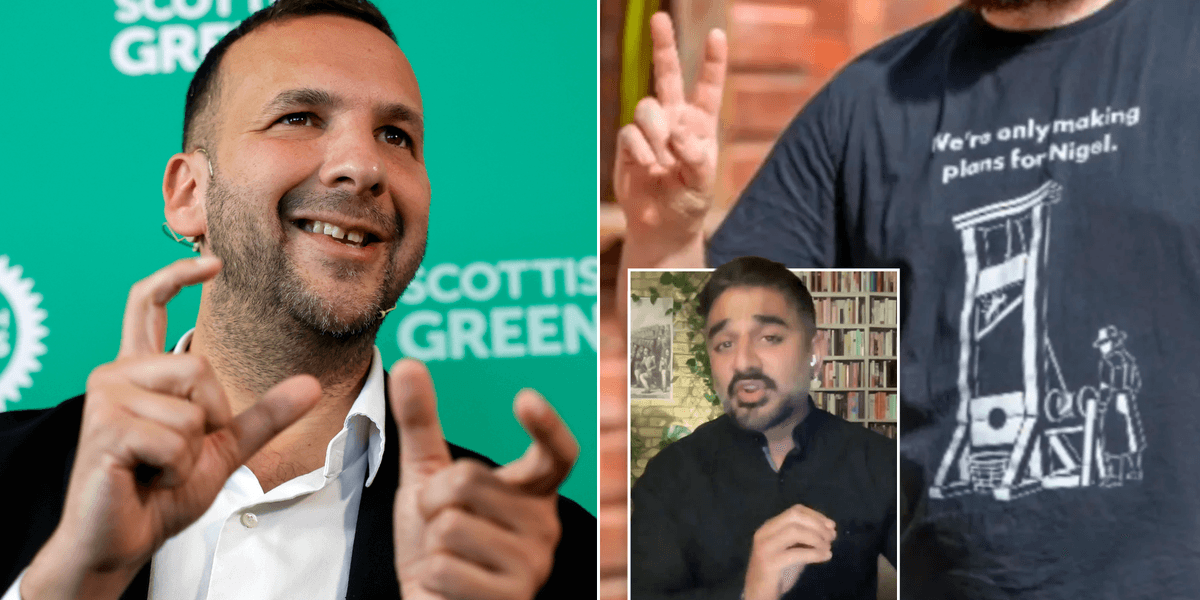
Dr Ashok Kumar insisted that Zack Polanski bore no responsibility for the inflammatory content, which depicted a man wearing a t-shirt featuring a guillotine and the words “We’re only making plans for Nigel” — a clear reference to decapitation, according to James Saunders writing in GB News.

The Green Party official told the outlet that Polanski had not consciously chosen to share the threatening imagery, which appeared among a collection of twenty images on his Instagram profile. The post was visible to his more than 700,000 followers before being removed.

Kumar, who also serves as an associate professor of Political Economy at Birkbeck University, claimed the incident was an obvious mistake stemming from a collaborative Instagram post involving multiple users. Under this format, images appear automatically on a user’s profile without individual review of each photo.

It was clearly a mistake, Kumar stated, adding that Polanski removed the content immediately after it was identified. He argued that users often view only the first few images in such collections and accept the rest assuming they will be appropriate.

Dismissing the controversy, Kumar questioned what political advantage Polanski could possibly gain from deliberately posting such content. He asked what constituency would be won over by seeing guillotine imagery in a photo collage, suggesting the notion of intentional sharing made no strategic sense.

Double Standards Warning

Nigel Farage issued a sharp rebuke, warning of blatant double standards in how threatening content is treated depending on who posts it. The Reform UK leader stated that if he were to share anything equally inciteful, he would expect to be arrested, and the same standard should apply to Polanski.

Zia Yusuf, Reform UK’s home affairs spokesman, also condemned the post, though his full statement was not completed in the available reporting.

The incident highlights ongoing concerns about political violence and the uneven application of standards when public figures share or amplify threatening imagery targeting their opponents.

Polanski serves in a prominent position within the Green Party and commands a substantial social media following, making the temporary appearance of such violent imagery particularly significant regardless of intent.

With information from GB News

Share:
Stefanos Banos
Stefanos Banos

Stefanos Banos was born in Piraeus and is an editor at NewsFire.GR, specializing in political analysis and international relations. He graduated from the Department of Communication and Media at the University of Bremen in Germany, where he also completed his Master of Arts in Communication and Media Studies. Married to Zoi, he is a proud father of three boys.

A senior Green Party politician did not deliberately share an image calling for violence against Nigel Farage, according to a party activist who defended the controversial social media post as an innocent error.

Dr Ashok Kumar insisted that Zack Polanski bore no responsibility for the inflammatory content, which depicted a man wearing a t-shirt featuring a guillotine and the words “We’re only making plans for Nigel” — a clear reference to decapitation, according to James Saunders writing in GB News.

The Green Party official told the outlet that Polanski had not consciously chosen to share the threatening imagery, which appeared among a collection of twenty images on his Instagram profile. The post was visible to his more than 700,000 followers before being removed.

Kumar, who also serves as an associate professor of Political Economy at Birkbeck University, claimed the incident was an obvious mistake stemming from a collaborative Instagram post involving multiple users. Under this format, images appear automatically on a user’s profile without individual review of each photo.

It was clearly a mistake, Kumar stated, adding that Polanski removed the content immediately after it was identified. He argued that users often view only the first few images in such collections and accept the rest assuming they will be appropriate.

Dismissing the controversy, Kumar questioned what political advantage Polanski could possibly gain from deliberately posting such content. He asked what constituency would be won over by seeing guillotine imagery in a photo collage, suggesting the notion of intentional sharing made no strategic sense.

Double Standards Warning

Nigel Farage issued a sharp rebuke, warning of blatant double standards in how threatening content is treated depending on who posts it. The Reform UK leader stated that if he were to share anything equally inciteful, he would expect to be arrested, and the same standard should apply to Polanski.

Zia Yusuf, Reform UK’s home affairs spokesman, also condemned the post, though his full statement was not completed in the available reporting.

The incident highlights ongoing concerns about political violence and the uneven application of standards when public figures share or amplify threatening imagery targeting their opponents.

Polanski serves in a prominent position within the Green Party and commands a substantial social media following, making the temporary appearance of such violent imagery particularly significant regardless of intent.

With information from GB News

