Necessary Cookies

Required for the site to function. Cannot be disabled.

Analytics Cookies

Help us understand how visitors interact with our site (Google Analytics via GTM).

Marketing Cookies

Used to track visitors and deliver personalised advertisements.

We use cookies to enhance your browsing experience and analyse site traffic. By clicking Accept All, you consent to our use of cookies. Privacy Policy
NewsFire Global
Home News Europe World Christianity Culture Wars Opinion Video
Information
About Us Authors Advertising Terms & Conditions Privacy Policy Contact
R2B Media
R2B NEWSFIRE.GR PAPAFOTIS.GR THRACTION HELLENIC CONSERVATIVES RIGHT2THEBONE YT
Opinion Europe

Greece electricity bills: Nobody knows what they’re paying!

A consumer's electricity bill reveals that nearly 45% consists of non-negotiable fees and taxes, while complex pricing formulas amplify wholesale costs with hidden discounts and penalties.
Panayotis Doumas
Panayotis Doumas Political Advisor & Analyst - NewsFire.GR Director
SEPTEMBER 1, 2026 AT 11:01 PM

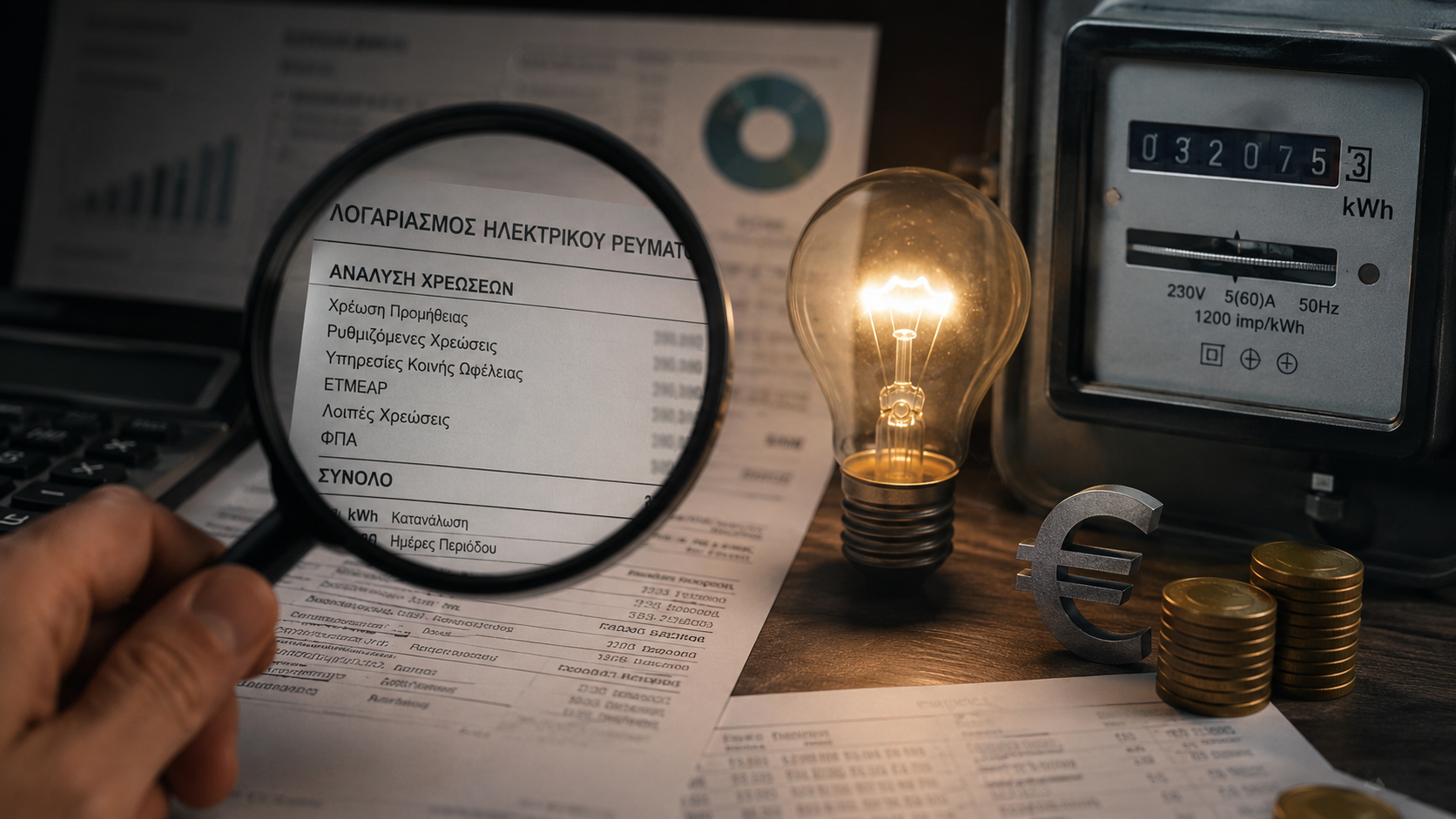
I needed a spreadsheet with six hundred formulas, a magnifying glass for the fine print on page six of a contract, and cross-referencing with published wholesale market data just to answer a question that should take ten seconds: did they charge me correctly? The complexity rivaled understanding Greece’s debt restructuring documents.

The answer was yes. And that’s precisely the problem. In a functional market, the legitimacy of a charge isn’t verified through investigative work.

What you’re actually paying

Take a typical summer electricity bill of 432 euros. The energy you actually purchased from the provider you chose accounts for 240 euros. The remaining 192 euros—44.6% of the bill—you never chose: network charges, Public Service Obligations, ETMEAR (Special Account for Renewable Energy Sources), special consumption tax, VAT, municipal fees, real estate tax, ERT (public broadcaster) charge. They’re identical no matter which provider you pick.

Public Service Obligations and ETMEAR alone—purely political decisions—make up 19% of the bill. The municipal component is another 10%. The municipality and the state collect through electricity bills because it’s convenient, and the consumer is left with the impression that the provider is charging them.

The traps you can’t see

The tariff I examined calculates the price as 1.21 times the average wholesale price of the previous month plus 35 euros per megawatt-hour, with no upper limit. The 1.21 coefficient means that every euro increase in wholesale becomes 1.21 euros on your bill. The consumer isn’t simply exposed to the market—they’re exposed with leverage.

On top of this are stacked four more layers of opacity. A punctuality discount that’s retroactively removed for an entire month if you’re three days late. A welcome discount that lasts sixty days and is buried in article 2.4 of the special terms. Tiered Public Service Obligation charges where the kilowatt-hour above a threshold costs twelve times more than the previous one, without this being stated anywhere in advance. And a power charge in kVA that very few know they’re paying.

None of this is illegal. Together, they make prediction impossible—and prediction is the precondition for competition. Without it, the “liberalised energy market” is a lottery with legally impeccable terms.

The number that won’t be heard from the podium

In Thessaloniki we’ll hear growth percentages, investments in renewables, shares of green energy. One indicator won’t be heard: how many citizens can predict their next bill with a deviation of less than 10%.

I suspect the percentage is single-digit. And it’s the only indicator that matters, because a consumer who can’t predict doesn’t compare, and a consumer who doesn’t compare doesn’t discipline any market.

What they do elsewhere—and it works

Australia: the reference price. The regulatory authority sets an annual reference price per region. Every offer must be advertised as a percentage deviation from it. The consumer doesn’t compare twenty charging structures—they compare “−8%” with “+3%”. One number, comparable, mandatory.

Germany and the Netherlands: equal monthly instalments. You pay the same amount every month and once a year there’s a settlement. The total cost doesn’t change. But the August shock disappears, and the provider gets stable cash flow. Nobody loses.

European Directive 2019/944: the single page. It already provides for a mandatory summary of key terms. In practice it’s become just another page in the folder. What’s needed is a standardised format, one page, with the duration of each discount in bold next to the advertised price.

Belgium: control of pricing formulas. After the energy crisis, the formulas of variable products are subject to oversight regarding transparency and the indices they use. A 1.21 coefficient in a household tariff would require at least justification.

Three rules would suffice for Greece: the advertised price is the price, without conditions that change it retroactively; no discount without its duration next to it, in the same font size; and first page with three numbers—kilowatt-hours, final cost per kilowatt-hour with everything included, total.

None of this harms providers. It only harms those who base their profit on confusion.

And the lignite question

Would electricity bills have been lower if the rushed de-lignification hadn’t happened? The answer requires numbers, not slogans.

The marginal cost of a natural gas unit with TTF at 49 euros, as in July, was approximately 120 euros per megawatt-hour. In late August, with TTF approaching 70, it shot up close to 155. The marginal cost of lignite, with fuel at around 20 euros and CO₂ allowances at 80.6 euros per tonne, is around 110-115 euros per megawatt-hour.

The conclusion is awkward for all sides: lignite isn’t cheaper than gas—it’s more stable. In months of mild prices it offers nothing. In months like August 2026, available lignite capacity would cut 30 to 40 euros from the marginal price during peak hours.

On an annual basis, a scenario with three gigawatts of available lignite would reduce the average wholesale price by 5 to 10 euros per megawatt-hour. For a household with 10,000 kilowatt-hours per year, this translates to 50 to 100 euros annually, or 3% to 6% of the bill.

This is real money. But it’s not the explanation for high prices, and anyone who claims otherwise is misleading. If CO₂ allowances rise to 93 euros, as forecast for 2027, the advantage cancels itself out.

The real cost of haste wasn’t financial. It was that we closed units before the alternative system was set up, ending up paying capacity mechanisms and imported gas to cover the gap—and that thousands of workers in Western Macedonia paid the bill for a transition that was called just before it proved to be so.

Energy policy isn’t judged on renewable percentages. It’s judged on whether the citizen understands what they’re paying and why. On that score, 2026 finds us worse off than 2019.

Share:
Panayotis Doumas
Panayotis Doumas

He was born in Athens and is a journalist and producer of online television programs. He attended the Athens College and studied Law and History in Freiburg, Germany. He was an entrepreneur for many years and served as Vice President of the Athens Chamber of Commerce from 2012 to 2015. He has worked as a journalist for the media groups DNM GROUP and ESTIA INVESTMENT GROUP and has contributed articles to the newspapers "Dimokratia," "Estia," "Eleftheri Ora," and "Eleftheros Kosmos," the magazine "STRATEGIKI," and the websites PRONEWS and NEWSBREAK. He is a correspondent for the German weekly newspaper "Junge Freiheit." He is one of the key contributors to the Network of Greek Conservatives and the online channel Right2TheBone.

I needed a spreadsheet with six hundred formulas, a magnifying glass for the fine print on page six of a contract, and cross-referencing with published wholesale market data just to answer a question that should take ten seconds: did they charge me correctly? The complexity rivaled understanding Greece’s debt restructuring documents.

The answer was yes. And that’s precisely the problem. In a functional market, the legitimacy of a charge isn’t verified through investigative work.

What you’re actually paying

Take a typical summer electricity bill of 432 euros. The energy you actually purchased from the provider you chose accounts for 240 euros. The remaining 192 euros—44.6% of the bill—you never chose: network charges, Public Service Obligations, ETMEAR (Special Account for Renewable Energy Sources), special consumption tax, VAT, municipal fees, real estate tax, ERT (public broadcaster) charge. They’re identical no matter which provider you pick.

Public Service Obligations and ETMEAR alone—purely political decisions—make up 19% of the bill. The municipal component is another 10%. The municipality and the state collect through electricity bills because it’s convenient, and the consumer is left with the impression that the provider is charging them.

The traps you can’t see

The tariff I examined calculates the price as 1.21 times the average wholesale price of the previous month plus 35 euros per megawatt-hour, with no upper limit. The 1.21 coefficient means that every euro increase in wholesale becomes 1.21 euros on your bill. The consumer isn’t simply exposed to the market—they’re exposed with leverage.

On top of this are stacked four more layers of opacity. A punctuality discount that’s retroactively removed for an entire month if you’re three days late. A welcome discount that lasts sixty days and is buried in article 2.4 of the special terms. Tiered Public Service Obligation charges where the kilowatt-hour above a threshold costs twelve times more than the previous one, without this being stated anywhere in advance. And a power charge in kVA that very few know they’re paying.

None of this is illegal. Together, they make prediction impossible—and prediction is the precondition for competition. Without it, the “liberalised energy market” is a lottery with legally impeccable terms.

The number that won’t be heard from the podium

In Thessaloniki we’ll hear growth percentages, investments in renewables, shares of green energy. One indicator won’t be heard: how many citizens can predict their next bill with a deviation of less than 10%.

I suspect the percentage is single-digit. And it’s the only indicator that matters, because a consumer who can’t predict doesn’t compare, and a consumer who doesn’t compare doesn’t discipline any market.

What they do elsewhere—and it works

Australia: the reference price. The regulatory authority sets an annual reference price per region. Every offer must be advertised as a percentage deviation from it. The consumer doesn’t compare twenty charging structures—they compare “−8%” with “+3%”. One number, comparable, mandatory.

Germany and the Netherlands: equal monthly instalments. You pay the same amount every month and once a year there’s a settlement. The total cost doesn’t change. But the August shock disappears, and the provider gets stable cash flow. Nobody loses.

European Directive 2019/944: the single page. It already provides for a mandatory summary of key terms. In practice it’s become just another page in the folder. What’s needed is a standardised format, one page, with the duration of each discount in bold next to the advertised price.

Belgium: control of pricing formulas. After the energy crisis, the formulas of variable products are subject to oversight regarding transparency and the indices they use. A 1.21 coefficient in a household tariff would require at least justification.

Three rules would suffice for Greece: the advertised price is the price, without conditions that change it retroactively; no discount without its duration next to it, in the same font size; and first page with three numbers—kilowatt-hours, final cost per kilowatt-hour with everything included, total.

None of this harms providers. It only harms those who base their profit on confusion.

And the lignite question

Would electricity bills have been lower if the rushed de-lignification hadn’t happened? The answer requires numbers, not slogans.

The marginal cost of a natural gas unit with TTF at 49 euros, as in July, was approximately 120 euros per megawatt-hour. In late August, with TTF approaching 70, it shot up close to 155. The marginal cost of lignite, with fuel at around 20 euros and CO₂ allowances at 80.6 euros per tonne, is around 110-115 euros per megawatt-hour.

The conclusion is awkward for all sides: lignite isn’t cheaper than gas—it’s more stable. In months of mild prices it offers nothing. In months like August 2026, available lignite capacity would cut 30 to 40 euros from the marginal price during peak hours.

On an annual basis, a scenario with three gigawatts of available lignite would reduce the average wholesale price by 5 to 10 euros per megawatt-hour. For a household with 10,000 kilowatt-hours per year, this translates to 50 to 100 euros annually, or 3% to 6% of the bill.

This is real money. But it’s not the explanation for high prices, and anyone who claims otherwise is misleading. If CO₂ allowances rise to 93 euros, as forecast for 2027, the advantage cancels itself out.

The real cost of haste wasn’t financial. It was that we closed units before the alternative system was set up, ending up paying capacity mechanisms and imported gas to cover the gap—and that thousands of workers in Western Macedonia paid the bill for a transition that was called just before it proved to be so.

Energy policy isn’t judged on renewable percentages. It’s judged on whether the citizen understands what they’re paying and why. On that score, 2026 finds us worse off than 2019.