Necessary Cookies

Required for the site to function. Cannot be disabled.

Analytics Cookies

Help us understand how visitors interact with our site (Google Analytics via GTM).

Marketing Cookies

Used to track visitors and deliver personalised advertisements.

We use cookies to enhance your browsing experience and analyse site traffic. By clicking Accept All, you consent to our use of cookies. Privacy Policy
NewsFire Global
Home News Europe World Christianity Culture Wars Opinion
Information
About Us Authors Advertising Terms & Conditions Privacy Policy Contact
R2B Media
R2B NEWSFIRE.GR PAPAFOTIS.GR THRACTION HELLENIC CONSERVATIVES RIGHT2THEBONE YT
Opinion Europe

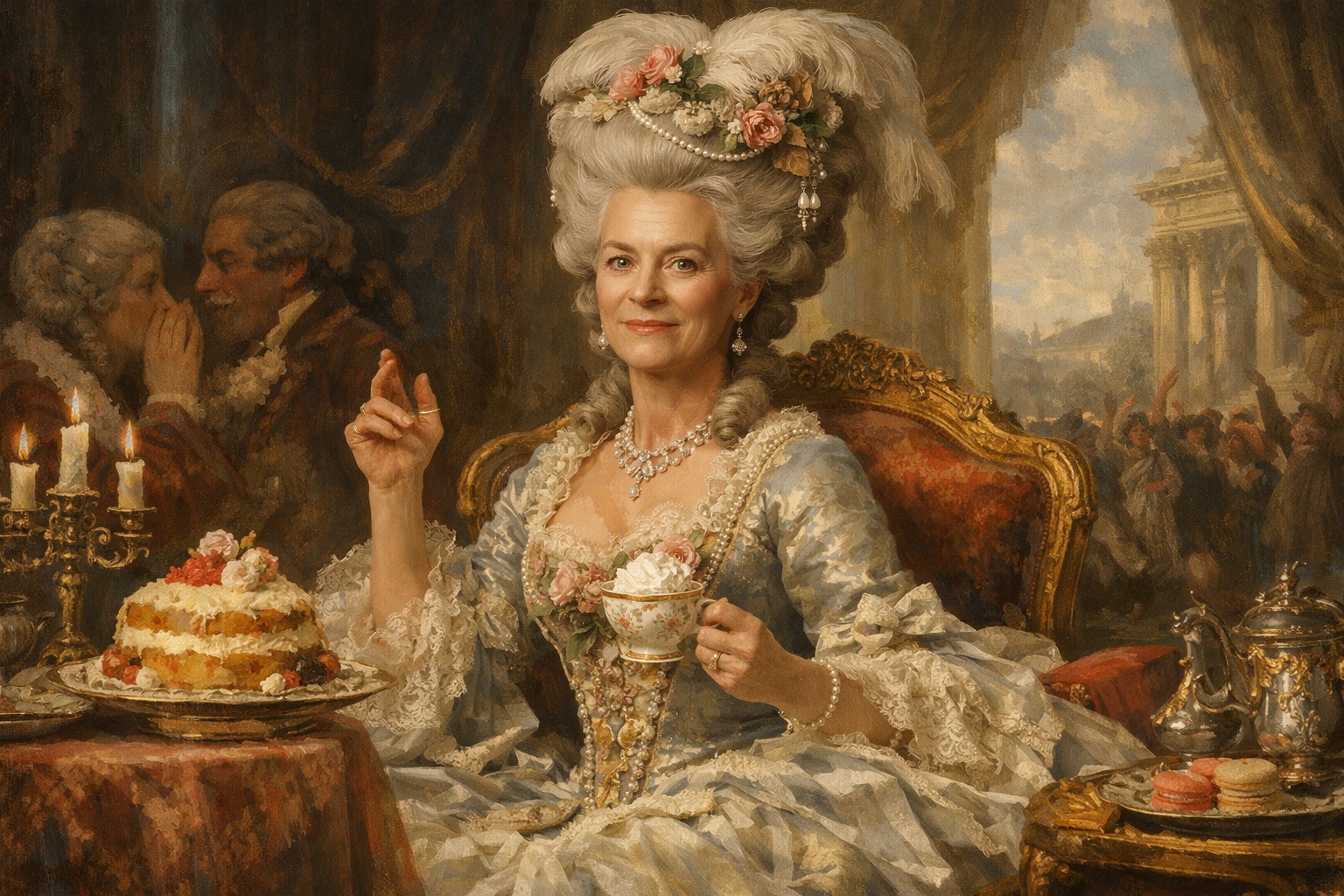
From Marie Antoinette to Ursula von der Leyen: From “Let Them Eat Cake” to “Use Less Energy”

Ursula von der Leyen’s remark that “the cheapest energy is the energy not used” reveals a deep disconnect between EU elites and citizens, exposing a crisis of political empathy amid soaring energy costs.
Panayotis Doumas
Panayotis Doumas Political Advisor & Analyst - NewsFire.GR Director
APRIL 15, 2026 AT 10:01 PM Updated: May 19, 2026 5:04 AM

When Ursula von der Leyen declared with a smile and a touch of self-satisfaction that “the cheapest energy is the energy that isn’t consumed,” she probably believed she was stating a technocratic truth. In reality, she articulated something far more revealing: the gap between the Brussels elite and the everyday lives of European citizens.

Because this phrase is not simply a call for saving energy. It is a political confession. Instead of politics adapting to the needs of citizens, citizens are being asked to adapt to the failure of politics. And here the story comes full, almost ironic, circle. Von der Leyen’s phrase strongly recalls the attributed remark of Marie Antoinette, who — facing popular hunger — is said to have declared: “Let them eat cake.”

The comparison isn’t an exaggeration. It is chillingly accurate. Back then, the aristocracy failed to understand that the people had no bread. Today, the European bureaucracy seems unable to grasp that energy is not a luxury to be limited, but a fundamental necessity for survival, production, and dignified living.

When you tell a worker, a family, or a small-to-medium enterprise that the solution to high energy costs is to consume less energy, what exactly do you mean? To heat less? To produce less? To live less?

This statement is not just unfortunate. It reveals a deeper mindset: that reducing demand is a substitute for reducing costs. That the problem is not the prices, but the consumption.

And yet, the very political leadership encouraging “saving” today is the same that contributed to shaping an energy market that is highly vulnerable, overregulated, and dependent on external factors.

The irony is almost poetic: first you limit choices, raise costs, weaken energy self-sufficiency — then you ask citizens to adapt to the new normal.

Just like back then!

The French Revolution did not erupt because a phrase was uttered. It erupted because that phrase reflected a reality: the complete severance of power from society.

And today, such statements serve as a reminder that when politics stops solving problems and starts shifting them onto citizens, we do not just have mismanagement. We have a crisis of perception!

And such crises are always the most dangerous.

Share:
Panayotis Doumas
Panayotis Doumas

He was born in Athens and is a journalist and producer of online television programs. He attended the Athens College and studied Law and History in Freiburg, Germany. He was an entrepreneur for many years and served as Vice President of the Athens Chamber of Commerce from 2012 to 2015. He has worked as a journalist for the media groups DNM GROUP and ESTIA INVESTMENT GROUP and has contributed articles to the newspapers "Dimokratia," "Estia," "Eleftheri Ora," and "Eleftheros Kosmos," the magazine "STRATEGIKI," and the websites PRONEWS and NEWSBREAK. He is a correspondent for the German weekly newspaper "Junge Freiheit." He is one of the key contributors to the Network of Greek Conservatives and the online channel Right2TheBone.

When Ursula von der Leyen declared with a smile and a touch of self-satisfaction that “the cheapest energy is the energy that isn’t consumed,” she probably believed she was stating a technocratic truth. In reality, she articulated something far more revealing: the gap between the Brussels elite and the everyday lives of European citizens.

Because this phrase is not simply a call for saving energy. It is a political confession. Instead of politics adapting to the needs of citizens, citizens are being asked to adapt to the failure of politics. And here the story comes full, almost ironic, circle. Von der Leyen’s phrase strongly recalls the attributed remark of Marie Antoinette, who — facing popular hunger — is said to have declared: “Let them eat cake.”

The comparison isn’t an exaggeration. It is chillingly accurate. Back then, the aristocracy failed to understand that the people had no bread. Today, the European bureaucracy seems unable to grasp that energy is not a luxury to be limited, but a fundamental necessity for survival, production, and dignified living.

When you tell a worker, a family, or a small-to-medium enterprise that the solution to high energy costs is to consume less energy, what exactly do you mean? To heat less? To produce less? To live less?

This statement is not just unfortunate. It reveals a deeper mindset: that reducing demand is a substitute for reducing costs. That the problem is not the prices, but the consumption.

And yet, the very political leadership encouraging “saving” today is the same that contributed to shaping an energy market that is highly vulnerable, overregulated, and dependent on external factors.

The irony is almost poetic: first you limit choices, raise costs, weaken energy self-sufficiency — then you ask citizens to adapt to the new normal.

Just like back then!

The French Revolution did not erupt because a phrase was uttered. It erupted because that phrase reflected a reality: the complete severance of power from society.

And today, such statements serve as a reminder that when politics stops solving problems and starts shifting them onto citizens, we do not just have mismanagement. We have a crisis of perception!

And such crises are always the most dangerous.

