Necessary Cookies

Required for the site to function. Cannot be disabled.

Analytics Cookies

Help us understand how visitors interact with our site (Google Analytics via GTM).

Marketing Cookies

Used to track visitors and deliver personalised advertisements.

We use cookies to enhance your browsing experience and analyse site traffic. By clicking Accept All, you consent to our use of cookies. Privacy Policy
NewsFire Global
Home News Europe World Christianity Culture Wars Opinion Video
Information
About Us Authors Advertising Terms & Conditions Privacy Policy Contact
R2B Media
R2B NEWSFIRE.GR PAPAFOTIS.GR THRACTION HELLENIC CONSERVATIVES RIGHT2THEBONE YT
News Europe

EU Sends New Defense Payment to Ukraine for Military Arms

The European Commission transferred €3.47 billion to Ukraine on July 30 for military equipment including drones and fighter jets as part of a €90 billion EU support package.

Dimitris Papafotis
Dimitris Papafotis Editor in Chief
JULY 30, 2026 AT 4:58 PM

According to Brussels Signal, the latest disbursement brings total payments under the loan’s defence component to €8.5 billion, with overall transfers now reaching €11.7 billion since the programme’s launch.

The funds will support an expanded Ukrainian drone procurement initiative that includes long-range jet-powered unmanned systems, along with missile systems and Saab Gripen fighter jets, Brussels confirmed.

Commission budget spokesman Balazs Ujvari signaled that the flow of military aid would continue without interruption through the traditional summer recess. He told reporters that additional financing programmes and transfers would receive approval in the weeks and months ahead, describing the coming period as intense with no holiday break in the process.

The Commission has set an ambitious target of moving €28.3 billion to Ukraine this year specifically to expand Ukrainian military industrial capacity.

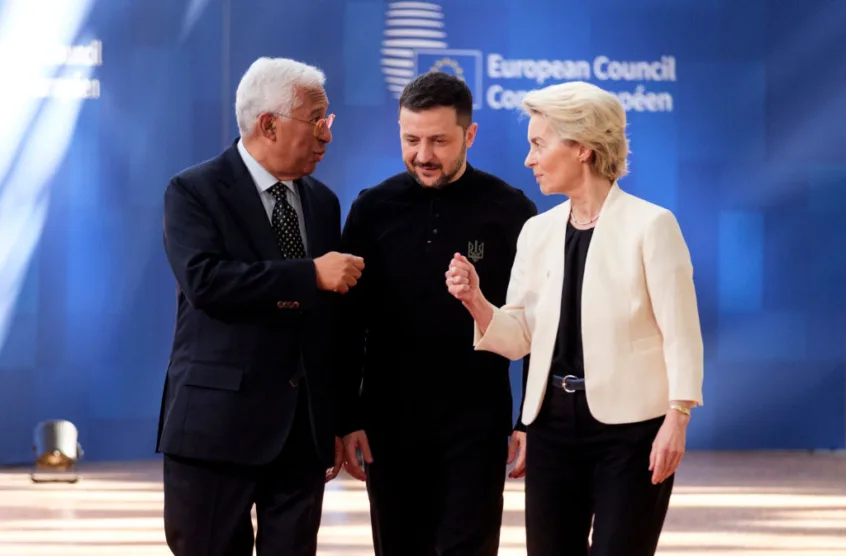
Commission President Ursula von der Leyen framed the support as strengthening Ukraine’s air defence capabilities and civilian protection while deepening ties between European and Ukrainian defence industries. She stated that Russian attacks only reinforce Ukraine’s resolve for freedom.

The July 30 payment follows a €3.2 billion transfer on June 25 designated for macro-financial assistance to maintain Ukrainian state functions and public services. An additional €3.9 billion was released on June 30 for drone procurement, followed by €1 billion during von der Leyen’s Kiev visit on July 15.

Hungarian Blockade Broken After Orbán Defeat

EU leaders reached agreement on the €90 billion loan package in December 2025, but implementation stalled for months due to Hungarian opposition. The Council of the European Union finalized the scheme on April 23, after Viktor Orbán’s electoral defeat brought a new government to power in Budapest.

Czechia, Hungary and Slovakia declined to participate in the programme, prompting the remaining member states to proceed under enhanced cooperation procedures that bypass the unanimity requirement.

The loan structure allocates €60 billion for defence industrial capacity and €30 billion for budget support across 2026 and 2027. Financing is secured through common EU borrowing on capital markets with backing from the EU budget.

Under the loan’s terms, Ukraine assumes repayment liability for the principal only if it secures war reparations from Russia. The Commission has estimated debt servicing costs at approximately €1 billion in 2027, rising to around €3 billion annually from 2028, to be carried by the EU budget.

The funding announcement came as Russian air strikes killed at least eight people across Ukraine, including one fatality in Kiev, a day after Ukrainian President Volodymyr Zelensky warned of an imminent large-scale attack.

With information from Brussels Signal

Share:
Dimitris Papafotis
Dimitris Papafotis

Dimitris Papafotis is the editor-in-chief of NewsFire.GR. He was born and raised in Athens. He studied at the Journalism Workshop (1991-1993). He currently lives in Pyrgos, Ilia, where he has been active in radio and various newspapers, while also maintaining his personal blog, Papafotis.gr.

According to Brussels Signal, the latest disbursement brings total payments under the loan’s defence component to €8.5 billion, with overall transfers now reaching €11.7 billion since the programme’s launch.

The funds will support an expanded Ukrainian drone procurement initiative that includes long-range jet-powered unmanned systems, along with missile systems and Saab Gripen fighter jets, Brussels confirmed.

Commission budget spokesman Balazs Ujvari signaled that the flow of military aid would continue without interruption through the traditional summer recess. He told reporters that additional financing programmes and transfers would receive approval in the weeks and months ahead, describing the coming period as intense with no holiday break in the process.

The Commission has set an ambitious target of moving €28.3 billion to Ukraine this year specifically to expand Ukrainian military industrial capacity.

Commission President Ursula von der Leyen framed the support as strengthening Ukraine’s air defence capabilities and civilian protection while deepening ties between European and Ukrainian defence industries. She stated that Russian attacks only reinforce Ukraine’s resolve for freedom.

The July 30 payment follows a €3.2 billion transfer on June 25 designated for macro-financial assistance to maintain Ukrainian state functions and public services. An additional €3.9 billion was released on June 30 for drone procurement, followed by €1 billion during von der Leyen’s Kiev visit on July 15.

Hungarian Blockade Broken After Orbán Defeat

EU leaders reached agreement on the €90 billion loan package in December 2025, but implementation stalled for months due to Hungarian opposition. The Council of the European Union finalized the scheme on April 23, after Viktor Orbán’s electoral defeat brought a new government to power in Budapest.

Czechia, Hungary and Slovakia declined to participate in the programme, prompting the remaining member states to proceed under enhanced cooperation procedures that bypass the unanimity requirement.

The loan structure allocates €60 billion for defence industrial capacity and €30 billion for budget support across 2026 and 2027. Financing is secured through common EU borrowing on capital markets with backing from the EU budget.

Under the loan’s terms, Ukraine assumes repayment liability for the principal only if it secures war reparations from Russia. The Commission has estimated debt servicing costs at approximately €1 billion in 2027, rising to around €3 billion annually from 2028, to be carried by the EU budget.

The funding announcement came as Russian air strikes killed at least eight people across Ukraine, including one fatality in Kiev, a day after Ukrainian President Volodymyr Zelensky warned of an imminent large-scale attack.

With information from Brussels Signal

