
EU Proposes 100,000-Strong Army for Continent’s Security, Official Says
The EU proposes a 100,000-strong army and a Security Council to assert strategic autonomy as reliance on US-led defense wanes amid rising geopolitical tensions and calls for unified European leadership.
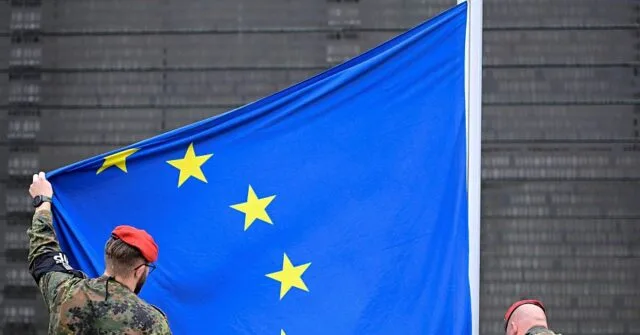

The European Union proposes the creation of an army of 100,000 soldiers and the establishment of a “European Security Council” as the era of “Pax Americana” has come to an end, a top commissioner declared.
The European Union aims to develop a parallel defense structure that will mirror many of the functions currently performed by the NATO alliance, said EU Defense Commissioner Antonius Kubilius at a military conference in Switzerland. While focusing on the war in Ukraine and the growing threat from Russia, he also mentioned other geopolitical challenges that, he said, make the need for European independence more urgent. Among these are the new US National Security Strategy, America’s pivot to the Pacific, actions by former President Donald Trump in Venezuela, and “threats to Greenland.”
The US officially asks us to be ready to take responsibility for the conventional defense of Europe. And we cannot refuse this proposal.
Kubilius emphasized that the era of “Pax Americana” is over.
The Lithuanian Commissioner, who grew up under Soviet rule, clarified that the proposals he is making are not new but were suggested a decade ago by the former President of the European Commission, Jean-Claude Juncker. Indeed, concerns about the prospect of a unified European army were considered one of the main reasons that led the United Kingdom to vote in favor of leaving the EU in 2016.
Even after Brexit, Great Britain does not seem to be excluded from the sovereignty-pooling plan, according to Kubilius, who said that non-EU members such as the UK, Ukraine, and Norway should also join this unified military project.
Referring to predecessors who described the EU’s 27 national armed forces as “bonsai armies,” Kubilius called for the creation of a new force of 100,000 European soldiers, comparing his plan to the federal armed forces of the United States. He stated:
“…We need to answer a very simple question: would the United States be militarily stronger if it had 50 state armies instead of one federal army? If our answer is ‘no,’ then – what are we waiting for?”
The new pan-European military force is only part of Kubilius’s plan. Highlighting the lack of “proper unified leadership” in Europe, he also called for the establishment of a European Security Council to “discuss the most important defense issues… quickly preparing key decisions.” Its first mission would be Ukraine, he said.
Simply increasing spending is not enough; it also requires the political will to fight – to deter the unwelcome presence of enemies in Europe.
Many of the ambitions mentioned for European defense as a whole are already included within the NATO framework and do not outline how the European Union can achieve better results in more complex areas. These include Europe’s fragmented defense industry, where several national companies maintain jobs and ensure sovereignty, although decades of successful NATO standardization have yielded limited results.
The perception that the European Union will not be taken seriously on the global stage or cannot exert real power without an army has existed in Brussels’s dining rooms for decades, with some steps taken toward its realization. The Eurocorps was founded in the 1990s and gathers troops detached from EU member states: its soldiers wear their national uniforms but also bear European insignia.
There are also EUFOR, a European Naval Force, an EU battle group, and the European Defence Agency, although in most cases they have achieved less than what a small European army could offer.





