
Erdoğan: EU Membership No Longer Priority for Turkey
Turkish President Erdogan declared EU membership is no longer a priority for Ankara after 53 years of rejection, though he said Turkey remains open to joining if invited.
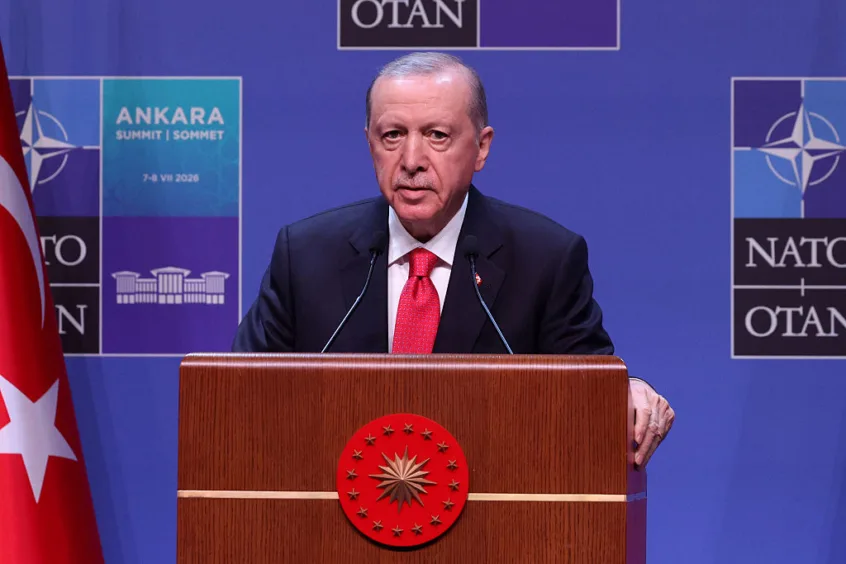

Turkish President Erdogan on EU:
Europe has not accepted Türkiye in its ranks for 53 years and is not thinking of accepting it in the coming period either.
The EU is not a priority for us.
We keep telling the European Union: you are the ones who will lose, not Türkiye. pic.twitter.com/7ZMU3AF1dH
— Clash Report (@clashreport) August 16, 2026
In remarks broadcast on Al Jazeera Arabic on August 16, Erdogan made clear that his government has shifted away from viewing EU membership as central to Turkey’s national interests, according to Brussels Signal.
The European Union is not a priority for us, the Turkish president stated during an interview with Al Muqabala that coincided with the 25th anniversary of his ruling Justice and Development Party.
Erdogan argued that Europe has consistently refused to accept Turkey into its ranks for over five decades, though he did not provide a precise starting date for that timeframe. Turkey signed the Ankara Agreement with the European Economic Community in 1963 and formally applied for full membership on April 14, 1987.
Despite the dismissive tone, Erdogan insisted Turkey has not completely abandoned the prospect of joining the bloc. He framed any European rejection as Brussels’ loss rather than Ankara’s, suggesting the EU would suffer more from Turkey’s exclusion than Turkey itself.
The Turkish leader maintained that his government remains open to membership if the EU extends an invitation, but stressed that rejection would be equally acceptable to Ankara.
Decades of Stalled Negotiations
Turkey has held official candidate status since 1999. Formal accession talks began in October 2005 but have remained frozen for years amid mounting European concerns over democratic governance, rule of law standards and fundamental rights protections.
Of 35 negotiating chapters, only 16 have been opened and just one provisionally closed, according to the Council of the European Union. The most recent intergovernmental conference with Ankara took place on June 30, 2016.
In June 2018, the General Affairs Council formally acknowledged that negotiations had reached a complete standstill, with no further chapters to be opened or closed and no additional work planned on modernising the EU-Turkey Customs Union.
Successive European Commission reports have documented restrictions on freedom of expression, compromised judicial independence and troubling treatment of opposition figures. The Commission’s 2025 enlargement report assessed Turkey as being at an early stage regarding judiciary and fundamental rights standards.
Regional Defence Pact and NATO Parallels
During the same interview, Erdogan addressed the recent defence agreement signed by Turkey, Pakistan and Saudi Arabia at the Safa Palace in Mecca on August 7, as Brussels Signal reports.
He characterized the pact as functioning similarly to NATO’s Article 5 collective defence provision, grounded in Article 51 of the United Nations Charter covering self-defence rights. Under the agreement, if any signatory faces attack, the others would respond jointly.
Erdogan indicated that Egypt could potentially join the arrangement in the future. Saudi Arabia and Pakistan had previously signed a separate mutual defence agreement in September 2025.
F-35 Programme and US Relations
On military cooperation with Washington, the Turkish president said he expects US President Donald Trump to honor a commitment regarding Turkey’s readmission to the F-35 fighter jet programme.
Turkey was expelled from the programme in 2019 after purchasing Russia’s S-400 air defence system, a move that triggered significant tensions with NATO allies.
Financial Exclusion from EU Defence Funding
The comments emerge amid ongoing friction in Turkey-EU relations. Ankara has pressed for access to the EU’s €150 billion Security Action for Europe loan instrument, from which Turkish firms remain excluded.
Third countries may participate in SAFE projects up to a 35 percent ceiling, European Commission spokesman Thomas Regnier stated on June 29, noting that lifting that cap would require a bilateral agreement Brussels has not concluded with Ankara. Greece has indicated it would block any such arrangement.
With information from Brussels Signal





