
Democracy Shield Targets Disinformation Threats in Europe
The European Parliament committee tasked with scrutinizing the European Democracy Shield instead endorsed expanding the controversial program despite dissenting members' concerns about overreach.
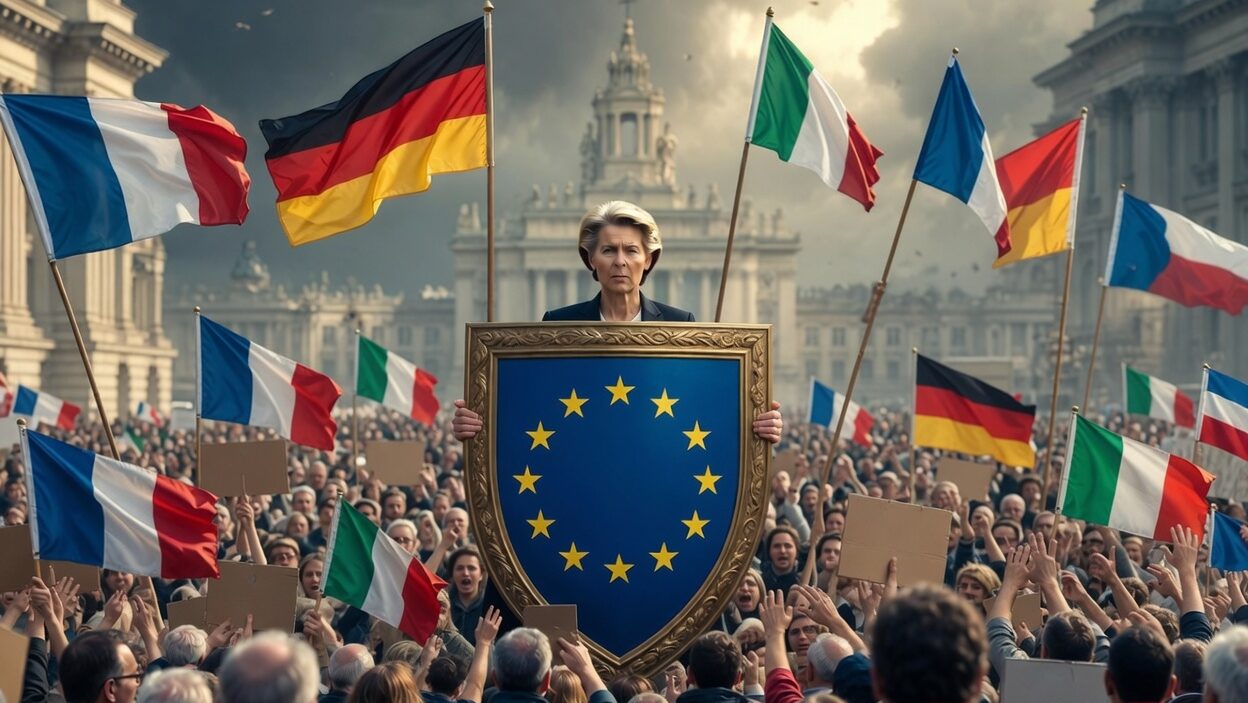

The Special Committee on the European Democracy Shield was meant to examine one of Brussels’ most ambitious political initiatives: a sweeping system designed to protect European democracy from alleged foreign interference and disinformation. Its mandate should have been clear—interrogate the purpose of the Shield, identify who determines what constitutes a threat, and ask whether defending democracy from manipulation could itself become a tool for manipulating democracy.
Instead, the committee’s draft report reads less like critical oversight and more like institutional cheerleading, according to The European Conservative. Rather than raising concerns about potential overreach, the committee concluded that the Democracy Shield requires more funding, more coordination, more legal authority, more monitoring capacity, and more permanent institutional infrastructure.
The report essentially transforms a Commission proposal into a Parliament-endorsed program of indefinite expansion. Where the European Commission suggested a shield, the committee demands a fortress. Where coordination was proposed, operational authority is now requested. Where existing initiatives were mapped, integration and legal codification are now sought.
Dissenting Voices Sidelined
Not all committee members embraced this trajectory. Several representatives courageously attempted to constrain what they viewed as the Shield’s anti-democratic elements, raising legitimate concerns about freedom of speech, political neutrality, institutional mission creep, and the outsourcing of democratic judgment to non-governmental organizations and technical experts.
These dissenting voices warned that the language of “resilience” could become a euphemism for censorship and that “information integrity” might serve as cover for political supervision. However, these members were effectively marginalized because scrutiny was never the committee’s intended function.
A System That Immunizes Itself From Criticism
The committee’s approach creates a self-reinforcing logic where questioning the Democracy Shield becomes evidence of the need for the Democracy Shield. Those concerned about information integrity are treated as proof of the information integrity crisis. Those asking who fact-checks the fact-checkers are deemed in need of media literacy training.
The more citizens question the system, the more necessary the system appears to become—a circular reasoning that insulates the project from democratic accountability.
Expansion Disguised as Oversight
The committee determined that the Shield urgently requires additional mandates, mechanisms, platforms, protocols, monitoring centers, databases, expert groups, civil society partners, media literacy schemes, election-monitoring capacity, sanctions frameworks, preparedness exercises, and substantially increased funding.
Parliamentary committees traditionally serve as checks on executive ambition, interrogating power and demanding limits. They protect citizens from institutional enthusiasm and insist on clear definitions before granting new authorities. This committee, however, has performed what The European Conservative describes as a more advanced function: applause.
The language employed is deliberately reassuring. Nothing is censored—it is “mitigated.” Nothing is policed—it is “coordinated.” Citizens are not managed—they are “empowered.” The public sphere is not controlled—it is made “resilient.”
Democratic Scrutiny Converted Into Endorsement
What should have been a clarifying democratic moment—elected representatives examining whether protecting democracy from manipulation might itself manipulate democracy—has instead become institutional validation for expanding the very project under review.
Brussels has demonstrated a peculiar talent for converting scrutiny into liturgy, treating the Commission’s Democracy Shield proposal not as a potential danger requiring careful examination but as a preliminary blueprint for what amounts to a Ministry of Democratic Correctness.
The Special Committee’s draft report represents a fundamental inversion of parliamentary oversight. Rather than asking whether the cure might be worse than the disease, it prescribes a larger dose. Rather than worrying about unintended consequences, it calls for acceleration. Rather than exercising caution, it demands a dedicated budget line.
With information from The European Conservative





