Necessary Cookies

Required for the site to function. Cannot be disabled.

Analytics Cookies

Help us understand how visitors interact with our site (Google Analytics via GTM).

Marketing Cookies

Used to track visitors and deliver personalised advertisements.

We use cookies to enhance your browsing experience and analyse site traffic. By clicking Accept All, you consent to our use of cookies. Privacy Policy
NewsFire Global
Home News Europe World Christianity Culture Wars Opinion Video
Information
About Us Authors Advertising Terms & Conditions Privacy Policy Contact
R2B Media
R2B NEWSFIRE.GR PAPAFOTIS.GR THRACTION HELLENIC CONSERVATIVES RIGHT2THEBONE YT
News Culture Wars

Is the Blank Page Racist?

European activists are accused of weaponising historical facts about ancient Greek polychromy to falsely portray Western aesthetic appreciation as rooted in racial supremacy.
Stefanos Banos
Stefanos Banos Staff Writer
AUGUST 22, 2026 AT 5:36 PM

A controversial debate has emerged in European art history circles, where claims of racial motivations behind classical aesthetics are being used to push contemporary political agendas, according to Causeur. The magazine exposes how modern activists are weaponising ancient polychromy to advance divisive identity politics.

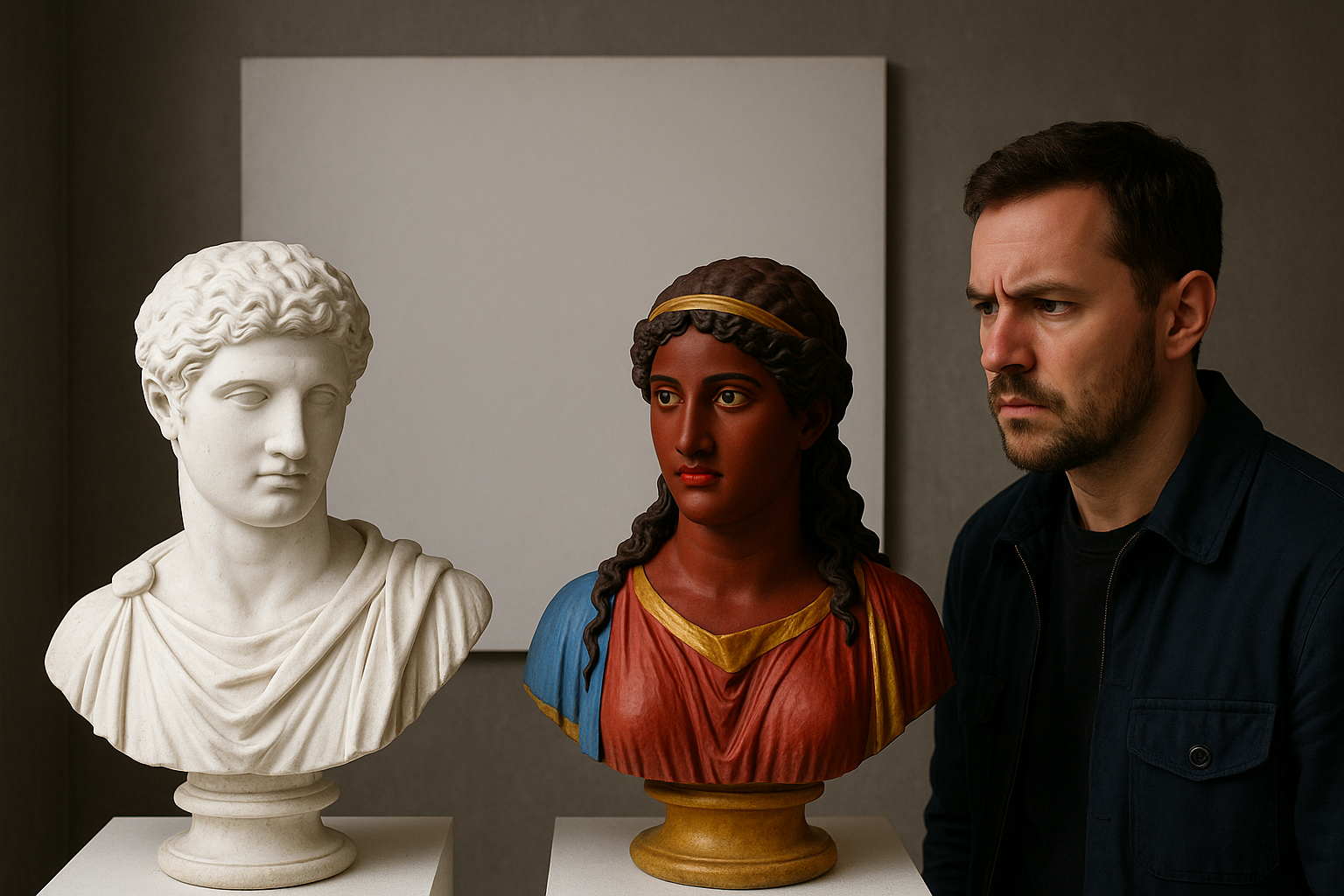
While it is well-established through literary and scientific evidence that Greek temples and statues were originally polychrome, with colours serving as a form of mediation with the gods, time and weathering destroyed these pigments. What survived were often Roman copies in white plaster, creating the visual impression of a monochrome classical world.

Over the past five years, this historical fact has been repurposed by activists and cultural institutions to suggest that the West harbours a pathological fear of colour rooted in racial supremacy. The theory, promoted by outlets including Arte, claims that seventeenth-century classicism imposed an aesthetic and moral ideal of whiteness, nudity, and purity that was later reinforced by racial theorists such as Gobineau in 1853, and exploited by Mussolini and Hitler.

This narrative argues that Westerners are inherently “chromophobic,” suffering from an irrational aversion to colour that supposedly stems from a belief in white racial superiority. The implication is that European appreciation for the bare marble of classical sculpture reflects not aesthetic sensibility but racial ideology.

Rewriting Art History Through Identity Politics

Causeur counters that Western appreciation for classical temples and statues in their current state reflects admiration for their exceptional proportions and pursuit of the golden ratio. The loss of ancient colour is indeed a frustration, as the Greeks who sculpted magnificently surely painted marvellously as well. Yet the fact that Ionian korai were painted with reddish hair does not, the publication argues, mandate contemporary France to embrace demographic transformation.

The same applies to Romanesque art. While Romanesque churches featured painted sections, coloured glass windows, and polychrome statues, representations of black saints were not uncommon in Christian art. Saint Maurice, for instance, an Egyptian-born Roman officer, was depicted with a black face. France is also home to numerous Black Madonnas, portrayed holding their children before them.

Censorship and Racial Engineering in the Arts

The politicisation of classical aesthetics has moved from theory to censorship. On 28 April 2019, a production of Aeschylus’ The Suppliants was blocked at the Sorbonne by activist groups including CRAN and LDNA, who denounced it as “Afrophobic, colonialist, and racist” due to the use of masks resembling blackface, despite these being authentic to ancient Greek theatre.

Contemporary opera houses now enforce racial quotas, mandating equal representation of black and white performers regardless of artistic considerations. The magazine notes wryly that musical notation has not yet been renamed, though it may come, observing that in universal solfège, a white note is worth two black notes.

The Paradox of “Chromophobia”

While anti-white racism was once termed “leucophobia,” denoting an irrational hatred of whiteness, it is now recognised simply as anti-white racism. Causeur raises the question of whether figures such as Jean-Luc Mélenchon, who advocates for the creolisation of the French language and the emergence of a mixed-race French people, might himself be exhibiting a form of chromophobia by demanding the erasure of European cultural identity.

As a pathological condition, chromophobia is not medically recognised. Historically, it has referred primarily to the Reformation-era dispute between Catholic prelates and Protestants over liturgical aesthetics. The fear of blank pages, known in positive psychology as “leucoselidophobia,” affects writers of all backgrounds and has no racial dimension.

Eugène Ionesco, quoted by commentator Mathieu Bock-Côté, wrote in Antidotes that bad faith is an ideological form of madness. If the reigning ideology consists of dewhitening the global order, Causeur asks a provocative closing question: is the blank page racist?

With information from Causeur

Share:
Stefanos Banos
Stefanos Banos

Stefanos Banos was born in Piraeus and is an editor at NewsFire.GR, specializing in political analysis and international relations. He graduated from the Department of Communication and Media at the University of Bremen in Germany, where he also completed his Master of Arts in Communication and Media Studies. Married to Zoi, he is a proud father of three boys.

A controversial debate has emerged in European art history circles, where claims of racial motivations behind classical aesthetics are being used to push contemporary political agendas, according to Causeur. The magazine exposes how modern activists are weaponising ancient polychromy to advance divisive identity politics.

While it is well-established through literary and scientific evidence that Greek temples and statues were originally polychrome, with colours serving as a form of mediation with the gods, time and weathering destroyed these pigments. What survived were often Roman copies in white plaster, creating the visual impression of a monochrome classical world.

Over the past five years, this historical fact has been repurposed by activists and cultural institutions to suggest that the West harbours a pathological fear of colour rooted in racial supremacy. The theory, promoted by outlets including Arte, claims that seventeenth-century classicism imposed an aesthetic and moral ideal of whiteness, nudity, and purity that was later reinforced by racial theorists such as Gobineau in 1853, and exploited by Mussolini and Hitler.

This narrative argues that Westerners are inherently “chromophobic,” suffering from an irrational aversion to colour that supposedly stems from a belief in white racial superiority. The implication is that European appreciation for the bare marble of classical sculpture reflects not aesthetic sensibility but racial ideology.

Rewriting Art History Through Identity Politics

Causeur counters that Western appreciation for classical temples and statues in their current state reflects admiration for their exceptional proportions and pursuit of the golden ratio. The loss of ancient colour is indeed a frustration, as the Greeks who sculpted magnificently surely painted marvellously as well. Yet the fact that Ionian korai were painted with reddish hair does not, the publication argues, mandate contemporary France to embrace demographic transformation.

The same applies to Romanesque art. While Romanesque churches featured painted sections, coloured glass windows, and polychrome statues, representations of black saints were not uncommon in Christian art. Saint Maurice, for instance, an Egyptian-born Roman officer, was depicted with a black face. France is also home to numerous Black Madonnas, portrayed holding their children before them.

Censorship and Racial Engineering in the Arts

The politicisation of classical aesthetics has moved from theory to censorship. On 28 April 2019, a production of Aeschylus’ The Suppliants was blocked at the Sorbonne by activist groups including CRAN and LDNA, who denounced it as “Afrophobic, colonialist, and racist” due to the use of masks resembling blackface, despite these being authentic to ancient Greek theatre.

Contemporary opera houses now enforce racial quotas, mandating equal representation of black and white performers regardless of artistic considerations. The magazine notes wryly that musical notation has not yet been renamed, though it may come, observing that in universal solfège, a white note is worth two black notes.

The Paradox of “Chromophobia”

While anti-white racism was once termed “leucophobia,” denoting an irrational hatred of whiteness, it is now recognised simply as anti-white racism. Causeur raises the question of whether figures such as Jean-Luc Mélenchon, who advocates for the creolisation of the French language and the emergence of a mixed-race French people, might himself be exhibiting a form of chromophobia by demanding the erasure of European cultural identity.

As a pathological condition, chromophobia is not medically recognised. Historically, it has referred primarily to the Reformation-era dispute between Catholic prelates and Protestants over liturgical aesthetics. The fear of blank pages, known in positive psychology as “leucoselidophobia,” affects writers of all backgrounds and has no racial dimension.

Eugène Ionesco, quoted by commentator Mathieu Bock-Côté, wrote in Antidotes that bad faith is an ideological form of madness. If the reigning ideology consists of dewhitening the global order, Causeur asks a provocative closing question: is the blank page racist?

With information from Causeur

