
Cyprus President Meets UN Official Before Secretary-General Visit
Cyprus President Christodoulides met with UN envoy Holguín ahead of Secretary-General Guterres' visit this week to advance stalled reunification talks with Turkish Cypriot leaders.
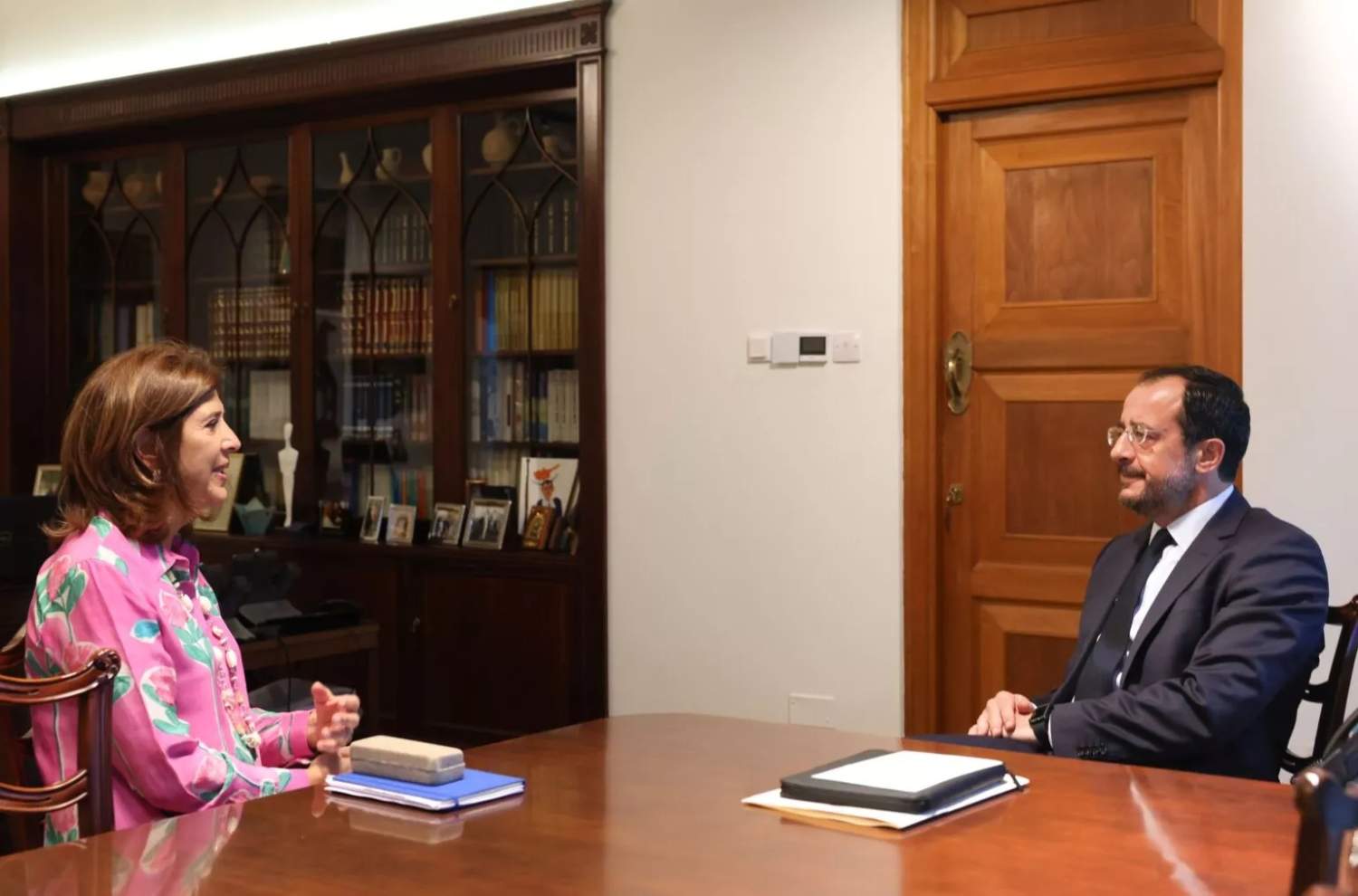

Cyprus President Nikos Christodoulides held talks with the United Nations Secretary-General’s personal envoy on the Cyprus question, María Ángela Holguín, at the Presidential Palace on Sunday, as preparations advance for a high-stakes visit by UN chief António Guterres this week.
According to in-cyprus (Philenews), Government Spokesperson Konstantinos Letymbiotis briefed reporters following the meeting, outlining a packed diplomatic schedule that will see Guterres engage separately with President Christodoulides and Turkish Cypriot leader Tufan Erhürman on Monday morning, followed by a trilateral dinner Monday evening and a joint meeting the following day.
Letymbiotis characterized the Secretary-General’s visit as a potential launching pad for broader international engagement, describing it as the foundation that could lead to the convening of an expanded multilateral conference on the long-stalled Cyprus settlement process.
Envoy Briefs on Turkish Contacts
Holguín updated President Christodoulides on her recent diplomatic outreach, including a meeting with Turkish Foreign Minister Hakan Fidan, before proceeding to meet with Erhürman in the Turkish Pseudostate in Northern Cyprus, Letymbiotis confirmed.
When pressed by reporters on whether Holguín’s account of her exchanges with the Turkish side offered grounds for optimism, the government spokesman struck a cautious tone. He emphasized that Nicosia remains realistic given the substantial obstacles posed by Turkey’s longstanding position on the island. He noted that Guterres and Fidan had spoken by telephone the previous evening, and said the President intends to raise directly with the UN chief the question of whether Ankara is willing to realign its stance with international law.
Nicosia Reaffirms Red Lines
Letymbiotis reiterated that the Republic of Cyprus continues to stand by the settlement framework enshrined in United Nations Security Council resolutions: a bizonal, bicommunal federation with political equality. He described this as the sole common ground between the two communities, the solution endorsed by the Secretary-General and the international community, and the only mandate under which the UN and its envoy are authorized to operate.
The spokesman warned against inflated expectations, given Turkey’s entrenched positions, but stressed that the government would seize any opportunity for meaningful progress. He said Nicosia anticipates that Guterres’s visit will clarify his vision for next steps, including the possible convening of a broader international conference.
Two-State Solution Off the Table
Asked about reports that Fidan had pressed for a two-state solution during his meeting with Holguín, Letymbiotis declined to speak on behalf of the UN envoy regarding the substance of those discussions. However, he stated unequivocally that any proposal departing from the bizonal, bicommunal federation framework cannot be regarded as constructive.
On the question of whether Guterres intends to update or modify the parameters established at the 2017 Crans-Montana talks, Letymbiotis said the government’s objective remains resuming negotiations from the point at which they collapsed at that summit, preserving the progress made in earlier rounds. He underscored that the central question is whether Turkey, which has openly advocated a two-state position since 2021, possesses genuine political will to return to alignment with Security Council resolutions.
No Room for Creative Ambiguity
When asked whether Cyprus is prepared to entertain so-called constructive ambiguities within a settlement framework, Letymbiotis said he could not lend credence to reports that Holguín herself has publicly denied. He added that President Christodoulides has categorically ruled out any ambiguities, creative or otherwise, or any language that could point toward solutions outside the agreed UN framework.
The government spokesman concluded by restating Nicosia’s non-negotiable red lines: safeguarding the sovereignty of the Republic of Cyprus, adherence to the settlement framework set out in Security Council resolutions, and full alignment with European Union law. He emphasized that these positions have been communicated clearly and consistently in every diplomatic engagement, and reflect not only Cyprus’s stance but also that of the broader international community and the European Union.
With information from in-cyprus (Philenews)





