
Court Forces Entry of Rejected Eritrean, Blow to Dobrindt
A Berlin court ordered federal police to admit an Eritrean asylum seeker twice turned away at the border, challenging Interior Minister Alexander Dobrindt's strict enforcement policy.


The Berlin Administrative Court issued an emergency ruling on May 22, 2026, compelling the Federal Police to allow a 29-year-old Eritrean man to enter Germany and undergo proper asylum processing procedures, according to Nius. The decision directly challenges the hardline border policy implemented by Alexander Dobrindt of the CSU after he took office as interior minister.
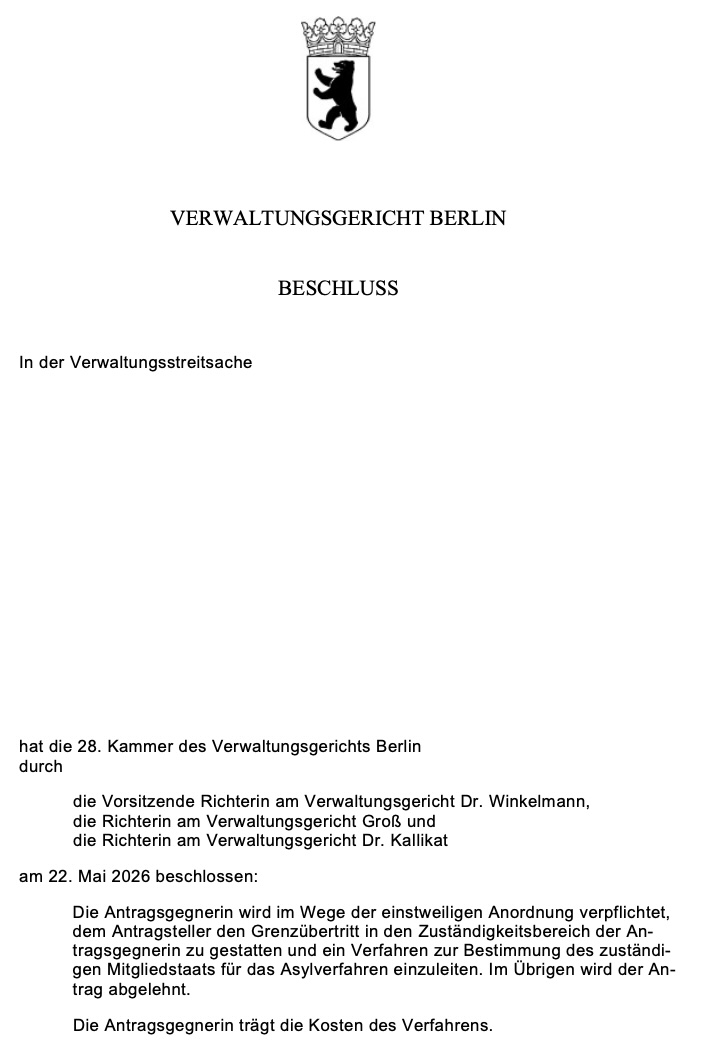
The case involves an asylum seeker who was first turned back by German authorities in September 2025. At that time, federal police issued an entry and residence ban valid until September 2027 and deported him to Poland. The man subsequently filed for international protection in Poland, but his application was never processed.
In March 2026, the individual attempted to cross into Germany again. He was stopped during a control check on March 22 near Gubinek in Brandenburg. Following a hearing with an interpreter on March 23, federal police rejected him a second time. The man maintained that he had expressed an asylum request both during the initial control and throughout the hearing process.
Court Invokes Dublin Regulations
The judges determined that the applicant credibly expressed a request for asylum. According to the court’s interpretation, once a person seeks protection at the border, the Dublin III Regulation takes precedence over national immigration and asylum laws. The 28th Chamber explicitly followed the legal reasoning of the 6th Chamber, which had ruled similarly in June 2025 in a comparable case involving three Somali nationals.
Because an asylum request was on record, the court concluded that German authorities must first determine which EU member state bears responsibility for examining the application. The ruling establishes that federal police cannot simply turn back asylum seekers without initiating the Dublin procedure to establish jurisdiction.
Dobrindt’s Border Strategy Under Fire
Since taking office, Dobrindt has intensified border controls and directed the Federal Police to turn back asylum seekers arriving from safe third countries such as Poland. The policy aims to reduce illegal entries and pressure the broader EU asylum system into reform. The minister has repeatedly characterized adverse court rulings as isolated cases that do not warrant fundamental policy changes.
Critics of the border policy view this latest ruling as further confirmation that Germany’s rejection practices violate European law. Supporters counter that functional borders remain essential as long as the Dublin system fails to operate effectively and external EU borders remain inadequately protected.
The introduction of the new EU asylum system, known as GEAS, in June 2026 was supposed to accelerate such procedures and resolve jurisdictional disputes more efficiently. However, this ruling suggests that German authorities must still comply with existing Dublin protocols regardless of domestic border enforcement priorities.
With information from Nius





