Necessary Cookies

Required for the site to function. Cannot be disabled.

Analytics Cookies

Help us understand how visitors interact with our site (Google Analytics via GTM).

Marketing Cookies

Used to track visitors and deliver personalised advertisements.

We use cookies to enhance your browsing experience and analyse site traffic. By clicking Accept All, you consent to our use of cookies. Privacy Policy
NewsFire Global
Home News Europe World Christianity Culture Wars Opinion Video
Information
About Us Authors Advertising Terms & Conditions Privacy Policy Contact
R2B Media
R2B NEWSFIRE.GR PAPAFOTIS.GR THRACTION HELLENIC CONSERVATIVES RIGHT2THEBONE YT
News Culture Wars

Budapest Nationalists Remove Pride Flags, Restore Hungarian Tricolors

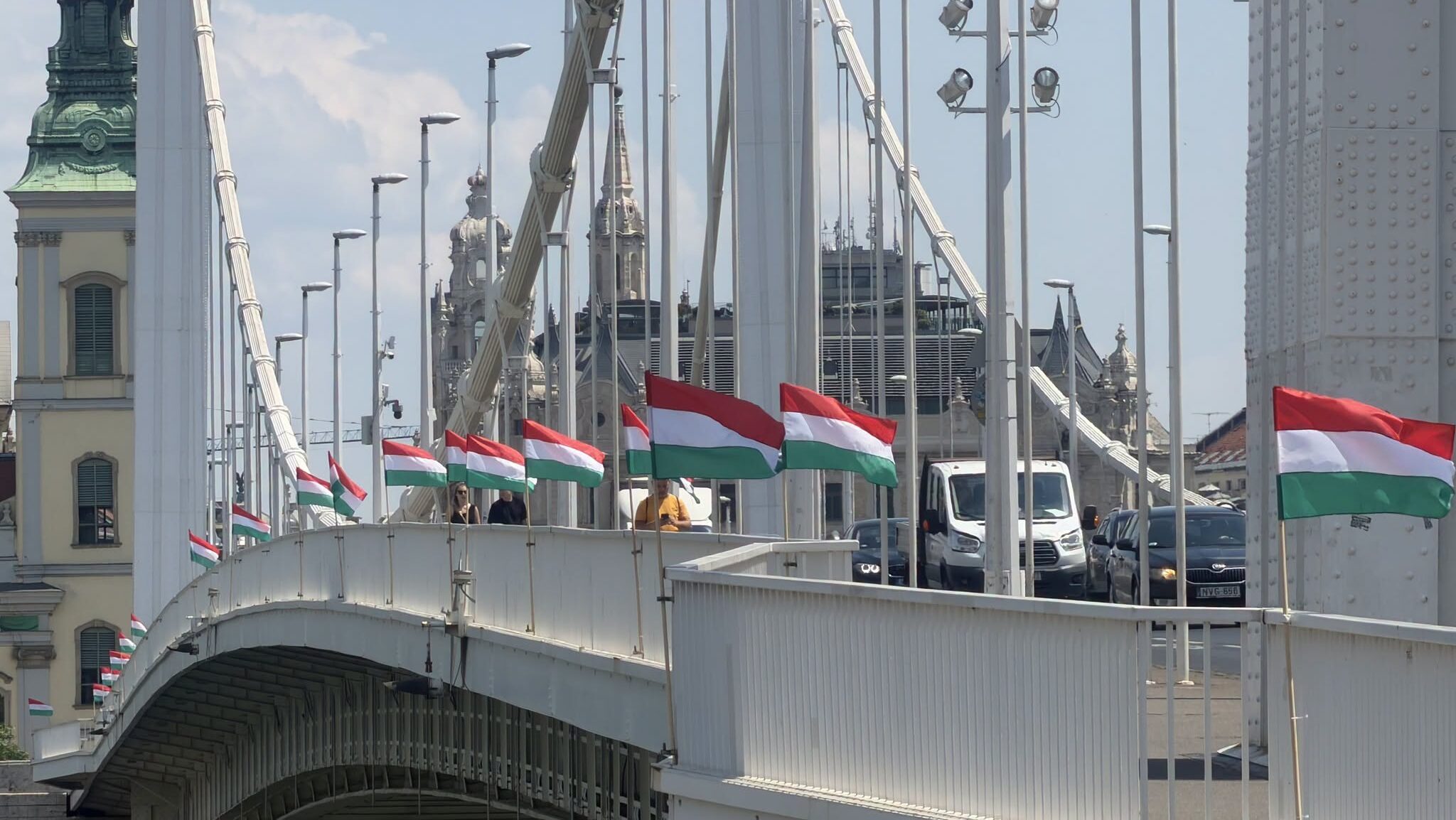
Hungary's nationalist Our Homeland Movement replaced Pride flags on Budapest's Elisabeth Bridge with national flags after a protester threw the original banners into the Danube River.
Stefanos Banos
Stefanos Banos Staff Writer
JUNE 24, 2026 AT 5:52 PM

The ongoing battle over public flag displays in Budapest has taken a fresh turn this week, with dozens of Hungarian national flags suddenly appearing along Elisabeth Bridge after Pride banners that previously occupied the same spots were removed and discarded into the Danube River.

According to The European Conservative, the origin of the new flags was swiftly disclosed by Előd Novák, vice-president of the nationalist Our Homeland Movement, known locally as Mi Hazánk. Novák confirmed that he personally participated in the operation alongside members of the party’s youth organization, methodically placing a Hungarian national flag in every available pole holder across the span of the bridge.

The flag installation occurred in the narrow window between the removal of the Pride flags by a protester, who threw them into the Danube, and any potential attempt by the city administration to reinstall them. Budapest’s municipal leadership, under its current mayor, had originally authorized the display of the Pride banners on the prominent bridge crossing.

Novák framed the action as a statement about national identity and shared public space, asserting that the Hungarian capital belongs to all its residents. The Our Homeland Movement has consistently positioned itself as a defender of traditional Hungarian values and national symbols in the face of what it characterizes as globalist cultural pressures.

The incident represents the latest chapter in an intensifying dispute over the use of public infrastructure for political and cultural messaging. Elisabeth Bridge, one of Budapest’s most visible landmarks spanning the Danube, has now become the focal point of competing visions for Hungarian identity and public expression.

Local authorities have not yet announced whether they will take action regarding the nationalist party’s unauthorized flag placement, though the situation continues to develop as both sides assert their claims to control symbolic displays in Hungary’s capital city.

With information from The European Conservative

Share:
Stefanos Banos
Stefanos Banos

Stefanos Banos was born in Piraeus and is an editor at NewsFire.GR, specializing in political analysis and international relations. He graduated from the Department of Communication and Media at the University of Bremen in Germany, where he also completed his Master of Arts in Communication and Media Studies. Married to Zoi, he is a proud father of three boys.

The ongoing battle over public flag displays in Budapest has taken a fresh turn this week, with dozens of Hungarian national flags suddenly appearing along Elisabeth Bridge after Pride banners that previously occupied the same spots were removed and discarded into the Danube River.

According to The European Conservative, the origin of the new flags was swiftly disclosed by Előd Novák, vice-president of the nationalist Our Homeland Movement, known locally as Mi Hazánk. Novák confirmed that he personally participated in the operation alongside members of the party’s youth organization, methodically placing a Hungarian national flag in every available pole holder across the span of the bridge.

The flag installation occurred in the narrow window between the removal of the Pride flags by a protester, who threw them into the Danube, and any potential attempt by the city administration to reinstall them. Budapest’s municipal leadership, under its current mayor, had originally authorized the display of the Pride banners on the prominent bridge crossing.

Novák framed the action as a statement about national identity and shared public space, asserting that the Hungarian capital belongs to all its residents. The Our Homeland Movement has consistently positioned itself as a defender of traditional Hungarian values and national symbols in the face of what it characterizes as globalist cultural pressures.

The incident represents the latest chapter in an intensifying dispute over the use of public infrastructure for political and cultural messaging. Elisabeth Bridge, one of Budapest’s most visible landmarks spanning the Danube, has now become the focal point of competing visions for Hungarian identity and public expression.

Local authorities have not yet announced whether they will take action regarding the nationalist party’s unauthorized flag placement, though the situation continues to develop as both sides assert their claims to control symbolic displays in Hungary’s capital city.

With information from The European Conservative

