Bakogiannis answered ‘call’ to do parachute stunt, but decree says otherwise
Athens former Mayor and nephew of PM Mitsotakis, Kostas Bakoyannis posted photos from military parachute jumps framing them as answering a duty call, though he voluntarily applied for the reserve training exercise.
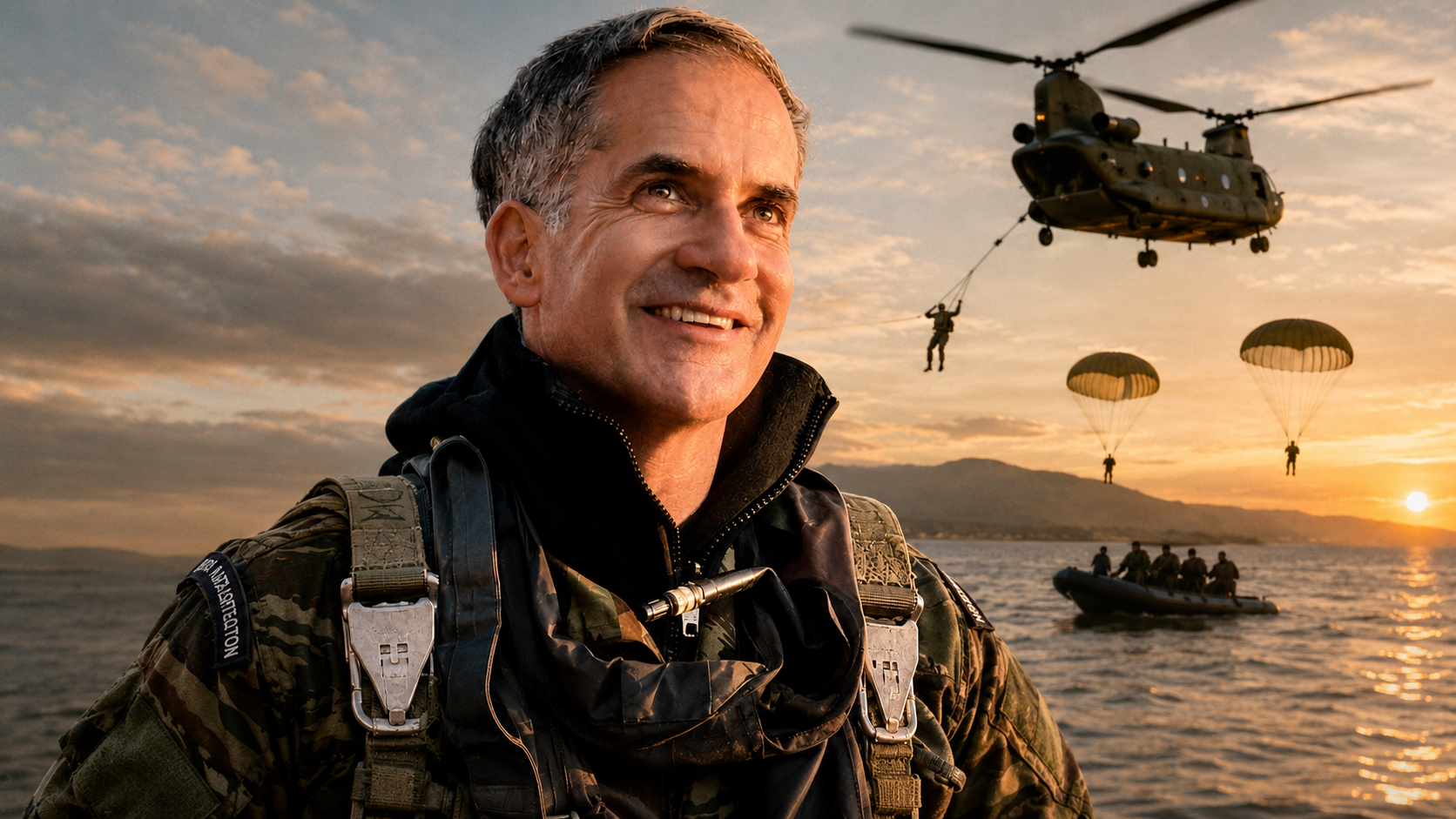

“An honor to be called. A duty to respond.” With this solemn conclusion, Kostas Bakoyannis accompanied the photos and videos from his two parachute jumps in Nea Peramos, on July 8, where the Hellenic National Defence General Staff organized “Reservist Paratroopers Retraining in operational static line jump,” with the participation of the Chief of General Staff himself, General Dimitrios Houpis.
Δείτε αυτή τη δημοσίευση στο Instagram.
Small problem: There was no call. The activity is part of, as the official announcement itself states, the institution of “Active Voluntary Reserve Service.” Voluntary, meaning following an application by the interested party—not following an Individual Call-Up Notice delivered by the neighborhood police officer. When you yourself apply to participate and then celebrate the “call” you “honored,” then either you don’t understand the difference or you’re betting that your reader doesn’t. And Mr. Bakoyannis is not someone who doesn’t understand.
I owe a clarification here, not for show but for documentation purposes: I’m dealing with this subject because I served my entire military service in the 1st Parachute Battalion. And I’m not, of course, the only one; thousands of Greeks have passed through the Parachute Battalions, with a weapon assigned in their name—a weapon that during their service jumps they carried on them, along with a load of at least 30 kilos. What follows, then, is not theory from press releases.
Why Two Jumps and Not One
The current Joint Ministerial Decision on hazard allowances (Government Gazette B’ 1762/2017, as amended in 2018) is clear: eligible recipients of the parachutist jump allowance are qualified parachutists—regular and reserve—provided they complete two jumps per semester. The amount is not negligible: €2,382.89 per semester for officers and warrant officers, €1,949.63 for professional NCOs and volunteer privates, €1,575.85 for conscripts and reserve privates.
Two jumps, then. Not one, not three. Exactly the number that “fits” the prerequisite for the qualifying semester. I’m not claiming that Mr. Bakoyannis collected or will collect the allowance, although he should—but that precisely is one of the questions that must be officially answered. I’m simply pointing out that the arithmetic of the day was not random, and that anyone who has gone through Parachutes understands it at first glance.
The Allowance by the Dropper
And here things get interesting. The parachute jump allowance system is not open; it’s closed like a stopcock. The JMD itself stipulates that the total expenditure in the relevant code (ΚΑΕ 0434) is not permitted to exceed the specified amount, except by a new joint decision of the Ministers of National Defense and Finance. It also stipulates that for privates the allowance is paid “up to a maximum number of beneficiaries determined by the Hellenic Army General Staff.” And—best of all—Appendix “B,” the very one that determines the maximum number of beneficiaries, is not even published in the Government Gazette.
In plain Greek: there is a closed, non-transparent number of allowance “positions.” The ballot is institutionalized. And when positions are counted, the question is no longer technical but deeply political: Who decides who gets them?
Let’s do the calculation that no official wants to do publicly. My Battalion (commando regiment) alone numbered about 400 people back then. If they were all called for one qualifying semester, the bill would exceed 600,000 euros. If we also include retired officers and NCOs, it would be much more. One Battalion, one semester. Now extend the calculation to decades of parachutist reserves and you understand why, in my long personal experience and familiarity with the field, a reserve parachutist with a qualifying jump in an official military exercise is a species rarer than a sincere pre-election pledge. The system, quite simply, ensures it doesn’t happen. Why? Because it costs money.
A Reserve That Never Even Saw the New Weapons
The issue, however, is not just the jumps. It’s the total abandonment of the Special Forces reserve. My generation was trained on FN rifles—Standard, Para (I myself carried one) and Fallow. A few years later, the Special Forces switched to the M-16. How many of us have been called since then for retraining on the new weaponry, with which we’re supposedly going to fight if needed? Very few to none. The undersigned, in fact, when once invited to an exercise—in “Parmenion”—was called for an armored vehicle assignment, even though he holds the rare specialty of cryptographer. “Bureaucratic error,” they told me at the time. As random as the fact that the parachutist reserve is never called where it would cost money.
Thus we arrive at the paradox: the vast majority of Special Forces reservists are not called even to hold in their hands the weapon they will be mobilized with, but for the scion of a political dynasty they found a helicopter, personnel, safety boats and the Chief of General Staff himself for a small-scale sea jump, in the middle of summer, in ideal conditions. And moreover, following his voluntary request and not a “call,” as he maintains.
“Operational” With Swimsuit Weather
And one last point, technical but eloquent: the General Staff announcement characterizes the jump as “operational.” The footage that Mr. Bakoyannis himself published shows something else: a jump from a Chinook helicopter—while part of the Press, copying uncritically, spoke of a C-130—with a small stick, without military load and without armament. This, in parachutist language, is called a training jump. Those who served in parachutes know operational jumps well: they’re done with your assigned weapon on you and with a load of at least 30 kilos strapped to your body—literal weight, not communicative. When official terminology doesn’t correspond to the published material, someone somewhere is embellishing reality.
The Questions the General Staff Must Answer
- Was or will a parachutist jump allowance be paid to the participants in the retraining of July 8 in Nea Peramos? In which categories and with what amounts? And more specifically, will Mr. Bakoyannis receive the amount due to him?
- How many reserve parachutists received the jump allowance in the last five years, and how many of them outside the Active Voluntary Reserve Service institution?
- By what criteria are participants selected for Active Voluntary Reserve Service activities? Is there a priority order, application registry, rejected applicants?
- What is the content of the unpublished Appendix “B” of the JMD, namely the maximum number of allowance beneficiaries, and why does it remain out of public view?
- How many Special Forces reservists have been retrained on the weaponry that replaced that of their service?
- Why was the July 8 jump characterized as “operational,” when the published material shows a jump without load and armament?
- How many in total jumped during the specific “operational jump”? Were there other Chinook helicopters?
- Does the General Staff believe that the promotion of public figures with political ambitions through selective “retraining” serves or undermines the—otherwise necessary and proper—institution of the reserve?
Let me make this clear, in closing: no one disputes Mr. Bakoyannis’s right to jump from aircraft or the value of the reserve institution—on the contrary, strengthening it is a national necessity in an era when our neighborhood is anything but quiet. It is in fact highly legitimate for political men of this country to have served in the Special Forces. What is disputed is the two-speed reserve: one for show, with helicopters, photographers and allowances for the chosen few, and one in storage, where thousands of trained Greek parachutists have been waiting for decades for a call that never comes—because, you see, they cost money.
An honor to be called, indeed. As long as you are called.