Necessary Cookies

Required for the site to function. Cannot be disabled.

Analytics Cookies

Help us understand how visitors interact with our site (Google Analytics via GTM).

Marketing Cookies

Used to track visitors and deliver personalised advertisements.

We use cookies to enhance your browsing experience and analyse site traffic. By clicking Accept All, you consent to our use of cookies. Privacy Policy
NewsFire Global
Home News Europe World Christianity Culture Wars Opinion
Information
About Us Authors Advertising Terms & Conditions Privacy Policy Contact
R2B Media
R2B NEWSFIRE.GR PAPAFOTIS.GR THRACTION HELLENIC CONSERVATIVES RIGHT2THEBONE YT
News Europe

Albanian Shock in Rome: Migration Agreement Ends

Albania’s refusal to renew its 2030 migrant processing deal with Italy undermines Rome’s flagship EU migration strategy, exposing the fragility of externalizing asylum controls amid Albania’s EU accession.

Dimitris Papafotis
Dimitris Papafotis Editor in Chief
MAY 14, 2026 AT 6:02 PM Updated: May 19, 2026 3:55 AM

Albania announced that it will not renew the agreement with Italy on migrants, which expires in 2030, undermining Rome’s central model for managing irregular migration and its wider efforts to promote it as an EU policy standard.

The agreement allows Italy to process certain asylum applications at facilities on Albanian territory. The Italian government, led by Prime Minister Giorgia Meloni, presented this agreement as an innovative tool to prevent irregular arrivals, dismantle trafficking networks, and ease pressure on the Italian asylum system.

It is also part of a broader effort to encourage similar external processing arrangements across the EU.

However, Albanian Foreign Minister Igli Hasani stated in an interview published by Euractiv that Tirana does not intend to extend the agreement beyond its scheduled expiration in 2030. He said his country expects to have joined the EU by then, making the continuation of such arrangements with an EU member state politically and legally incompatible with its future status in the Union.

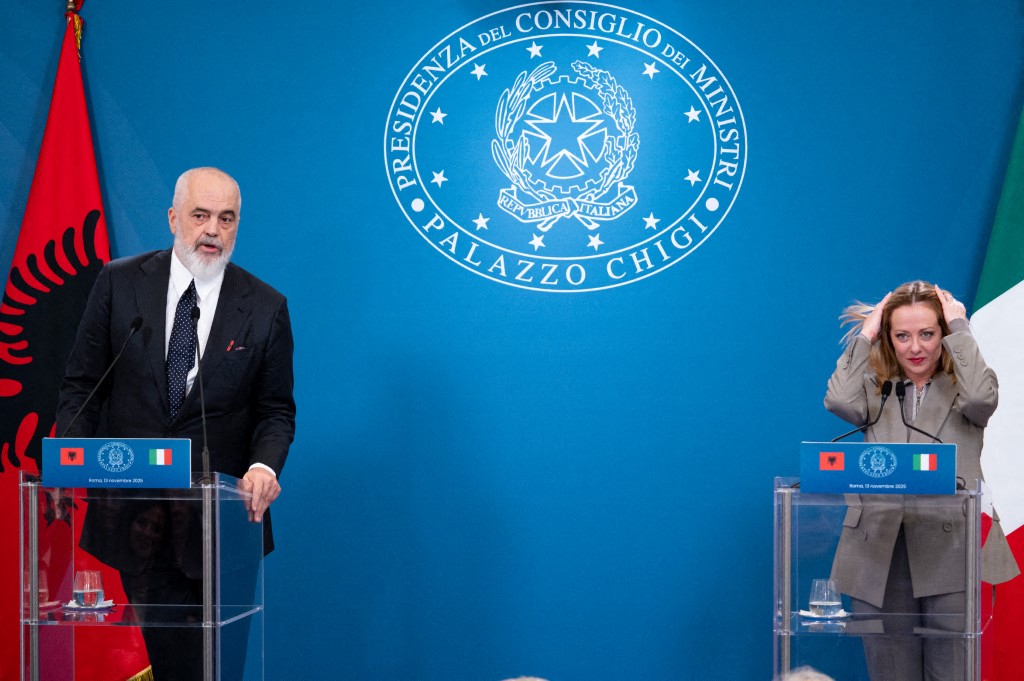
The Italy-Albania agreement was signed in November 2023 by Meloni and Albanian Prime Minister Edi Rama, quickly becoming a cornerstone of Italy’s migration policy. Under the agreement, migrants found by Italian authorities at sea or on Italian territory could be transferred to facilities built and managed by Italian staff in Albania, where their asylum applications would be processed outside the EU.

This initiative generally received cautious but positive reception from the European Commission, which did not officially endorse it as an EU model but described it as an “innovative approach” that could be considered, provided it remains fully compatible with European law and fundamental rights obligations.

To date, the project has led to the construction of two main facilities managed by Italy in Albania, designed as reception and processing centers for transferred migrants. The Italian state has invested approximately one billion euros in the plan, covering infrastructure, security, and operational costs.

However, despite this significant expenditure, only a limited number of migrants—estimated in the hundreds—have passed through the centers. This is partly due to legal challenges and repeated delays caused by decisions of Italian courts, raising questions about the model’s efficiency and operational impact.

Meanwhile, Albania continues to progress with its EU accession process. Negotiations officially opened in July 2022 after years of delays related to rule-of-law reforms, concerns over corruption, and disagreements among member states. Since then, Brussels has accelerated the process as part of a broader strategy to stabilize the Western Balkans and counter external geopolitical influences from Russia and China.

Although no accession date has been set, EU officials have indicated that Albania could join before the end of the decade, provided reforms continue.

Thus, Tirana’s announcement goes beyond a bilateral issue between Rome and Albania. It highlights growing uncertainty around the EU’s broader “externalization” approach, which relies on third countries to manage migration flows on Europe’s behalf.

Under the current situation, the centers are expected to remain formally operational at least until the agreement ends in 2029-2030, but their effective use depends entirely on whether Italian courts continue to allow the transfers.

This means they may remain structurally open but only sporadically or minimally active if legal suspensions persist, raising questions about their long-term viability even before the political deadline set by Tirana.

For Meloni, the implications are politically sensitive. The agreement with Albania was central to her argument that Europe must shift from humanitarian migration management toward prevention, border control, and external processing.

A clear expiration date, without prospects for renewal, risks turning one of the EU’s most ambitious experiments against irregular migration into a time-limited policy with significant financial costs and limited operational results.


Share:
Dimitris Papafotis
Dimitris Papafotis

Dimitris Papafotis is the editor-in-chief of NewsFire.GR. He was born and raised in Athens. He studied at the Journalism Workshop (1991-1993). He currently lives in Pyrgos, Ilia, where he has been active in radio and various newspapers, while also maintaining his personal blog, Papafotis.gr.

Albania announced that it will not renew the agreement with Italy on migrants, which expires in 2030, undermining Rome’s central model for managing irregular migration and its wider efforts to promote it as an EU policy standard.

The agreement allows Italy to process certain asylum applications at facilities on Albanian territory. The Italian government, led by Prime Minister Giorgia Meloni, presented this agreement as an innovative tool to prevent irregular arrivals, dismantle trafficking networks, and ease pressure on the Italian asylum system.

It is also part of a broader effort to encourage similar external processing arrangements across the EU.

However, Albanian Foreign Minister Igli Hasani stated in an interview published by Euractiv that Tirana does not intend to extend the agreement beyond its scheduled expiration in 2030. He said his country expects to have joined the EU by then, making the continuation of such arrangements with an EU member state politically and legally incompatible with its future status in the Union.

The Italy-Albania agreement was signed in November 2023 by Meloni and Albanian Prime Minister Edi Rama, quickly becoming a cornerstone of Italy’s migration policy. Under the agreement, migrants found by Italian authorities at sea or on Italian territory could be transferred to facilities built and managed by Italian staff in Albania, where their asylum applications would be processed outside the EU.

This initiative generally received cautious but positive reception from the European Commission, which did not officially endorse it as an EU model but described it as an “innovative approach” that could be considered, provided it remains fully compatible with European law and fundamental rights obligations.

To date, the project has led to the construction of two main facilities managed by Italy in Albania, designed as reception and processing centers for transferred migrants. The Italian state has invested approximately one billion euros in the plan, covering infrastructure, security, and operational costs.

However, despite this significant expenditure, only a limited number of migrants—estimated in the hundreds—have passed through the centers. This is partly due to legal challenges and repeated delays caused by decisions of Italian courts, raising questions about the model’s efficiency and operational impact.

Meanwhile, Albania continues to progress with its EU accession process. Negotiations officially opened in July 2022 after years of delays related to rule-of-law reforms, concerns over corruption, and disagreements among member states. Since then, Brussels has accelerated the process as part of a broader strategy to stabilize the Western Balkans and counter external geopolitical influences from Russia and China.

Although no accession date has been set, EU officials have indicated that Albania could join before the end of the decade, provided reforms continue.

Thus, Tirana’s announcement goes beyond a bilateral issue between Rome and Albania. It highlights growing uncertainty around the EU’s broader “externalization” approach, which relies on third countries to manage migration flows on Europe’s behalf.

Under the current situation, the centers are expected to remain formally operational at least until the agreement ends in 2029-2030, but their effective use depends entirely on whether Italian courts continue to allow the transfers.

This means they may remain structurally open but only sporadically or minimally active if legal suspensions persist, raising questions about their long-term viability even before the political deadline set by Tirana.

For Meloni, the implications are politically sensitive. The agreement with Albania was central to her argument that Europe must shift from humanitarian migration management toward prevention, border control, and external processing.

A clear expiration date, without prospects for renewal, risks turning one of the EU’s most ambitious experiments against irregular migration into a time-limited policy with significant financial costs and limited operational results.
