Green Left demands ‘right to coolness’ after ‘right to laziness’
French green politicians are proposing a legally binding "right to coolness" that would guarantee shade, climate-adapted buildings, and temperature-based pool access to combat heat deaths.

According to Valeurs Actuelles, Marine Tondelier, national secretary of France’s Green party, along with David Belliard, mayor of Paris’s 11th arrondissement, and two Paris deputy mayors Alice Timsit and Aminata Niakaté, published a manifesto in Liberation newspaper calling for the establishment of a “right to natural coolness” as a legally protected entitlement.
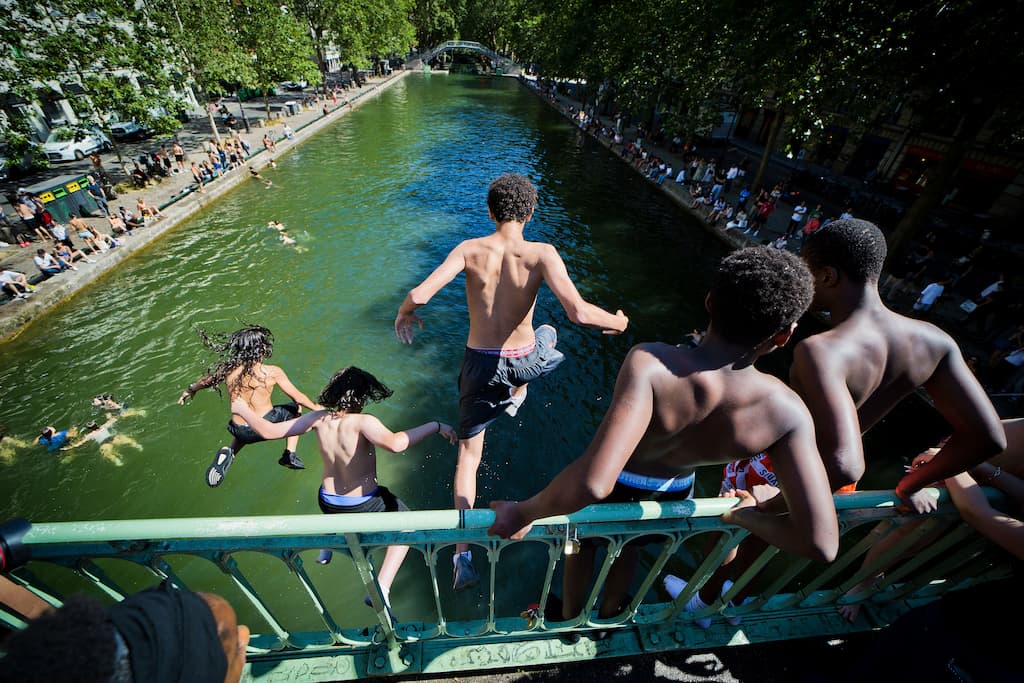
The proposal emerged following a viral incident in which young people attempted to swim in Paris’s Canal Saint-Martin during a heatwave, only to be removed by police enforcing the ban on bathing in the waterway. The green politicians claim this episode demonstrates France’s failure to treat heatwaves as a permanent phenomenon rather than seasonal accidents.
Beyond Opening Parks Late
The environmentalist proposal goes far beyond minor adjustments to public facilities. The signatories demand a comprehensive right to shade, access to climate-adapted public buildings, swimming areas opened according to temperature rather than calendar dates, and a “climate leave” policy for workers exposed to extreme heat. They also advocate for a mandatory national coolness plan to give their demands binding force.
Journalist Jade Lindgaard advanced similar arguments in Mediapart, framing the “right to coolness” as an emerging demand across multiple countries. Proponents argue that if rights to housing and healthcare exist, why not establish a right to live free from health-threatening environments during heatwaves.
The Death Toll Argument
Supporters cite mortality figures to justify their proposal. Summer 2022 allegedly caused over 60,000 heat-related deaths across Europe, including nearly 5,000 in France. Globally, approximately 489,000 people reportedly died annually from heat between 2000 and 2019. The elderly, isolated individuals, and households in poorly insulated housing face the highest risk.
For its advocates, the “right to coolness” would transform a health question into a political imperative, forcing public authorities to adapt cities, schools, gymnasiums, housing, and workplaces. The green manifesto directly blames the French state, criticizing the reduction of the green fund from 2.5 billion euros in 2024 to 650 million euros in 2026.
The Proliferation of New Rights
The proposal follows a pattern on the French left of responding to every social difficulty by inventing a new right, whether the right to laziness, right to disconnect, right to free time, or now right to coolness. The terminology raises fundamental questions about implementation. Every right requires someone to bear the obligation: who will pay, who will guarantee enforcement, which government agency will monitor temperatures in homes, schools, and offices, and how far will the state intrude into urban planning and business operations.
Some suggested measures appear practical, such as planting more trees, making soil more permeable, adjusting work schedules on construction sites, protecting the elderly, and opening air-conditioned facilities during heat peaks. Other elements reveal a more ideological project that uses heatwaves as justification for expanding state control under the banner of climate adaptation.
Heat as Inequality
For green activists, heat is not merely a phenomenon to manage but an inequality to combat through legal mandates. This latest demand exemplifies a well-established tendency to respond to every crisis with additional regulations, national plans, and new obligations imposed on society.
The push for legally enforceable coolness rights demonstrates how environmental concerns become vehicles for expanding government intervention into private life and economic activity, transforming practical responses to weather into instruments of political control.
With information from Valeurs Actuelles