Necessary Cookies

Required for the site to function. Cannot be disabled.

Analytics Cookies

Help us understand how visitors interact with our site (Google Analytics via GTM).

Marketing Cookies

Used to track visitors and deliver personalised advertisements.

We use cookies to enhance your browsing experience and analyse site traffic. By clicking Accept All, you consent to our use of cookies. Privacy Policy
NewsFire Global
Home News Europe World Christianity Culture Wars Opinion Video
Information
About Us Authors Advertising Terms & Conditions Privacy Policy Contact
R2B Media
R2B NEWSFIRE.GR PAPAFOTIS.GR THRACTION HELLENIC CONSERVATIVES RIGHT2THEBONE YT
News Europe

Belfast: War and Barbarism

A knife attack in Belfast by a Sudanese migrant that left a victim severely wounded has sparked immigration debates and violent protests across the UK.

Dimitris Papafotis
Dimitris Papafotis Editor in Chief
JUNE 11, 2026 AT 12:00 AM

The incident, which occurred on a Belfast street and was filmed by a local resident before being shared Monday evening, depicted an attacker throwing his victim to the ground before gouging out his eyes and attempting to decapitate him. The shocking nature of the violence has provoked widespread outrage across the country, according to Causeur.

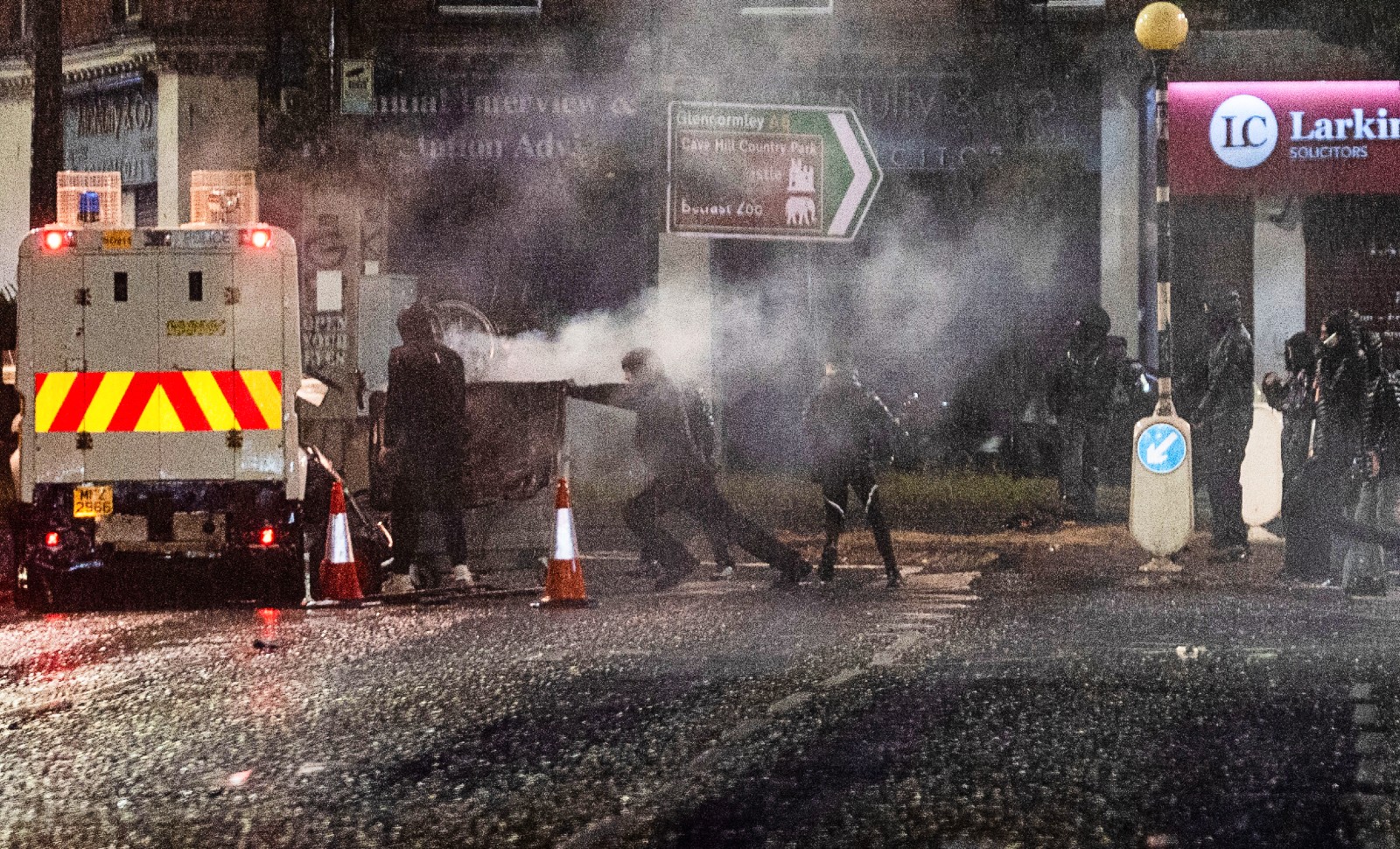
While authorities have ruled out terrorism as a motive, anti-immigration demonstrations erupted Tuesday in response to the attack, with some protests deteriorating into violent clashes. Prime Minister Keir Starmer responded on social media platform X, condemning both the original assault and the subsequent unrest in similar terms, calling the knife attack sickening while simultaneously denouncing what he characterized as abhorrent scenes of violence at the demonstrations.

Beyond Crime Statistics

The Belfast incident represents something that transcends ordinary criminal violence or even political terrorism, raising fundamental questions about how Western societies categorize and respond to extreme brutality. The attack recalls historical periods when mutilation served as public messaging, when severed heads adorned fortress walls as warnings, when the degradation of victims carried meaning beyond mere death.

Modern discourse has developed a troubling tendency to label all forms of violence as barbaric, whether conflicts, terrorist attacks, crimes, riots, military operations, border enforcement, or even offensive speech. This linguistic inflation has drained the term of meaningful distinction, creating confusion that hampers clear thinking about the nature of violence itself.

War Versus Barbarity

War, however terrible, operates within frameworks oriented toward external objectives such as territorial defense, conquest, political dominance, independence, or national survival. Even in its brutality, warfare remains connected to purposes beyond the act of killing itself. Barbarity emerges when these purposes dissolve, replaced by the pleasure of destruction for its own sake.

Barbarity begins when killing alone proves insufficient, when humiliation becomes necessary, when desecration must accompany death, when the victim’s body transforms into a message for survivors. A soldier may kill from duty, fear, discipline, or conviction. The barbarian kills while simultaneously seeking to destroy the very humanity of his victim, erasing the face before extinguishing life, degrading as thoroughly as annihilating.

Contemporary Examples

Recent history provides numerous illustrations of this distinction. In Rwanda during 1994, neighbors slaughtered neighbors with machetes in fury that severed all bonds of civilization. Under territories controlled by the Islamic State, men were beheaded before cameras so their deaths would reach global audiences. Mexican cartels have suspended mutilated corpses from highway bridges and deposited human remains in public squares to terrorize rivals. Entire Sudanese villages have suffered murder, pillaging, and mass rape. On October 7, 2023, families were massacred and civilians murdered, with images of their suffering converted into trophies circulated across social media platforms.

Though causes, ideologies, and contexts differ across these cases, a common thread persists. Violence ceases functioning as means and becomes spectacle. Suffering stops being consequence and becomes objective. Murder transcends warfare or ordinary criminality, transforming into ceremony of humiliation.

The Failure to Recognize

Contemporary Western societies have cultivated extraordinary capacity for explaining violence through frameworks of exclusion, poverty, historical trauma, discrimination, social frustration, and colonial legacy. While these explanations may contain partial truths, they become dangerous when they replace direct observation. The pursuit of underlying causes can obscure the acts themselves. Emphasis on understanding can displace judgment. Explaining perpetrators can blind observers to what they actually do.

The Belfast case proves particularly revealing in this regard. What strikes most forcefully is not merely the extreme violence of the assault itself, but the broader patterns it illuminates about how Western nations struggle to acknowledge certain forms of brutality when they appear in their own streets, preferring elaborate contextualization over straightforward recognition of barbarity.

Civilizations often begin their decline when they lose the ability to make essential distinctions, when all violence becomes equivalent, when moral clarity gives way to endless explanation and qualification.

With information from Causeur

Share:
Dimitris Papafotis
Dimitris Papafotis

Dimitris Papafotis is the editor-in-chief of NewsFire.GR. He was born and raised in Athens. He studied at the Journalism Workshop (1991-1993). He currently lives in Pyrgos, Ilia, where he has been active in radio and various newspapers, while also maintaining his personal blog, Papafotis.gr.

The incident, which occurred on a Belfast street and was filmed by a local resident before being shared Monday evening, depicted an attacker throwing his victim to the ground before gouging out his eyes and attempting to decapitate him. The shocking nature of the violence has provoked widespread outrage across the country, according to Causeur.

While authorities have ruled out terrorism as a motive, anti-immigration demonstrations erupted Tuesday in response to the attack, with some protests deteriorating into violent clashes. Prime Minister Keir Starmer responded on social media platform X, condemning both the original assault and the subsequent unrest in similar terms, calling the knife attack sickening while simultaneously denouncing what he characterized as abhorrent scenes of violence at the demonstrations.

Beyond Crime Statistics

The Belfast incident represents something that transcends ordinary criminal violence or even political terrorism, raising fundamental questions about how Western societies categorize and respond to extreme brutality. The attack recalls historical periods when mutilation served as public messaging, when severed heads adorned fortress walls as warnings, when the degradation of victims carried meaning beyond mere death.

Modern discourse has developed a troubling tendency to label all forms of violence as barbaric, whether conflicts, terrorist attacks, crimes, riots, military operations, border enforcement, or even offensive speech. This linguistic inflation has drained the term of meaningful distinction, creating confusion that hampers clear thinking about the nature of violence itself.

War Versus Barbarity

War, however terrible, operates within frameworks oriented toward external objectives such as territorial defense, conquest, political dominance, independence, or national survival. Even in its brutality, warfare remains connected to purposes beyond the act of killing itself. Barbarity emerges when these purposes dissolve, replaced by the pleasure of destruction for its own sake.

Barbarity begins when killing alone proves insufficient, when humiliation becomes necessary, when desecration must accompany death, when the victim’s body transforms into a message for survivors. A soldier may kill from duty, fear, discipline, or conviction. The barbarian kills while simultaneously seeking to destroy the very humanity of his victim, erasing the face before extinguishing life, degrading as thoroughly as annihilating.

Contemporary Examples

Recent history provides numerous illustrations of this distinction. In Rwanda during 1994, neighbors slaughtered neighbors with machetes in fury that severed all bonds of civilization. Under territories controlled by the Islamic State, men were beheaded before cameras so their deaths would reach global audiences. Mexican cartels have suspended mutilated corpses from highway bridges and deposited human remains in public squares to terrorize rivals. Entire Sudanese villages have suffered murder, pillaging, and mass rape. On October 7, 2023, families were massacred and civilians murdered, with images of their suffering converted into trophies circulated across social media platforms.

Though causes, ideologies, and contexts differ across these cases, a common thread persists. Violence ceases functioning as means and becomes spectacle. Suffering stops being consequence and becomes objective. Murder transcends warfare or ordinary criminality, transforming into ceremony of humiliation.

The Failure to Recognize

Contemporary Western societies have cultivated extraordinary capacity for explaining violence through frameworks of exclusion, poverty, historical trauma, discrimination, social frustration, and colonial legacy. While these explanations may contain partial truths, they become dangerous when they replace direct observation. The pursuit of underlying causes can obscure the acts themselves. Emphasis on understanding can displace judgment. Explaining perpetrators can blind observers to what they actually do.

The Belfast case proves particularly revealing in this regard. What strikes most forcefully is not merely the extreme violence of the assault itself, but the broader patterns it illuminates about how Western nations struggle to acknowledge certain forms of brutality when they appear in their own streets, preferring elaborate contextualization over straightforward recognition of barbarity.

Civilizations often begin their decline when they lose the ability to make essential distinctions, when all violence becomes equivalent, when moral clarity gives way to endless explanation and qualification.

With information from Causeur

