The Imaginary Iranian and His Portrait – Western Media’s Vision of a Resilient, Invincible Iran
War obscures Iran’s reality as blackout and chaos shatter communication, revealing a fragmented power struggle marked by swift leadership changes, internal rivalries, and a resilient yet misunderstood society.
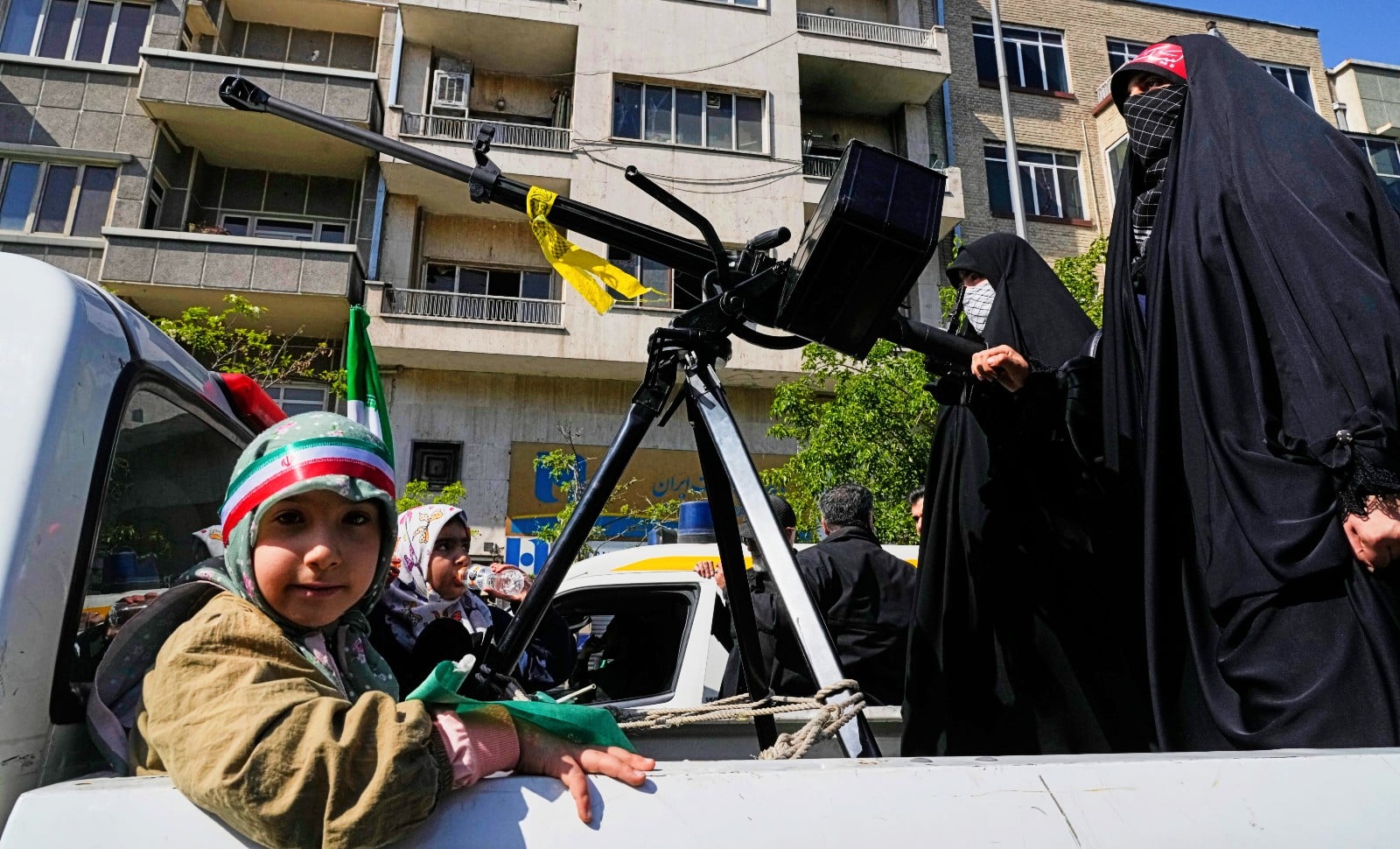

What exactly is happening within the power structures and Iranian society since the beginning of the war? We know almost nothing; we only have the regime’s propaganda images, rare information gathered by the families of exiles, and reports from a French-speaking Iranian journalist working in Tehran, Siavash Ghazi, who appears on the channels La Une and France 24.
He broadcasts videos of regime-organized demonstrations that serve to self-praise, describes what he sees from his window, using words that are undoubtedly carefully monitored by the authorities.
With the internet cut off, phone lines destroyed, and streets cluttered with rubble, the flow of news both inside and outside the country is severely hindered.
- Written by Alain Niuror
The Asparagus Theory
The Iranian of April 2026 is thus largely unknown. His image is nothing more than an empty silhouette framed by a landscape of smoking ruins. Since information abhors a vacuum, journalists, military personnel, and diplomats commenting on this war take it upon themselves to paint the face of the absent one.
They project their fantasies there, and above all, they draw conclusions based on what they know about the Iranian without considering the changes he has undergone since 1979, especially since the month of intense bombings.
It is somewhat like Europeans in the 16th century filling in the blanks about peoples they had just encountered. They created the myth of the “Noble Savage” based on a few fascinating details reported by explorers in the Pacific and America.
In 1542, the Spanish explorer Nuñez Cabeza de Vaca published the Naufragios, in which he describes the shipwreck of his galleon[1] off the coast of Florida. Together with some companions, he managed to return to Mexico, already conquered by Spain, after a harrowing journey among alligators, mosquitoes, snakes, and Native American tribes competing in cruelty and cannibalism. The brave knight encountered no “Noble Savage.”

Let us begin with the striking renewal of military and political leaders as Israel or the United States execute them. Better than the Lernaean Hydra, better than the self-regeneration of a snail’s shell or a lizard’s tail, an almost biological process is at work: they execute the head of the Revolutionary Guards of a province, and immediately a successor appears.
The successor who is eliminated is immediately replaced, and so on. It is like asparagus in the beautiful gardens of France at this time: you cut one, and the next day you have another. I doubt human reality is that simple.
The number 3 leader, Mohammadi (Peter), may be in a jealous rivalry with the number 2 leader Asfari (Paul) and could organize a conspiracy to oust him or accidentally send him a drone attack. Even the glorious soldiers of the Islamic Republic can commit “friendly fire” …
The golden myth of “Iranian resistance” refuses to take into account that the replacement number 6 or 7 is necessarily less capable, less experienced than number 1 — otherwise, he would have held the position from the start. The executions carried out by allies are certainly not pointless, contrary to what a journalistic rationalistic perspective steeped in anti-Americanism and anti-Zionism wants us to believe.
What I say about jealousies or rivalries among the Revolutionary Guards can be extended to the relationships between the military and the mullahs in Iran. Rivalries, hatred between factions, a general secretly atheist, a mullah secretly homosexual and rejected by the young colonel he loves — the real Iranian is subject to the normal workings of human nature.
It is possible that the Revolutionary Guards are keeping Khamenei’s son in a semi-coma to give the impression of a smooth transition of power. It is time for Western journalists to treat Iranians as people with their weaknesses and passions, not as asparagus.
A Great Civilization
The myth of “mosaic” defense. How clever these Iranians are, the inventors of chess! They decentralized their defense, granting military autonomy to each of Iran’s 31 provinces. Communications are cut, and each military leader can take his own war initiatives.
The colonel of Isfahan can bomb Kuwait’s airport at will, the one in Mashhad can strike Dubai’s port. Thirty-one little individual wars! I highly doubt Sun Tzu or Clausewitz would agree with this strategic individualism.
The lack of coordination among these renowned mosaic entities is undoubtedly the explanation for the colossal mistake of overwhelming the Gulf Arab monarchies with missiles and drones. These were probably friendly toward Iran and are now filled with hatred.
The same mistake could have occurred on Saturday, April 18, during an Iranian artillery strike against an Indian cargo ship: the intelligent mosaic defense results in multiplying Iran’s enemies. This does not prevent our television colonels and generals from admiring this mosaic, which ought to be called chaos.
The imaginary Iranian is by nature timeless, the passing years causing no change in him, and generations follow one another with the same ideas and reflexes, immutable as the waves beating the shores of the Caspian Sea and the Arab-Persian Gulf.
If he is a military man of mature age, he has retained the same unyielding patriotism as the ten or twelve-year-old boys who went to blow themselves up on mines with the plastic key to paradise in their pockets during the horrific Iran-Iraq war.
He survived the mines but did not evolve afterward, did not understand that “Earth is a sweet cake,” did not squander oil money on holidays in Ibiza, sending his children to study at Yale or Cambridge, or allowing his wife to have plastic surgery on her nose in Switzerland, far safer than from Turkish charlatans. He will go into battle with the same boldness as before; how could America not be defeated?
The same applies to the mullahs. In 2026, they remain in the glorious generation of the Martyrs of Shi’ism, ready to whip themselves to death for their faith, determined to hide for centuries in the depths of their refuge and reappear as the Thirteenth Imam at the end of times.
How could the United States, entangled in its short-term horizon, rising oil prices, and the approach of the midterm elections, achieve victory over these monuments of fearless determination and continuity, the Iranian military and religious leaders?
The French of 1939 did not feel the war as those of 1914 did, while Iranians are eternal, like diamonds.
A Bit of History…
The Iranian dates back to antiquity. How could a young country about to celebrate its 250th anniversary not win? In a beautiful outburst of excessive lyricism worthy even of Trump, Éric Brunet declared on March 26 on LCI[2] that “there were libraries in Tehran 5,000 years before Jesus Christ, while our ancestors rubbed flints.”
No one contradicted him that the oldest script is that of the Sumerians, which appeared around 3300 B.C., and that Tehran was founded in 1783. In reality, the Iranian, like everyone else, has had his ups and downs.
The small city of Athens twice defeated the armies of the vast Persian Empire. A tiny democracy crushed a huge tyranny in what became known as the Med Persian Wars. “Who rules them, who are they slaves to?” asks Queen Atossa in Aeschylus’ Persians. “To no one,” the chorus replies.
Montesquieu’s Persian Letters, published in 1725, present, through letters sent from Persia by correspondents Usbek and Rica, a feudal and violent society. Great lords imprisoned hordes of women and eunuchs in their harems, poor little black people abducted from Africa, stripped of their male dignity, thanks to the eastern slave trade, which lasted much longer than the Atlantic one.
However, there is a simple way to get to know the real Iranian without inventing his face: cinema. No one mentioned this among the many experts dominating the French media. In the malicious shadow of this detestable regime, an original, dynamic, and moving cinema flourished.
The great Belgian poet Henri Michaux invented an imaginary country where some children grow up under terrible abuse to become geniuses. A method that succeeded in Tehran. Abbas Kiarostami, Asghar Farhadi, and many others, honored in Cannes or Berlin, are the abused children of the torturers in power. They show us today’s Iranians who resemble us as brothers because they are our brothers.
In Asghar Farhadi’s film “Fire Ceremony”, a couple wants to go to Dubai for the weekend, like a Londoner dreaming of Mallorca. In his film “A Separation,” the same director shows a woman wanting to separate to leave for the West, like everyone in the Global South except dictators.
One day, we will see a film set in a liberated Tehran celebrating, perhaps a love story born between such beautiful Iranian women and a young man from the Midwest.
Source: Causeur.fr