Necessary Cookies

Required for the site to function. Cannot be disabled.

Analytics Cookies

Help us understand how visitors interact with our site (Google Analytics via GTM).

Marketing Cookies

Used to track visitors and deliver personalised advertisements.

We use cookies to enhance your browsing experience and analyse site traffic. By clicking Accept All, you consent to our use of cookies. Privacy Policy
NewsFire Global
Home News Europe World Christianity Culture Wars Opinion
Information
About Us Authors Advertising Terms & Conditions Privacy Policy Contact
R2B Media
R2B NEWSFIRE.GR PAPAFOTIS.GR THRACTION HELLENIC CONSERVATIVES RIGHT2THEBONE YT
News Europe

How Bernadette Chirac Won French Hearts With Spare Change

Bernadette Chirac transformed from France's most ridiculed first lady into its most beloved public figure by championing Pièces Jaunes, a campaign collecting spare change for hospitalized children.

Dimitris Papafotis
Dimitris Papafotis Editor in Chief
JUNE 7, 2026 AT 4:17 PM

When Jacques Chirac entered the Élysée Palace in May 1995, his wife was virtually unknown to the French public. Worse still, she was actively mocked. The satirical television program Les Guignols de l’info regularly ridiculed her austere appearance and outdated handbag. She was even excluded from her husband’s official investiture photograph following his 1995 presidential victory. Behind the scenes, presidential communications adviser Jacques Pilhan openly dismissed her as hopelessly out of touch.

A decade later, according to Valeurs Actuelles, she had become the most popular face of the Chirac presidency. The transformation came through a piggy bank.

An American Model Adapted for France

The Pièces Jaunes operation was not originally Bernadette Chirac’s creation. Professor Claude Griscelli, then president of the Hospitals Foundation, launched it in 1989 to improve conditions for hospitalized children and adolescents. The concept drew directly from a highly successful American fundraising model called the March of Dimes, which collected ten-cent coins in urns distributed across the country. The principle was straightforward: transform loose change forgotten in pockets into concrete funding for pediatric services.

The program remained relatively obscure until Bernadette Chirac assumed the presidency of the Hospitals of Paris-Hospitals of France Foundation in 1994. She did not merely lend her name to the cause. She restructured it, brought it into the media spotlight, and personally took to the field.

The Recipe for Popular Success

The operation’s success stemmed from a carefully calibrated approach. Through a tightly orchestrated media strategy and the recruitment of celebrity sponsors including judoka David Douillet, singer Lorie, and footballer Christian Karembeu, Bernadette Chirac made the campaign massively popular across France. Each winter, the campaign became a national ritual, with cardboard piggy banks distributed in post offices and schools, and the collection punctuated by the First Lady’s appearances at the bedsides of sick children.

It was in these hospital settings that her personal transformation occurred. Journalist Erwan L’Éléouet analyzed for Le Figaro Madame in 2023 that this was where she developed a taste for the spotlight and built up her popularity, which had long been in deficit among a public that viewed her as withdrawn, cold, austere, and perhaps even sad. The bourgeois rigidity previously seen as a liability became reframed as seriousness and steadfastness in service of an unquestionable cause. Bernadette Chirac did not achieve genuine popularity until age 65.

Results That Became an Institution

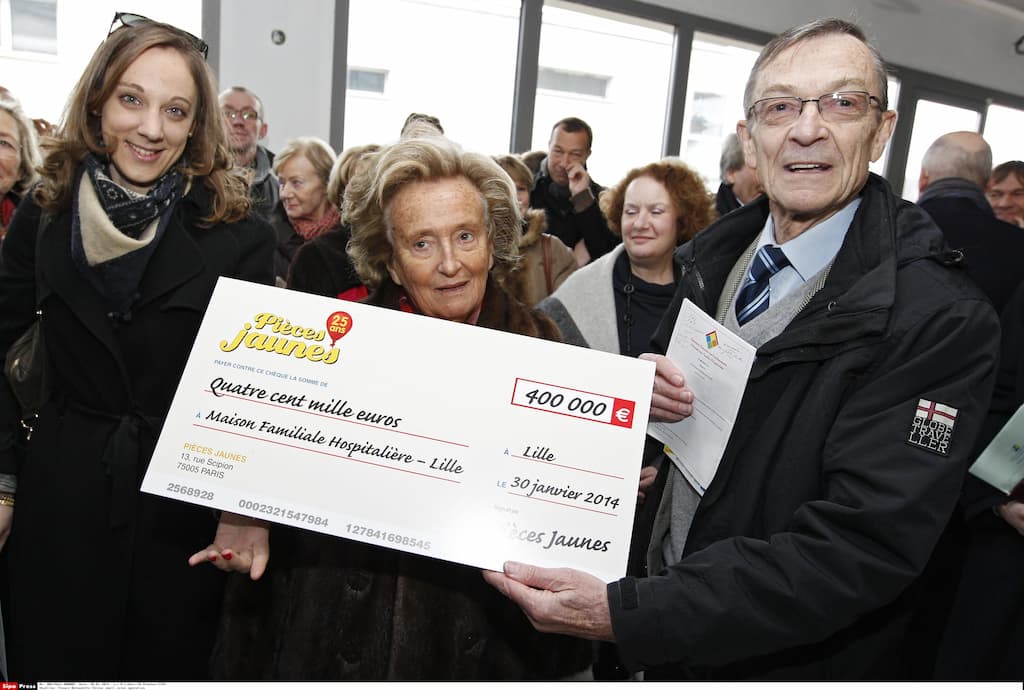
The success can be measured in concrete figures. Since its 1989 launch, the Pièces Jaunes operation has collected over 111 million euros and funded 9,700 projects, as Valeurs Actuelles reports. France’s transition to the euro provided a historic windfall: 15 million euros collected in 2002 alone, as French citizens emptied their piggy banks of obsolete francs. The annual operation, held each year between January and February, evolved toward digital donations following the 2020 COVID crisis. For the 2026 edition, two million piggy banks were still distributed.

Bernadette Chirac’s commitment proved remarkably durable. She directed the national campaigns from 1994 to 2019 before becoming honorary president of the Foundation. This loyalty explains why tributes paid to her this weekend remain inseparable from this charitable collection of spare change.

Success Not Without Critics

The story was not without shadows. In April 2006, L’Express published an investigation titled “The Gray Zones of Pièces Jaunes,” highlighting a sharp decline in collections after the 2002 peak and questioning the operation’s management. The suspicions proved short-lived. Targeted by an internet rumor campaign in 2008, the Foundation itself requested an audit. The French Court of Accounts delivered its findings in 2010, detecting no problems and judging the management exemplary.

From this modest mechanism, Bernadette Chirac created both a useful charitable enterprise and the instrument of her own rehabilitation. The woman once deemed unsuited for public life proved, one coin at a time, that a cause patiently championed could be worth more than all the communication strategies money could buy.

With information from Valeurs Actuelles

Share:
Dimitris Papafotis
Dimitris Papafotis

Dimitris Papafotis is the editor-in-chief of NewsFire.GR. He was born and raised in Athens. He studied at the Journalism Workshop (1991-1993). He currently lives in Pyrgos, Ilia, where he has been active in radio and various newspapers, while also maintaining his personal blog, Papafotis.gr.

When Jacques Chirac entered the Élysée Palace in May 1995, his wife was virtually unknown to the French public. Worse still, she was actively mocked. The satirical television program Les Guignols de l’info regularly ridiculed her austere appearance and outdated handbag. She was even excluded from her husband’s official investiture photograph following his 1995 presidential victory. Behind the scenes, presidential communications adviser Jacques Pilhan openly dismissed her as hopelessly out of touch.

A decade later, according to Valeurs Actuelles, she had become the most popular face of the Chirac presidency. The transformation came through a piggy bank.

An American Model Adapted for France

The Pièces Jaunes operation was not originally Bernadette Chirac’s creation. Professor Claude Griscelli, then president of the Hospitals Foundation, launched it in 1989 to improve conditions for hospitalized children and adolescents. The concept drew directly from a highly successful American fundraising model called the March of Dimes, which collected ten-cent coins in urns distributed across the country. The principle was straightforward: transform loose change forgotten in pockets into concrete funding for pediatric services.

The program remained relatively obscure until Bernadette Chirac assumed the presidency of the Hospitals of Paris-Hospitals of France Foundation in 1994. She did not merely lend her name to the cause. She restructured it, brought it into the media spotlight, and personally took to the field.

The Recipe for Popular Success

The operation’s success stemmed from a carefully calibrated approach. Through a tightly orchestrated media strategy and the recruitment of celebrity sponsors including judoka David Douillet, singer Lorie, and footballer Christian Karembeu, Bernadette Chirac made the campaign massively popular across France. Each winter, the campaign became a national ritual, with cardboard piggy banks distributed in post offices and schools, and the collection punctuated by the First Lady’s appearances at the bedsides of sick children.

It was in these hospital settings that her personal transformation occurred. Journalist Erwan L’Éléouet analyzed for Le Figaro Madame in 2023 that this was where she developed a taste for the spotlight and built up her popularity, which had long been in deficit among a public that viewed her as withdrawn, cold, austere, and perhaps even sad. The bourgeois rigidity previously seen as a liability became reframed as seriousness and steadfastness in service of an unquestionable cause. Bernadette Chirac did not achieve genuine popularity until age 65.

Results That Became an Institution

The success can be measured in concrete figures. Since its 1989 launch, the Pièces Jaunes operation has collected over 111 million euros and funded 9,700 projects, as Valeurs Actuelles reports. France’s transition to the euro provided a historic windfall: 15 million euros collected in 2002 alone, as French citizens emptied their piggy banks of obsolete francs. The annual operation, held each year between January and February, evolved toward digital donations following the 2020 COVID crisis. For the 2026 edition, two million piggy banks were still distributed.

Bernadette Chirac’s commitment proved remarkably durable. She directed the national campaigns from 1994 to 2019 before becoming honorary president of the Foundation. This loyalty explains why tributes paid to her this weekend remain inseparable from this charitable collection of spare change.

Success Not Without Critics

The story was not without shadows. In April 2006, L’Express published an investigation titled “The Gray Zones of Pièces Jaunes,” highlighting a sharp decline in collections after the 2002 peak and questioning the operation’s management. The suspicions proved short-lived. Targeted by an internet rumor campaign in 2008, the Foundation itself requested an audit. The French Court of Accounts delivered its findings in 2010, detecting no problems and judging the management exemplary.

From this modest mechanism, Bernadette Chirac created both a useful charitable enterprise and the instrument of her own rehabilitation. The woman once deemed unsuited for public life proved, one coin at a time, that a cause patiently championed could be worth more than all the communication strategies money could buy.

With information from Valeurs Actuelles