Necessary Cookies

Required for the site to function. Cannot be disabled.

Analytics Cookies

Help us understand how visitors interact with our site (Google Analytics via GTM).

Marketing Cookies

Used to track visitors and deliver personalised advertisements.

We use cookies to enhance your browsing experience and analyse site traffic. By clicking Accept All, you consent to our use of cookies. Privacy Policy
NewsFire Global
Home News Europe World Christianity Culture Wars Opinion
Information
About Us Authors Advertising Terms & Conditions Privacy Policy Contact
R2B Media
R2B NEWSFIRE.GR PAPAFOTIS.GR THRACTION HELLENIC CONSERVATIVES RIGHT2THEBONE YT
News Europe

How the EU Plans to Pay Kyiv’s €90B Loan Despite Hungary’s Block – Cost to Greece?

Hungary’s veto delays the EU’s €90 billion loan to Ukraine amid Kyiv’s urgent cash crisis, but EU leaders vow to find alternative funding methods while hoping political shifts will soon resolve the deadlock.
Panayotis Doumas
Panayotis Doumas Political Advisor & Analyst - NewsFire.GR Director
FEBRUARY 25, 2026 AT 6:00 PM Updated: May 17, 2026 2:14 AM

Hungary blocked the payment of the first installment of the €90 billion loan from the EU, but Ukraine has run out of money. The President of the Commission, von der Leyen, promised Kyiv that the funds will be paid regardless. But how will that happen?

After the EU failed in December to gather a majority to seize the Russian funds frozen in Europe, it was decided to finance Ukraine in 2026 and 2027 with a €90 billion loan, which the EU will receive, pay the interest on, and which Kyiv will not have to repay, because the EU believes Russia will lose the war and will repay the loan with reparations.

However, Hungarian Prime Minister Orbán exercised a veto when the issue of releasing the first tranche of the loan to Kyiv was raised. This did not happen because, as the mainstream media simply present it, Orbán and Hungary maintain friendly relations with Russia. In fact, Orbán said he agrees with the European Commission’s proposal on the condition that Hungary be exempted from its corresponding financial burden from such a loan.

To understand the scale — since some believe that when the EU distributes money, it comes from some “money tree” — the amount allocated to Greece, in case Russia does not pay war reparations or the EU cannot access the frozen Russian funds, is about €1.2 billion. Similarly, for Hungary, it would be roughly the same, around €1.1 billion. Simply put, Orbán is defending his country’s economy, while Mitsotakis chooses to be generous with our money, hoping he can win the coveted position of Antonio Costa as President of the European Council.

The problem is that Kyiv will run out of money by March, so Ukraine urgently needs new funds; otherwise, it will not be able to pay public servants’ salaries, soldiers, and other bills. In practice, this would mean the collapse of the Ukrainian state and, consequently, the end of the war, something the EU obviously wants to avoid, as it officially still bets on a victory over Russia.

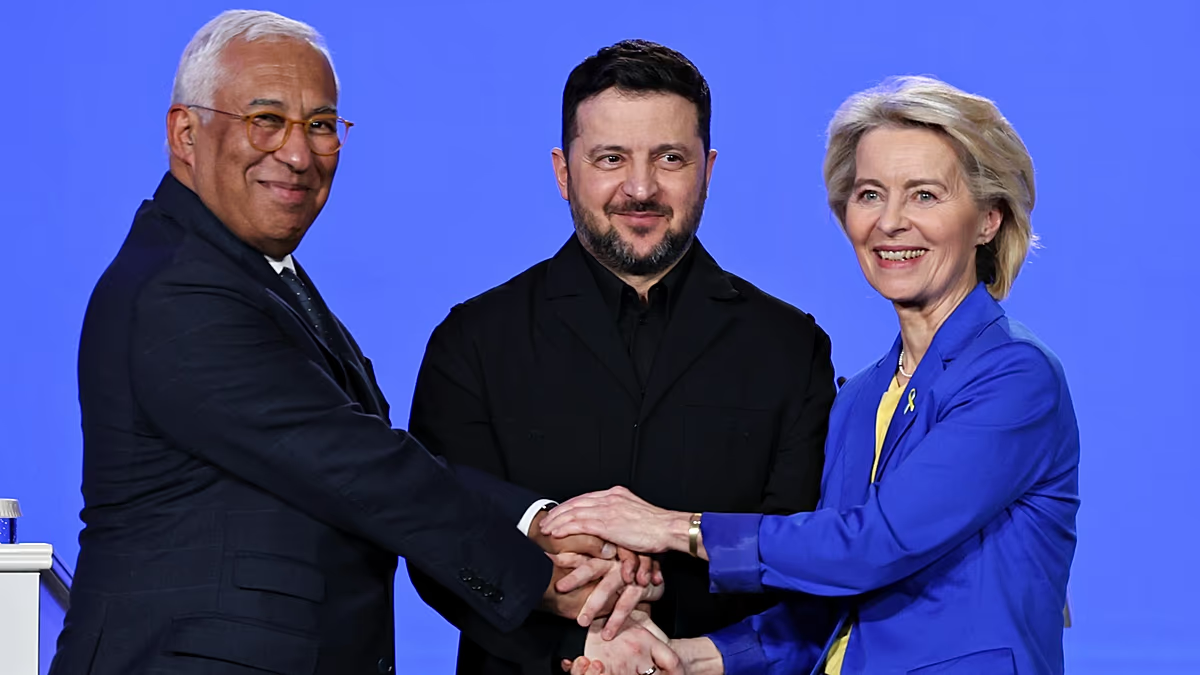
Von der Leyen was in Kyiv on Tuesday, the fourth anniversary of the escalation in Ukraine, together with the President of the EU Council Costa, where she wanted to officially present the 20th package of anti-Russian sanctions and the disbursement of the first tranche of the loan, but this did not happen due to Orbán’s veto.

However, von der Leyen announced in Kyiv that the money will be paid regardless. She said:

We will provide the loan one way or another. We have several options. We will use them.

But how exactly will this happen, since a unanimous decision of the EU is required, which Orbán is currently blocking?

Perhaps the answer is just as obvious, but what is discussed on television panels shows that for many it is unclear which “options” von der Leyen meant. So let’s explain, because it is really quite simple.

Generally, there are only two options: either the European Commission still has a few billion euros that it does not need immediately and can transfer these to Kyiv as interim financing, or individual EU member states will take action. If this happens, it will most likely be Germany, whose radically anti-Russian government surely will not need much persuasion to proceed with an advance payment, especially given that besides Germany, almost no other EU member state has the capacity to spontaneously provide – say – ten billion euros.

But regardless of who advances the funds, of course the money will be repaid at some point in the coming months, because Hungary’s veto will not last forever.

For now, both the European Commission and Kyiv are willing to raise the stakes with Orbán because they hope – and are doing everything for this – that Orbán will lose the elections on April 12. Then, the current opposition candidate, according to their hopes, will quickly form a new government and by around May the new Hungarian government will lift the veto and open the way for the €90 billion loan. From the first tranche, the “advance” paid by the EU or Germany could then be reimbursed.

Even if Orbán wins the elections, he will lift the veto eventually. This is because there is another reason for his veto: it is the embargo on oil imposed by Kyiv, as Ukraine no longer allows Russian oil to flow through the pipeline supplying Hungary. Should Orbán win the elections, Kyiv will have no choice but to allow the oil flow again so Orbán no longer blocks the EU support payments to Ukraine.

Orbán’s veto, which many currently rejoice at, hoping it will have some effect, will in any case only be a brief episode. Of course, his veto is annoying for von der Leyen and Costa, who had to travel to Kyiv empty-handed instead of organizing a large celebration for the fourth anniversary of the escalation, but essentially it will not have a big impact, because sooner or later the 20th sanctions package will be approved and a solution will also be found for the interim financing of the first tranche of the €90 billion loan.


Share:
Panayotis Doumas
Panayotis Doumas

He was born in Athens and is a journalist and producer of online television programs. He attended the Athens College and studied Law and History in Freiburg, Germany. He was an entrepreneur for many years and served as Vice President of the Athens Chamber of Commerce from 2012 to 2015. He has worked as a journalist for the media groups DNM GROUP and ESTIA INVESTMENT GROUP and has contributed articles to the newspapers "Dimokratia," "Estia," "Eleftheri Ora," and "Eleftheros Kosmos," the magazine "STRATEGIKI," and the websites PRONEWS and NEWSBREAK. He is a correspondent for the German weekly newspaper "Junge Freiheit." He is one of the key contributors to the Network of Greek Conservatives and the online channel Right2TheBone.

Hungary blocked the payment of the first installment of the €90 billion loan from the EU, but Ukraine has run out of money. The President of the Commission, von der Leyen, promised Kyiv that the funds will be paid regardless. But how will that happen?

After the EU failed in December to gather a majority to seize the Russian funds frozen in Europe, it was decided to finance Ukraine in 2026 and 2027 with a €90 billion loan, which the EU will receive, pay the interest on, and which Kyiv will not have to repay, because the EU believes Russia will lose the war and will repay the loan with reparations.

However, Hungarian Prime Minister Orbán exercised a veto when the issue of releasing the first tranche of the loan to Kyiv was raised. This did not happen because, as the mainstream media simply present it, Orbán and Hungary maintain friendly relations with Russia. In fact, Orbán said he agrees with the European Commission’s proposal on the condition that Hungary be exempted from its corresponding financial burden from such a loan.

To understand the scale — since some believe that when the EU distributes money, it comes from some “money tree” — the amount allocated to Greece, in case Russia does not pay war reparations or the EU cannot access the frozen Russian funds, is about €1.2 billion. Similarly, for Hungary, it would be roughly the same, around €1.1 billion. Simply put, Orbán is defending his country’s economy, while Mitsotakis chooses to be generous with our money, hoping he can win the coveted position of Antonio Costa as President of the European Council.

The problem is that Kyiv will run out of money by March, so Ukraine urgently needs new funds; otherwise, it will not be able to pay public servants’ salaries, soldiers, and other bills. In practice, this would mean the collapse of the Ukrainian state and, consequently, the end of the war, something the EU obviously wants to avoid, as it officially still bets on a victory over Russia.

Von der Leyen was in Kyiv on Tuesday, the fourth anniversary of the escalation in Ukraine, together with the President of the EU Council Costa, where she wanted to officially present the 20th package of anti-Russian sanctions and the disbursement of the first tranche of the loan, but this did not happen due to Orbán’s veto.

However, von der Leyen announced in Kyiv that the money will be paid regardless. She said:

We will provide the loan one way or another. We have several options. We will use them.

But how exactly will this happen, since a unanimous decision of the EU is required, which Orbán is currently blocking?

Perhaps the answer is just as obvious, but what is discussed on television panels shows that for many it is unclear which “options” von der Leyen meant. So let’s explain, because it is really quite simple.

Generally, there are only two options: either the European Commission still has a few billion euros that it does not need immediately and can transfer these to Kyiv as interim financing, or individual EU member states will take action. If this happens, it will most likely be Germany, whose radically anti-Russian government surely will not need much persuasion to proceed with an advance payment, especially given that besides Germany, almost no other EU member state has the capacity to spontaneously provide – say – ten billion euros.

But regardless of who advances the funds, of course the money will be repaid at some point in the coming months, because Hungary’s veto will not last forever.

For now, both the European Commission and Kyiv are willing to raise the stakes with Orbán because they hope – and are doing everything for this – that Orbán will lose the elections on April 12. Then, the current opposition candidate, according to their hopes, will quickly form a new government and by around May the new Hungarian government will lift the veto and open the way for the €90 billion loan. From the first tranche, the “advance” paid by the EU or Germany could then be reimbursed.

Even if Orbán wins the elections, he will lift the veto eventually. This is because there is another reason for his veto: it is the embargo on oil imposed by Kyiv, as Ukraine no longer allows Russian oil to flow through the pipeline supplying Hungary. Should Orbán win the elections, Kyiv will have no choice but to allow the oil flow again so Orbán no longer blocks the EU support payments to Ukraine.

Orbán’s veto, which many currently rejoice at, hoping it will have some effect, will in any case only be a brief episode. Of course, his veto is annoying for von der Leyen and Costa, who had to travel to Kyiv empty-handed instead of organizing a large celebration for the fourth anniversary of the escalation, but essentially it will not have a big impact, because sooner or later the 20th sanctions package will be approved and a solution will also be found for the interim financing of the first tranche of the €90 billion loan.
