Necessary Cookies

Required for the site to function. Cannot be disabled.

Analytics Cookies

Help us understand how visitors interact with our site (Google Analytics via GTM).

Marketing Cookies

Used to track visitors and deliver personalised advertisements.

We use cookies to enhance your browsing experience and analyse site traffic. By clicking Accept All, you consent to our use of cookies. Privacy Policy
NewsFire Global
Home News Europe World Christianity Culture Wars Opinion Video
Information
About Us Authors Advertising Terms & Conditions Privacy Policy Contact
R2B Media
R2B NEWSFIRE.GR PAPAFOTIS.GR THRACTION HELLENIC CONSERVATIVES RIGHT2THEBONE YT
News Europe

Daesh Recruiters Found Among Ceuta Migrants

Spanish counter-terrorism officers found convicted jihadist recruiters among tens of thousands of migrants who crossed into Ceuta in July, exposing failures in border screening.

Dimitris Papafotis
Dimitris Papafotis Editor in Chief
SEPTEMBER 3, 2026 AT 2:11 PM

According to Brussels Signal, National Police officers discovered among the July 30-31 arrivals multiple men previously sentenced for recruiting fighters for Islamic State, some of whom had already served their prison terms and re-entered Spain without triggering any live judicial alerts that would permit immediate arrest.

Police sources told Spanish outlet ABC that one identified individual had actively recruited soldiers for Islamic State and been detected operating in Syria on behalf of the terror group. He had completed a prison sentence exceeding ten years but faced no outstanding warrants in Spain. Officers could only register him as a person of interest and forward his details to intelligence units.

Additional individuals identified after the crossing had prior convictions for glorifying terrorism through the distribution of jihadist propaganda materials, ABC reported.

The Unified Police Union (SUP) stated on September 1 that more than ten people among those who entered Ceuta carried records, flags, or profiles connected to jihadist radicalism, and that identification work remained incomplete. The union had initially demanded stricter border checks on August 4, characterizing the situation as a national security matter.

Deportations Begin as Security Review Continues

Spanish authorities have already returned three migrants with Islamist terrorism backgrounds to Morocco, according to El Español, with more than ten additional profiles of interest under active review. Most are Moroccan nationals identified partly through online activity monitoring.

Counter-terrorism officers believed at least ten men previously arrested, convicted, and deported from Spain over jihadist offences had successfully crossed back into the country on July 30, as Brussels Signal reports.

Fernando Grande-Marlaska, Spain’s interior minister, told the Congress of Deputies on August 28 that more than one hundred individuals who entered during the episode have been expelled. He has not released a breakdown specific to terrorism-related cases. Expulsions can result from court orders following criminal offences, existing deportation orders, or rejected asylum claims.

Official figures published September 1 show 214 expulsions and 3,519 voluntary returns to Morocco through August 31, with 1,612 minors registered among those who crossed.

Simultaneous Mass Arrival Overwhelmed Screening Capacity

The SUP has argued that the simultaneous arrival of tens of thousands of people rendered normal border screening procedures impossible, and that completing comprehensive identity and background checks now constitutes a major security operation.

The union added that designation as a person of interest does not automatically indicate someone is preparing an attack.

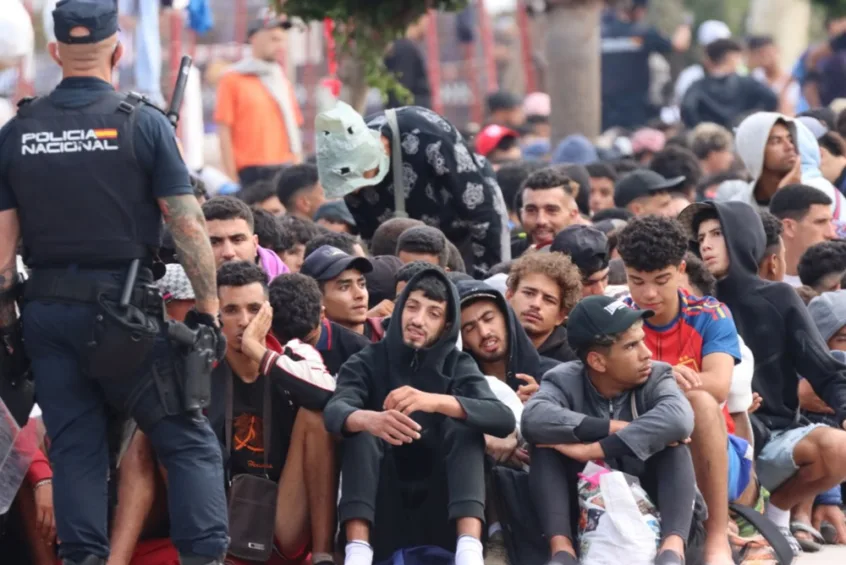
Spanish authorities estimate approximately 72,000 people crossed on July 30 and 31. The majority returned to Morocco within days. Several thousand remain in the city of roughly 84,000 residents, with about 3,400 still housed in emergency accommodation as of early September.

Leaked Police Report Implicates Moroccan Security Forces

The revelations coincided with publication by El Español of a leaked police report stating that Moroccan security forces demonstrated “total permissiveness” during the July crossings and in some instances were observed actively directing migrant groups toward beaches leading into Spanish territory.

The 55-page report with two annexes, submitted by the National Police’s National Immigration and Borders Centre (CENIF) to Spain’s National Court, points to Moroccan gendarme involvement in facilitating or failing to prevent the crossings. The document describes advance planning and the “active guiding” of migrants, though it stops short of directly attributing the operation to the Moroccan government. The report is held by investigating judge María Tardón.

The disclosure has intensified political pressure on Prime Minister Pedro Sánchez‘s government. The Spanish government initially attributed the unprecedented influx primarily to organized smuggling networks and misinformation circulated through social media. Opposition parties have since seized on the police report to accuse Sánchez of failing to protect Ceuta and permitting Morocco to weaponize migration pressure as a political instrument.

Public anger was visible on Ceuta Day, September 2, when more than 20,000 people participated in demonstrations across the city, according to the government delegation.

With information from Brussels Signal

Share:
Dimitris Papafotis
Dimitris Papafotis

Dimitris Papafotis is the editor-in-chief of NewsFire.GR. He was born and raised in Athens. He studied at the Journalism Workshop (1991-1993). He currently lives in Pyrgos, Ilia, where he has been active in radio and various newspapers, while also maintaining his personal blog, Papafotis.gr.

According to Brussels Signal, National Police officers discovered among the July 30-31 arrivals multiple men previously sentenced for recruiting fighters for Islamic State, some of whom had already served their prison terms and re-entered Spain without triggering any live judicial alerts that would permit immediate arrest.

BREAKING:

Spanish riot police launches charges and fires pepper spray at the crowds which have gathered in Madrid tonight to protest against mass-immigration and the invasion of Ceuta.

No pepper spray was used against the 80 000 illegal migrants when they stormed Ceuta pic.twitter.com/2Lm5zypFcJ

— Visegrád 24 (@visegrad24) September 2, 2026

Police sources told Spanish outlet ABC that one identified individual had actively recruited soldiers for Islamic State and been detected operating in Syria on behalf of the terror group. He had completed a prison sentence exceeding ten years but faced no outstanding warrants in Spain. Officers could only register him as a person of interest and forward his details to intelligence units.

Additional individuals identified after the crossing had prior convictions for glorifying terrorism through the distribution of jihadist propaganda materials, ABC reported.

Delegación de Gobierno cifra en 50.000 los asistentes a la concentración en Madrid https://t.co/K9K3sEZJmS pic.twitter.com/gnkIxCqIwP

— EL MUNDO (@elmundoes) September 2, 2026

The Unified Police Union (SUP) stated on September 1 that more than ten people among those who entered Ceuta carried records, flags, or profiles connected to jihadist radicalism, and that identification work remained incomplete. The union had initially demanded stricter border checks on August 4, characterizing the situation as a national security matter.

Deportations Begin as Security Review Continues

Spanish authorities have already returned three migrants with Islamist terrorism backgrounds to Morocco, according to El Español, with more than ten additional profiles of interest under active review. Most are Moroccan nationals identified partly through online activity monitoring.

Counter-terrorism officers believed at least ten men previously arrested, convicted, and deported from Spain over jihadist offences had successfully crossed back into the country on July 30, as Brussels Signal reports.

Fernando Grande-Marlaska, Spain’s interior minister, told the Congress of Deputies on August 28 that more than one hundred individuals who entered during the episode have been expelled. He has not released a breakdown specific to terrorism-related cases. Expulsions can result from court orders following criminal offences, existing deportation orders, or rejected asylum claims.

Official figures published September 1 show 214 expulsions and 3,519 voluntary returns to Morocco through August 31, with 1,612 minors registered among those who crossed.

Simultaneous Mass Arrival Overwhelmed Screening Capacity

The SUP has argued that the simultaneous arrival of tens of thousands of people rendered normal border screening procedures impossible, and that completing comprehensive identity and background checks now constitutes a major security operation.

The union added that designation as a person of interest does not automatically indicate someone is preparing an attack.

Spanish authorities estimate approximately 72,000 people crossed on July 30 and 31. The majority returned to Morocco within days. Several thousand remain in the city of roughly 84,000 residents, with about 3,400 still housed in emergency accommodation as of early September.

Leaked Police Report Implicates Moroccan Security Forces

The revelations coincided with publication by El Español of a leaked police report stating that Moroccan security forces demonstrated “total permissiveness” during the July crossings and in some instances were observed actively directing migrant groups toward beaches leading into Spanish territory.

The 55-page report with two annexes, submitted by the National Police’s National Immigration and Borders Centre (CENIF) to Spain’s National Court, points to Moroccan gendarme involvement in facilitating or failing to prevent the crossings. The document describes advance planning and the “active guiding” of migrants, though it stops short of directly attributing the operation to the Moroccan government. The report is held by investigating judge María Tardón.

The disclosure has intensified political pressure on Prime Minister Pedro Sánchez‘s government. The Spanish government initially attributed the unprecedented influx primarily to organized smuggling networks and misinformation circulated through social media. Opposition parties have since seized on the police report to accuse Sánchez of failing to protect Ceuta and permitting Morocco to weaponize migration pressure as a political instrument.

Public anger was visible on Ceuta Day, September 2, when more than 20,000 people participated in demonstrations across the city, according to the government delegation.

With information from Brussels Signal