
The significance of Farage’s re-election
Nigel Farage resigned as MP for Clacton to trigger a by-election he will contest, framing financial investigations against him as a showdown between the people and the establishment.
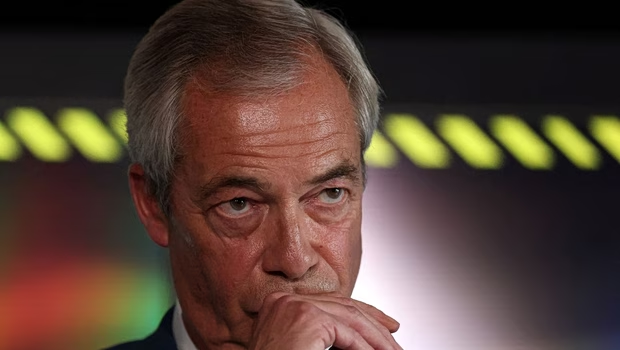

Nigel Farage announced on July 7 that he is resigning as MP for the constituency of Clacton, triggering a by-election (as they call it in England), in which he declared he would stand as a candidate again. He himself presents his move as a showdown “of the people versus the establishment.” He claims that, because he is at the center of investigations and intense publicity regarding financial matters and benefit declarations, he wants the voters themselves to decide whether they continue to trust him. Farage denies that he has violated the rules.
His move is not simply an electoral tactic. It fits into a broader strategy of populist and anti-establishment politics, which he has been implementing for decades: he is turning defense into offense. Instead of constantly being in the position of defending himself over the investigations and accusations, he is attempting to change the question from “Did he do something wrong?” to “Do the citizens trust Farage or the political establishment that is accusing him?” In this way, he shifts the discussion from the legal or ethical level to the political. He is also reinforcing the anti-system narrative. Farage has been arguing for years that there is an elite—political, bureaucratic, and media—that is trying to halt the rise of Reform UK. If he wins again, he will be able to claim that “despite the attacks, the people have renewed their trust in me.”
This constitutes a powerful political message to his supporters.
He is also testing the strength of Reform UK. The by-election functions as a “poll with real votes.” If Reform increases its percentage, he will argue that not only has it not been weakened, but it has been strengthened.
If the other parties choose not to field strong candidates or to downplay the contest, Farage can accuse them of being afraid of the citizens’ verdict. If, on the other hand, they put up a big fight, he will present the election as proof that “the entire establishment united against him.”
There are obvious similarities with Trump in his style of political communication. Personalization of the political conflict, presentation of judicial or institutional investigations as politically motivated, transformation of every crisis into an opportunity to rally the electoral base, emphasis on legitimization through the popular vote.
If Farage is re-elected comfortably or increases his percentage, he will strengthen the image that Reform UK remains the main protest force in British politics. The contest in Clacton therefore has significance that goes beyond a single parliamentary seat: it functions as a test of Farage’s political power and as an indication of the extent to which Reform UK can maintain or expand its influence at the national level.





