Necessary Cookies

Required for the site to function. Cannot be disabled.

Analytics Cookies

Help us understand how visitors interact with our site (Google Analytics via GTM).

Marketing Cookies

Used to track visitors and deliver personalised advertisements.

We use cookies to enhance your browsing experience and analyse site traffic. By clicking Accept All, you consent to our use of cookies. Privacy Policy
NewsFire Global
Home News Europe World Christianity Culture Wars Opinion Video
Information
About Us Authors Advertising Terms & Conditions Privacy Policy Contact
R2B Media
R2B NEWSFIRE.GR PAPAFOTIS.GR THRACTION HELLENIC CONSERVATIVES RIGHT2THEBONE YT
News World

China’s Hainan Province Bans Gas-Powered Vehicle Sales

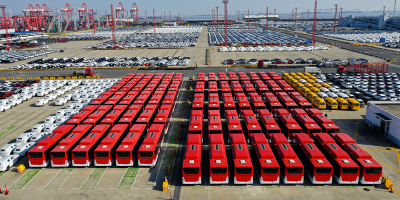
China's Hainan province will ban all new combustion-engine car sales by 2030, becoming the first jurisdiction in the world's largest EV market to impose a mandatory transition deadline.


Dimitris Papafotis
Dimitris Papafotis Editor in Chief
JULY 15, 2026 AT 8:38 PM

The provincial government has confirmed it will enforce the ban timeline originally set in 2022, according to Electrive (EU ηλεκτροκίνηση). Under the plan, Hainan will completely prohibit the sale of pure petrol-powered vehicles by 2030, requiring all new and replacement private-sector vehicles to be electric or alternative-fuel models.

The move challenges a frequent conservative talking point in Western debates over vehicle electrification: that China’s e-mobility surge is market-driven rather than government-mandated. Hainan’s decision demonstrates that Chinese regional authorities are willing to impose hard regulatory deadlines, not unlike their European counterparts.

Aggressive Targets Exceed National Goals

Hainan’s roadmap calls for so-called New Energy Vehicles—a category that includes battery-electric vehicles, plug-in hybrids, and fuel cell vehicles—to make up 45 per cent of the province’s total vehicle fleet by 2030, up from 23.75 per cent in 2025. That target surpasses China’s latest national electrification objectives, positioning the tropical province as a testbed for accelerated transition policies.

The provincial plan also prioritizes fuel cell vehicles for heavy-duty trucks, cold-chain logistics operations, and public transport, signaling a sector-specific approach to decarbonization.
Island Geography as Policy Advantage

Hainan’s island geography may offer logistical advantages for enforcing the ban. The province consists of several islands in southern China, making border control and compliance monitoring simpler than in mainland regions with porous provincial boundaries.

The 2030 deadline also aligns with broader Chinese industrial policy aimed at dominating global electric vehicle production and supply chains, a priority that has raised concerns among Western automakers and policymakers wary of Beijing’s growing influence in the sector.

As Western nations continue to debate the role of government mandates in accelerating vehicle electrification, Hainan’s hard ban offers a case study in top-down transition management—one that may provide data points for both proponents and critics of similar policies in Europe and North America.

With information from Electrive (EU ηλεκτροκίνηση)

Share:
Dimitris Papafotis
Dimitris Papafotis

Dimitris Papafotis is the editor-in-chief of NewsFire.GR. He was born and raised in Athens. He studied at the Journalism Workshop (1991-1993). He currently lives in Pyrgos, Ilia, where he has been active in radio and various newspapers, while also maintaining his personal blog, Papafotis.gr.

The provincial government has confirmed it will enforce the ban timeline originally set in 2022, according to Electrive (EU ηλεκτροκίνηση). Under the plan, Hainan will completely prohibit the sale of pure petrol-powered vehicles by 2030, requiring all new and replacement private-sector vehicles to be electric or alternative-fuel models.

The move challenges a frequent conservative talking point in Western debates over vehicle electrification: that China’s e-mobility surge is market-driven rather than government-mandated. Hainan’s decision demonstrates that Chinese regional authorities are willing to impose hard regulatory deadlines, not unlike their European counterparts.

Aggressive Targets Exceed National Goals

Hainan’s roadmap calls for so-called New Energy Vehicles—a category that includes battery-electric vehicles, plug-in hybrids, and fuel cell vehicles—to make up 45 per cent of the province’s total vehicle fleet by 2030, up from 23.75 per cent in 2025. That target surpasses China’s latest national electrification objectives, positioning the tropical province as a testbed for accelerated transition policies.

The provincial plan also prioritizes fuel cell vehicles for heavy-duty trucks, cold-chain logistics operations, and public transport, signaling a sector-specific approach to decarbonization.
Island Geography as Policy Advantage

Hainan’s island geography may offer logistical advantages for enforcing the ban. The province consists of several islands in southern China, making border control and compliance monitoring simpler than in mainland regions with porous provincial boundaries.

The 2030 deadline also aligns with broader Chinese industrial policy aimed at dominating global electric vehicle production and supply chains, a priority that has raised concerns among Western automakers and policymakers wary of Beijing’s growing influence in the sector.

As Western nations continue to debate the role of government mandates in accelerating vehicle electrification, Hainan’s hard ban offers a case study in top-down transition management—one that may provide data points for both proponents and critics of similar policies in Europe and North America.

With information from Electrive (EU ηλεκτροκίνηση)


