
Young American Spies Rescued Greece’s Priceless Treasures
American archaeologists working as spies thwarted Hitler's plan to loot ancient Greek treasures to prove a false Aryan connection to classical Greece during World War II.
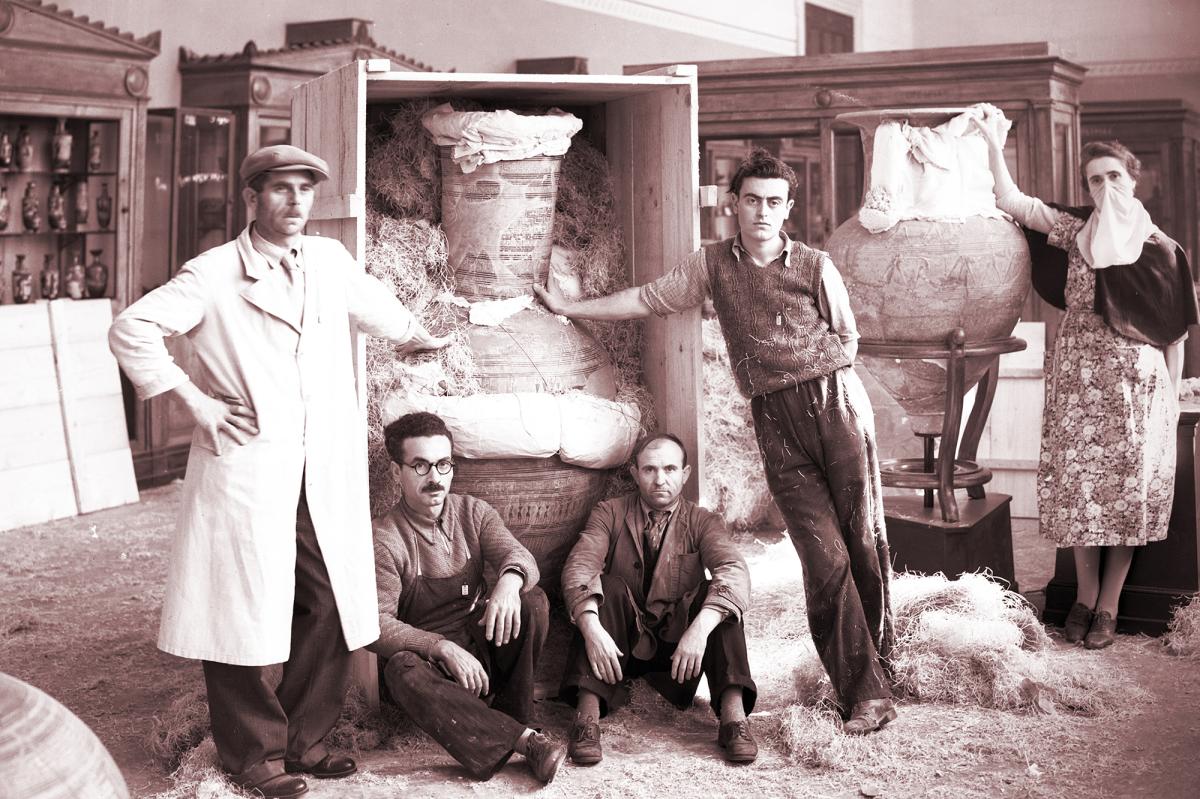

When Wehrmacht officers marched into Athens’ National Archaeological Museum in spring 1941, they expected to seize priceless antiquities including a statue of Zeus and the Mask of Agamemnon for transport back to Germany. Instead, they found empty display cases, as New York Post reports. The treasures had been hidden underground by Greek officials anticipating the Nazi occupation.
Author Stephan Talty documents this dramatic episode in his new book “The American School of Spies: The Archaeologists Who Fought the Nazis and Saved the Treasures of Ancient Greece,” published by Dutton. The account reveals how Hitler’s twisted ideology drove him to believe ancient Greece was founded by Aryans, prompting him to dispatch Nazi classicists across occupied Greece searching for Germanic artifacts that would validate this false historical narrative.
According to Talty, Hitler was particularly obsessed with the Discobolus, a statue of a crouched discus thrower that featured prominently in Leni Riefenstahl’s propaganda film about the 1936 Olympics. The Nazi regime claimed Aryans were the creators of the world’s first great civilization and fixated on ancient Greek artifacts as supposed proof.
Roosevelt Deploys Unconventional Warriors
President Franklin Delano Roosevelt responded by tasking General William “Wild Bill” Donovan, head of the Office of Strategic Services—the CIA’s predecessor—with creating a covert intelligence network to combat Nazi operations in Greece. Donovan personally traveled to Greece and was struck by the population’s resilience under occupation.
The general controversially concluded that conventional military forces alone could not defeat the Germans in the region. His solution was to establish guerrilla units staffed by Greek immigrants from American communities, recruiting heavily from Harvard and Yale graduates to serve as secret agents.
For spymaster, Donovan selected Rodney Young, a 33-year-old American archaeologist with zero military experience but extensive knowledge of Greek excavation sites. The wealthy East Coast blue blood from the Ballantine brewing family had grown up in a Greek Revival mansion in Newark and learned classical Greek at the exclusive St. Paul’s School before attending Princeton.
Scholars Become Secret Agents
Young’s mission was transforming epigraphers, scholars, classicists and archaeologists into functional intelligence operatives—what became known in Washington as the Greek Desk. Operating from the American School of Classical Studies in Athens, Young survived a shrapnel injury that penetrated his intestines and stomach wall during the occupation.
Among his recruits was Dorothy Hannah Cox, a 50-year-old excavation architect and ancient coin expert who used her position with Greek War Relief as cover for espionage activities. The practice of using archaeological work as intelligence cover proved controversial within academic circles, with some scholars accusing their colleagues of prostituting science.
By July 1942, Young’s recruits—predominantly Greek-Americans—began four weeks of intensive spy training covering everything from creating false identities to combat techniques. Their efforts ultimately protected Greece’s archaeological heritage from Nazi looting while gathering vital intelligence for the Allied war effort.
The complete removal and hiding of museum collections before Nazi arrival demonstrated remarkable foresight by Greek cultural authorities. Hitler’s quest for non-existent Aryan artifacts in Greece ended in failure, while approximately 70,000 Greek Jews perished in the Holocaust.
With information from New York Post





