Necessary Cookies

Required for the site to function. Cannot be disabled.

Analytics Cookies

Help us understand how visitors interact with our site (Google Analytics via GTM).

Marketing Cookies

Used to track visitors and deliver personalised advertisements.

We use cookies to enhance your browsing experience and analyse site traffic. By clicking Accept All, you consent to our use of cookies. Privacy Policy
NewsFire Global
Home News Europe World Christianity Culture Wars Opinion
Information
About Us Authors Advertising Terms & Conditions Privacy Policy Contact
R2B Media
R2B NEWSFIRE.GR PAPAFOTIS.GR THRACTION HELLENIC CONSERVATIVES RIGHT2THEBONE YT
News Culture Wars

When Will the Woke Crowd Leave the Elgin Marbles Alone?

A British-Sicilian archaeologist's conference at Athens' Acropolis Museum was abruptly canceled amid the ongoing Elgin Marbles dispute between Greece and Britain.
Stefanos Banos
Stefanos Banos Staff Writer
JUNE 8, 2026 AT 10:20 AM

Marco Trabucco della Torretta was set to hold a conference organized by the Royal Institution of Chartered Surveyors (RICS) at the Greek museum when the event was pulled without warning.

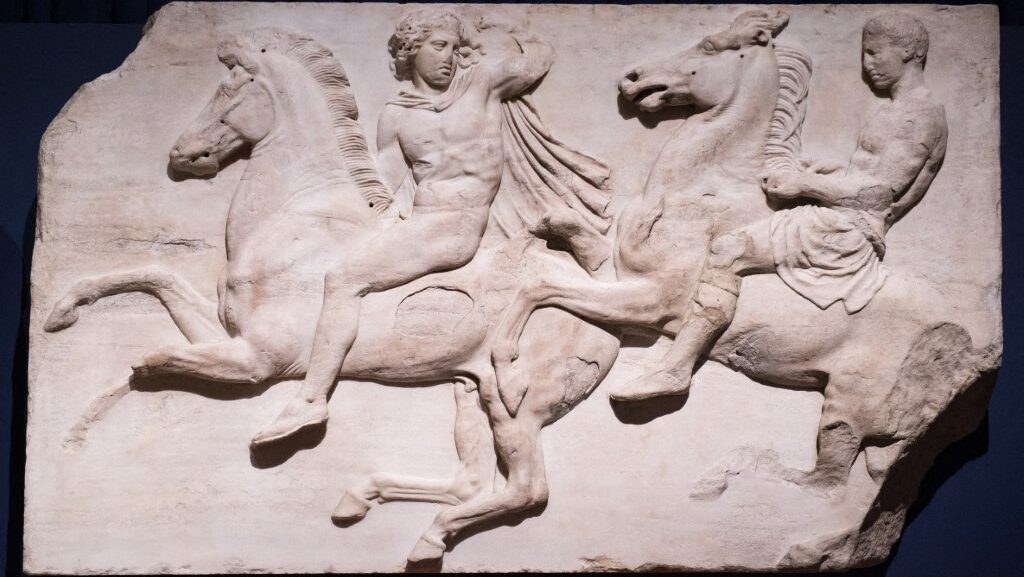
The Elgin Marbles controversy has evolved far beyond a simple disagreement about ancient artifacts. The collection, created by Phidias—Ancient Greece’s most renowned sculptor—once adorned the Acropolis in Athens, including the iconic Parthenon temple. In the early 19th century, agents working for Thomas Bruce, Earl of Elgin, removed the sculptures from Greece and transported them to England, where they have remained ever since in British custody.

Greek patriots have demanded the return of the marbles for generations, long before contemporary political movements adopted the cause. The loss of works by a master like Phidias represents a wound to national heritage that Greeks have never accepted. While recent activism has been amplified by progressive cultural politics, the underlying Greek claim carries genuine historical and emotional weight that resonates with citizens of any nation who value their cultural patrimony.

However, as The European Conservative reports, the passion surrounding this issue has occasionally descended into unreasonable behavior. The cancellation of Trabucco della Torretta’s archaeological conference represents exactly this kind of overreach—where legitimate cultural concerns transform into censorious action against scholarly discourse.

The decision by the Acropolis Museum and RICS to cancel the event highlights how cultural disputes can interfere with academic freedom and international scholarly cooperation, even when the subject matter relates to the very civilization both sides claim to honor.

With information from The European Conservative

Share:
Stefanos Banos
Stefanos Banos

Stefanos Banos was born in Piraeus and is an editor at NewsFire.GR, specializing in political analysis and international relations. He graduated from the Department of Communication and Media at the University of Bremen in Germany, where he also completed his Master of Arts in Communication and Media Studies. Married to Zoi, he is a proud father of three boys.

Marco Trabucco della Torretta was set to hold a conference organized by the Royal Institution of Chartered Surveyors (RICS) at the Greek museum when the event was pulled without warning.

The Elgin Marbles controversy has evolved far beyond a simple disagreement about ancient artifacts. The collection, created by Phidias—Ancient Greece’s most renowned sculptor—once adorned the Acropolis in Athens, including the iconic Parthenon temple. In the early 19th century, agents working for Thomas Bruce, Earl of Elgin, removed the sculptures from Greece and transported them to England, where they have remained ever since in British custody.

Greek patriots have demanded the return of the marbles for generations, long before contemporary political movements adopted the cause. The loss of works by a master like Phidias represents a wound to national heritage that Greeks have never accepted. While recent activism has been amplified by progressive cultural politics, the underlying Greek claim carries genuine historical and emotional weight that resonates with citizens of any nation who value their cultural patrimony.

However, as The European Conservative reports, the passion surrounding this issue has occasionally descended into unreasonable behavior. The cancellation of Trabucco della Torretta’s archaeological conference represents exactly this kind of overreach—where legitimate cultural concerns transform into censorious action against scholarly discourse.

The decision by the Acropolis Museum and RICS to cancel the event highlights how cultural disputes can interfere with academic freedom and international scholarly cooperation, even when the subject matter relates to the very civilization both sides claim to honor.

With information from The European Conservative