Necessary Cookies

Required for the site to function. Cannot be disabled.

Analytics Cookies

Help us understand how visitors interact with our site (Google Analytics via GTM).

Marketing Cookies

Used to track visitors and deliver personalised advertisements.

We use cookies to enhance your browsing experience and analyse site traffic. By clicking Accept All, you consent to our use of cookies. Privacy Policy
NewsFire Global
Home News Europe World Christianity Culture Wars Opinion Video
Information
About Us Authors Advertising Terms & Conditions Privacy Policy Contact
R2B Media
R2B NEWSFIRE.GR PAPAFOTIS.GR THRACTION HELLENIC CONSERVATIVES RIGHT2THEBONE YT
News World

Venezuela’s Interim President Meets Old Maduro Pal Erdogan

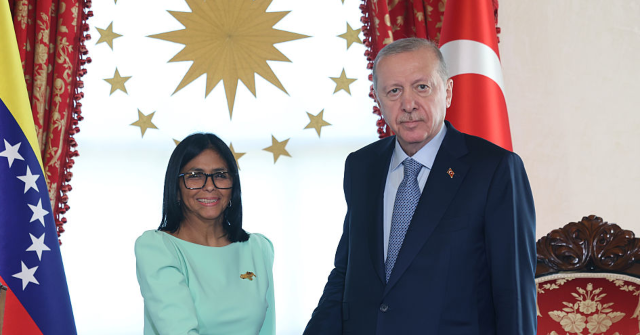
Venezuela's interim leader Delcy Rodríguez met Turkish President Erdogan in Constantinople seeking foreign investment as the socialist regime attempts to revive its oil-rich but economically devastated nation.

Newsroom
Newsroom Staff Writer
JUNE 10, 2026 AT 8:20 AM

Rodríguez, a former lieutenant to Nicolás Maduro, assumed control of Venezuela following Maduro’s arrest by American law enforcement in January. Her Constantinople visit followed a stop in India, where she met with Prime Minister Narendra Modi to negotiate expanded crude oil sales to one of the world’s largest energy markets.

Venezuela sits atop the world’s largest known oil reserves outside the United States, yet more than two decades of socialist mismanagement have left its refineries and infrastructure in ruins. Under Maduro, the regime imported Iranian engineers to rehabilitate key oil facilities, but those arrangements appear to have dissolved after his detention and Rodríguez’s subsequent pivot toward cooperation with Washington.

Erdogan has long positioned himself domestically as a free-market religious conservative, yet his foreign policy reveals close alignment with some of the world’s most repressive leftist regimes. Turkey under his rule warmly embraced Maduro through multiple sham elections and state visits, pursuing expanded bilateral trade. Following Maduro’s arrest, Erdogan issued only token objections and quickly shifted focus to cultivating ties with Rodríguez.

Turkish state outlet Anadolu Agency reported that Erdogan hosted Rodríguez in Constantinople to discuss expanded bilateral cooperation, particularly on economic matters. Turkey’s Communications Directorate issued a readout stating that Erdogan will always stand by the friendly people of Venezuela and remains committed to deepening cooperation in trade, energy, and mining.

The two leaders agreed on a concrete target of raising bilateral trade volume to three billion dollars. Current trade between the two nations stands at just 448 million dollars as of late 2025, according to Venezuelan independent newspaper El Nacional. Of that total, Turkish imports of Venezuelan goods, primarily oil, accounted for 251 million dollars, while Turkish exports to Venezuela represented 197 million dollars.

El Nacional noted that Turkey’s commercial exchange with Venezuela remains temporarily below its trade with Peru and Chile, and well beneath its volumes with regional powers Brazil and Colombia.

Venezuelan state broadcaster VTV characterized the Constantinople meeting as fruitful and aimed at mutual development and consolidating bilateral relations at the highest level. Rodríguez reportedly discussed commerce, investment, energy, mining, housing, and education with the Turkish president.

Back in Caracas, Diosdado Cabello, head of Maduro’s United Socialist Party, told reporters Monday that Rodríguez’s foreign travel aims to diversify Venezuela’s economy beyond its historic dependence on oil sales. Venezuela is diversifying, Cabello stated, and the visits by Rodríguez and cabinet ministers seek to consolidate relationships with partner countries.

Rodríguez’s agenda in New Delhi mirrored her Constantinople objectives. She identified transportation, health, energy complementarity, agriculture, science, and technology as priority sectors for cooperation with India. Though not explicitly confirmed in public statements, India stands to benefit substantially from expanded Venezuelan oil purchases as it navigates supply disruptions in the Strait of Hormuz caused by ongoing American-Iranian hostilities. Reports indicate India dramatically increased its Venezuelan oil purchases to 427,000 barrels per day in May.

In Erdogan, Rodríguez found a more ideologically familiar partner than Modi. The Turkish leader was among the most vocal international supporters of the Maduro regime during the 2010s crisis, when socialist policies triggered mass malnourishment and nationwide protests. In 2016, Erdogan publicly condemned international pressure on Maduro’s government.

With information from Breitbart News

Share:
Newsroom
Newsroom

NewsFire.GR is a website created with the hope that the media will rediscover their true identity, which is none other than informing the public about the real stakes of our times. Journalism and political analysis must hold power accountable, not serve it.

Rodríguez, a former lieutenant to Nicolás Maduro, assumed control of Venezuela following Maduro’s arrest by American law enforcement in January. Her Constantinople visit followed a stop in India, where she met with Prime Minister Narendra Modi to negotiate expanded crude oil sales to one of the world’s largest energy markets.

Venezuela sits atop the world’s largest known oil reserves outside the United States, yet more than two decades of socialist mismanagement have left its refineries and infrastructure in ruins. Under Maduro, the regime imported Iranian engineers to rehabilitate key oil facilities, but those arrangements appear to have dissolved after his detention and Rodríguez’s subsequent pivot toward cooperation with Washington.

Erdogan has long positioned himself domestically as a free-market religious conservative, yet his foreign policy reveals close alignment with some of the world’s most repressive leftist regimes. Turkey under his rule warmly embraced Maduro through multiple sham elections and state visits, pursuing expanded bilateral trade. Following Maduro’s arrest, Erdogan issued only token objections and quickly shifted focus to cultivating ties with Rodríguez.

Turkish state outlet Anadolu Agency reported that Erdogan hosted Rodríguez in Constantinople to discuss expanded bilateral cooperation, particularly on economic matters. Turkey’s Communications Directorate issued a readout stating that Erdogan will always stand by the friendly people of Venezuela and remains committed to deepening cooperation in trade, energy, and mining.

The two leaders agreed on a concrete target of raising bilateral trade volume to three billion dollars. Current trade between the two nations stands at just 448 million dollars as of late 2025, according to Venezuelan independent newspaper El Nacional. Of that total, Turkish imports of Venezuelan goods, primarily oil, accounted for 251 million dollars, while Turkish exports to Venezuela represented 197 million dollars.

El Nacional noted that Turkey’s commercial exchange with Venezuela remains temporarily below its trade with Peru and Chile, and well beneath its volumes with regional powers Brazil and Colombia.

Venezuelan state broadcaster VTV characterized the Constantinople meeting as fruitful and aimed at mutual development and consolidating bilateral relations at the highest level. Rodríguez reportedly discussed commerce, investment, energy, mining, housing, and education with the Turkish president.

Back in Caracas, Diosdado Cabello, head of Maduro’s United Socialist Party, told reporters Monday that Rodríguez’s foreign travel aims to diversify Venezuela’s economy beyond its historic dependence on oil sales. Venezuela is diversifying, Cabello stated, and the visits by Rodríguez and cabinet ministers seek to consolidate relationships with partner countries.

Rodríguez’s agenda in New Delhi mirrored her Constantinople objectives. She identified transportation, health, energy complementarity, agriculture, science, and technology as priority sectors for cooperation with India. Though not explicitly confirmed in public statements, India stands to benefit substantially from expanded Venezuelan oil purchases as it navigates supply disruptions in the Strait of Hormuz caused by ongoing American-Iranian hostilities. Reports indicate India dramatically increased its Venezuelan oil purchases to 427,000 barrels per day in May.

In Erdogan, Rodríguez found a more ideologically familiar partner than Modi. The Turkish leader was among the most vocal international supporters of the Maduro regime during the 2010s crisis, when socialist policies triggered mass malnourishment and nationwide protests. In 2016, Erdogan publicly condemned international pressure on Maduro’s government.

With information from Breitbart News

